

Iron Oxide–Gold Composite Nanoparticles and Nano-Gap Junctions …
259
Nanomaterials Synthesis
Seed-Mediated Approach of Iron Oxide–Gold Spheres Multifunctional
Nanoparticle
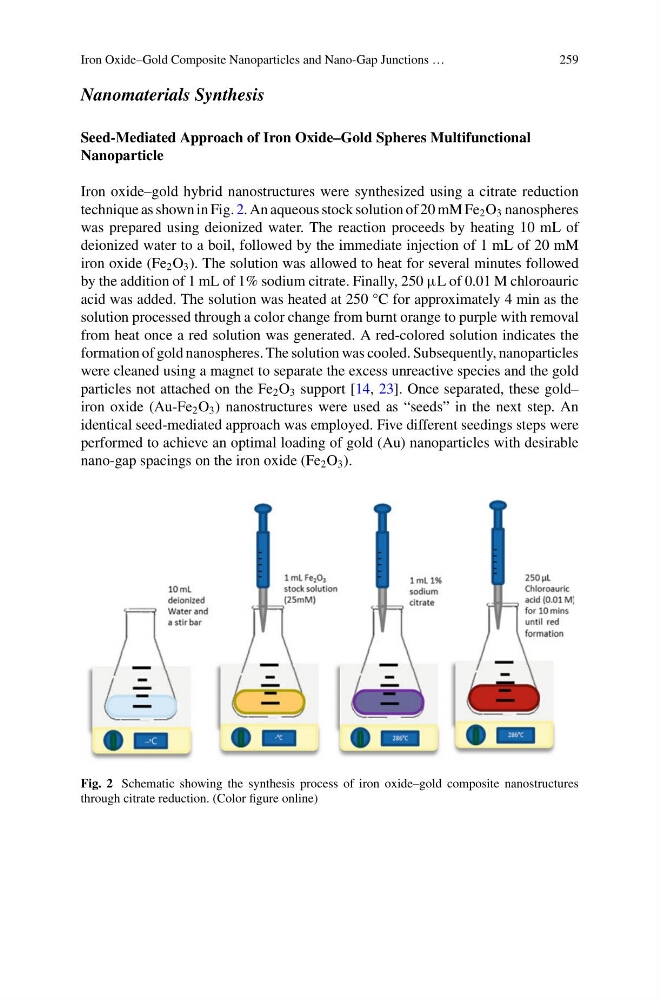
Iron oxide–gold hybrid nanostructures were synthesized using a citrate reduction
technique as shown in Fig. 2. An aqueous stock solution of 20 mM Fe 2 O 3 nanospheres
was prepared using deionized water. The reaction proceeds by heating 10 mL of
deionized water to a boil, followed by the immediate injection of 1 mL of 20 mM
iron oxide (Fe 2 O 3 ). The solution was allowed to heat for several minutes followed
by the addition of 1 mL of 1% sodium citrate. Finally, 250 μL of 0.01 M chloroauric
acid was added. The solution was heated at 250 °C for approximately 4 min as the
solution processed through a color change from burnt orange to purple with removal
from heat once a red solution was generated. A red-colored solution indicates the
formation of gold nanospheres. The solution was cooled. Subsequently, nanoparticles
were cleaned using a magnet to separate the excess unreactive species and the gold
particles not attached on the Fe 2 O 3 support [14, 23]. Once separated, these gold–
iron oxide (Au-Fe 2 O 3 ) nanostructures were used as “seeds” in the next step. An
identical seed-mediated approach was employed. Five different seedings steps were
performed to achieve an optimal loading of gold (Au) nanoparticles with desirable
nano-gap spacings on the iron oxide (Fe 2 O 3 ).
Fig. 2 Schematic showing the synthesis process of iron oxide–gold composite nanostructures
through citrate reduction. (Color figure online)
259
Nanomaterials Synthesis
Seed-Mediated Approach of Iron Oxide–Gold Spheres Multifunctional
Nanoparticle
Iron oxide–gold hybrid nanostructures were synthesized using a citrate reduction
technique as shown in Fig. 2. An aqueous stock solution of 20 mM Fe 2 O 3 nanospheres
was prepared using deionized water. The reaction proceeds by heating 10 mL of
deionized water to a boil, followed by the immediate injection of 1 mL of 20 mM
iron oxide (Fe 2 O 3 ). The solution was allowed to heat for several minutes followed
by the addition of 1 mL of 1% sodium citrate. Finally, 250 μL of 0.01 M chloroauric
acid was added. The solution was heated at 250 °C for approximately 4 min as the
solution processed through a color change from burnt orange to purple with removal
from heat once a red solution was generated. A red-colored solution indicates the
formation of gold nanospheres. The solution was cooled. Subsequently, nanoparticles
were cleaned using a magnet to separate the excess unreactive species and the gold
particles not attached on the Fe 2 O 3 support [14, 23]. Once separated, these gold–
iron oxide (Au-Fe 2 O 3 ) nanostructures were used as “seeds” in the next step. An
identical seed-mediated approach was employed. Five different seedings steps were
performed to achieve an optimal loading of gold (Au) nanoparticles with desirable
nano-gap spacings on the iron oxide (Fe 2 O 3 ).
Fig. 2 Schematic showing the synthesis process of iron oxide–gold composite nanostructures
through citrate reduction. (Color figure online)