

Iron Oxide–Gold Composite Nanoparticles and Nano-Gap Junctions …
257
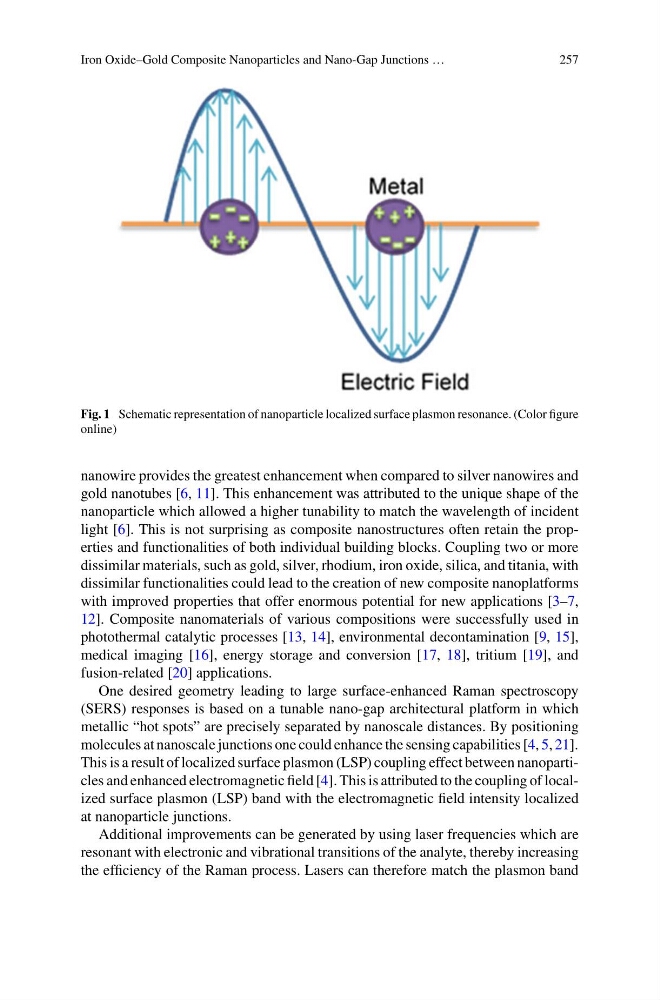
Fig. 1 Schematic representation of nanoparticle localized surface plasmon resonance. (Color figure
online)
nanowire provides the greatest enhancement when compared to silver nanowires and
gold nanotubes [6, 11]. This enhancement was attributed to the unique shape of the
nanoparticle which allowed a higher tunability to match the wavelength of incident
light [6]. This is not surprising as composite nanostructures often retain the properties and functionalities of both individual building blocks. Coupling two or more
dissimilar materials, such as gold, silver, rhodium, iron oxide, silica, and titania, with
dissimilar functionalities could lead to the creation of new composite nanoplatforms
with improved properties that offer enormous potential for new applications [3–7,
12]. Composite nanomaterials of various compositions were successfully used in
photothermal catalytic processes [13, 14], environmental decontamination [9, 15],
medical imaging [16], energy storage and conversion [17, 18], tritium [19], and
fusion-related [20] applications.
One desired geometry leading to large surface-enhanced Raman spectroscopy
(SERS) responses is based on a tunable nano-gap architectural platform in which
metallic “hot spots” are precisely separated by nanoscale distances. By positioning
molecules at nanoscale junctions one could enhance the sensing capabilities [4, 5, 21].
This is a result of localized surface plasmon (LSP) coupling effect between nanoparticles and enhanced electromagnetic field [4]. This is attributed to the coupling of localized surface plasmon (LSP) band with the electromagnetic field intensity localized
at nanoparticle junctions.
Additional improvements can be generated by using laser frequencies which are
resonant with electronic and vibrational transitions of the analyte, thereby increasing
the efficiency of the Raman process. Lasers can therefore match the plasmon band
257
Fig. 1 Schematic representation of nanoparticle localized surface plasmon resonance. (Color figure
online)
nanowire provides the greatest enhancement when compared to silver nanowires and
gold nanotubes [6, 11]. This enhancement was attributed to the unique shape of the
nanoparticle which allowed a higher tunability to match the wavelength of incident
light [6]. This is not surprising as composite nanostructures often retain the properties and functionalities of both individual building blocks. Coupling two or more
dissimilar materials, such as gold, silver, rhodium, iron oxide, silica, and titania, with
dissimilar functionalities could lead to the creation of new composite nanoplatforms
with improved properties that offer enormous potential for new applications [3–7,
12]. Composite nanomaterials of various compositions were successfully used in
photothermal catalytic processes [13, 14], environmental decontamination [9, 15],
medical imaging [16], energy storage and conversion [17, 18], tritium [19], and
fusion-related [20] applications.
One desired geometry leading to large surface-enhanced Raman spectroscopy
(SERS) responses is based on a tunable nano-gap architectural platform in which
metallic “hot spots” are precisely separated by nanoscale distances. By positioning
molecules at nanoscale junctions one could enhance the sensing capabilities [4, 5, 21].
This is a result of localized surface plasmon (LSP) coupling effect between nanoparticles and enhanced electromagnetic field [4]. This is attributed to the coupling of localized surface plasmon (LSP) band with the electromagnetic field intensity localized
at nanoparticle junctions.
Additional improvements can be generated by using laser frequencies which are
resonant with electronic and vibrational transitions of the analyte, thereby increasing
the efficiency of the Raman process. Lasers can therefore match the plasmon band