

A Method for Measuring Total Protium and Total Deuterium …
253
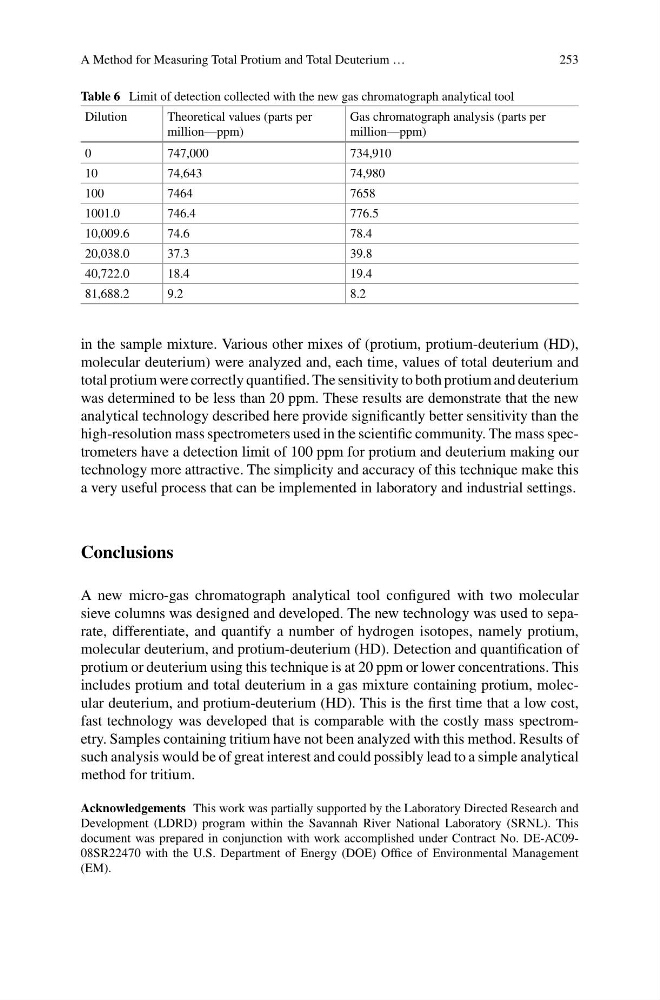
Table 6 Limit of detection collected with the new gas chromatograph analytical tool
Dilution
Theoretical values (parts per
million—ppm)
Gas chromatograph analysis (parts per
million—ppm)
0
747,000
734,910
10
74,643
74,980
100
7464
7658
1001.0
746.4
776.5
10,009.6
74.6
78.4
20,038.0
37.3
39.8
40,722.0
18.4
19.4
81,688.2
9.2
8.2
in the sample mixture. Various other mixes of (protium, protium-deuterium (HD),
molecular deuterium) were analyzed and, each time, values of total deuterium and
total protium were correctly quantified. The sensitivity to both protium and deuterium
was determined to be less than 20 ppm. These results are demonstrate that the new
analytical technology described here provide significantly better sensitivity than the
high-resolution mass spectrometers used in the scientific community. The mass spectrometers have a detection limit of 100 ppm for protium and deuterium making our
technology more attractive. The simplicity and accuracy of this technique make this
a very useful process that can be implemented in laboratory and industrial settings.
Conclusions
A new micro-gas chromatograph analytical tool configured with two molecular
sieve columns was designed and developed. The new technology was used to separate, differentiate, and quantify a number of hydrogen isotopes, namely protium,
molecular deuterium, and protium-deuterium (HD). Detection and quantification of
protium or deuterium using this technique is at 20 ppm or lower concentrations. This
includes protium and total deuterium in a gas mixture containing protium, molecular deuterium, and protium-deuterium (HD). This is the first time that a low cost,
fast technology was developed that is comparable with the costly mass spectrometry. Samples containing tritium have not been analyzed with this method. Results of
such analysis would be of great interest and could possibly lead to a simple analytical
method for tritium.
Acknowledgements This work was partially supported by the Laboratory Directed Research and
Development (LDRD) program within the Savannah River National Laboratory (SRNL). This
document was prepared in conjunction with work accomplished under Contract No. DE-AC0908SR22470 with the U.S. Department of Energy (DOE) Office of Environmental Management
(EM).
253
Table 6 Limit of detection collected with the new gas chromatograph analytical tool
Dilution
Theoretical values (parts per
million—ppm)
Gas chromatograph analysis (parts per
million—ppm)
0
747,000
734,910
10
74,643
74,980
100
7464
7658
1001.0
746.4
776.5
10,009.6
74.6
78.4
20,038.0
37.3
39.8
40,722.0
18.4
19.4
81,688.2
9.2
8.2
in the sample mixture. Various other mixes of (protium, protium-deuterium (HD),
molecular deuterium) were analyzed and, each time, values of total deuterium and
total protium were correctly quantified. The sensitivity to both protium and deuterium
was determined to be less than 20 ppm. These results are demonstrate that the new
analytical technology described here provide significantly better sensitivity than the
high-resolution mass spectrometers used in the scientific community. The mass spectrometers have a detection limit of 100 ppm for protium and deuterium making our
technology more attractive. The simplicity and accuracy of this technique make this
a very useful process that can be implemented in laboratory and industrial settings.
Conclusions
A new micro-gas chromatograph analytical tool configured with two molecular
sieve columns was designed and developed. The new technology was used to separate, differentiate, and quantify a number of hydrogen isotopes, namely protium,
molecular deuterium, and protium-deuterium (HD). Detection and quantification of
protium or deuterium using this technique is at 20 ppm or lower concentrations. This
includes protium and total deuterium in a gas mixture containing protium, molecular deuterium, and protium-deuterium (HD). This is the first time that a low cost,
fast technology was developed that is comparable with the costly mass spectrometry. Samples containing tritium have not been analyzed with this method. Results of
such analysis would be of great interest and could possibly lead to a simple analytical
method for tritium.
Acknowledgements This work was partially supported by the Laboratory Directed Research and
Development (LDRD) program within the Savannah River National Laboratory (SRNL). This
document was prepared in conjunction with work accomplished under Contract No. DE-AC0908SR22470 with the U.S. Department of Energy (DOE) Office of Environmental Management
(EM).