

A Method for Measuring Total Protium and Total Deuterium …
251
Table 4 Comparison of gas
chromatograph and mass
spectrometry analysis
Mass spectrometry
analysis (%)
1/2HD + (D 2 or
H 2 )(%)
Gas chromatograph
analysis (%)
D 2 = 24.89
H 2 = 26.36
1/2 HD + D 2 =
49.25
D 2 = 48.51
HD = 48.73
1/2 HD + H 2 =
50.72
H 2 = 51.36
D 2 = 56.22
H 2 = 6.82
1/2 HD + D 2 =
74.70
D 2 = 73.70
HD = 36.98
1/2 HD + H 2 =
25.30
H 2 = 26.12
D 2 = 6.64
H 2 = 56.67
1/2 HD + D 2 =
24.99
D 2 = 23.94
HD = 36.69
1/2 HD + H 2 =
75.01
H 2 = 75.87
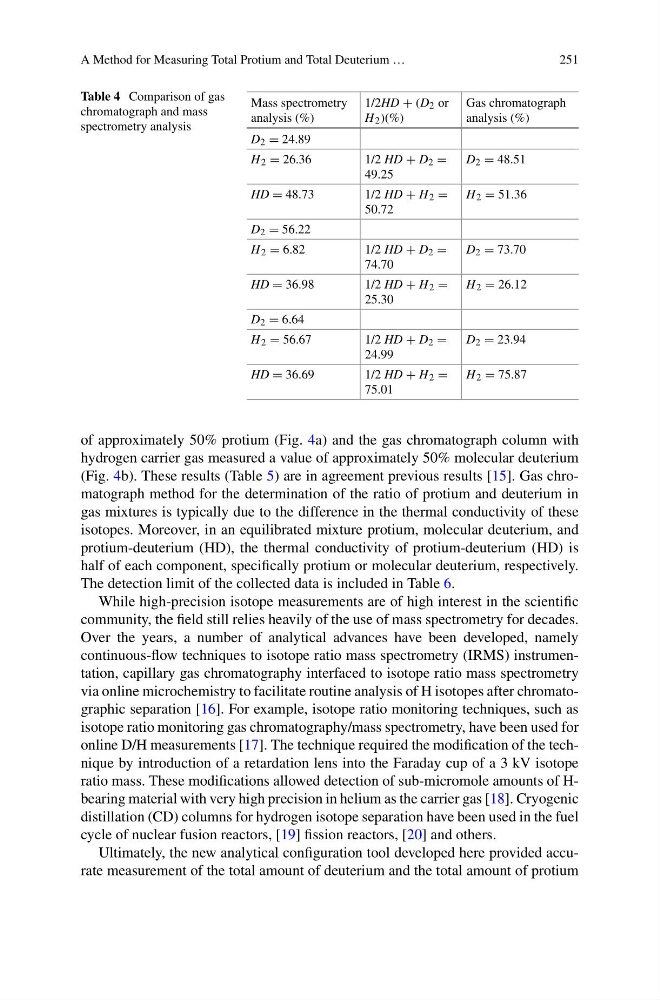
of approximately 50% protium (Fig. 4a) and the gas chromatograph column with
hydrogen carrier gas measured a value of approximately 50% molecular deuterium
(Fig. 4b). These results (Table 5) are in agreement previous results [15]. Gas chromatograph method for the determination of the ratio of protium and deuterium in
gas mixtures is typically due to the difference in the thermal conductivity of these
isotopes. Moreover, in an equilibrated mixture protium, molecular deuterium, and
protium-deuterium (HD), the thermal conductivity of protium-deuterium (HD) is
half of each component, specifically protium or molecular deuterium, respectively.
The detection limit of the collected data is included in Table 6.
While high-precision isotope measurements are of high interest in the scientific
community, the field still relies heavily of the use of mass spectrometry for decades.
Over the years, a number of analytical advances have been developed, namely
continuous-flow techniques to isotope ratio mass spectrometry (IRMS) instrumentation, capillary gas chromatography interfaced to isotope ratio mass spectrometry
via online microchemistry to facilitate routine analysis of H isotopes after chromatographic separation [16]. For example, isotope ratio monitoring techniques, such as
isotope ratio monitoring gas chromatography/mass spectrometry, have been used for
online D/H measurements [17]. The technique required the modification of the technique by introduction of a retardation lens into the Faraday cup of a 3 kV isotope
ratio mass. These modifications allowed detection of sub-micromole amounts of Hbearing material with very high precision in helium as the carrier gas [18]. Cryogenic
distillation (CD) columns for hydrogen isotope separation have been used in the fuel
cycle of nuclear fusion reactors, [19] fission reactors, [20] and others.
Ultimately, the new analytical configuration tool developed here provided accurate measurement of the total amount of deuterium and the total amount of protium
251
Table 4 Comparison of gas
chromatograph and mass
spectrometry analysis
Mass spectrometry
analysis (%)
1/2HD + (D 2 or
H 2 )(%)
Gas chromatograph
analysis (%)
D 2 = 24.89
H 2 = 26.36
1/2 HD + D 2 =
49.25
D 2 = 48.51
HD = 48.73
1/2 HD + H 2 =
50.72
H 2 = 51.36
D 2 = 56.22
H 2 = 6.82
1/2 HD + D 2 =
74.70
D 2 = 73.70
HD = 36.98
1/2 HD + H 2 =
25.30
H 2 = 26.12
D 2 = 6.64
H 2 = 56.67
1/2 HD + D 2 =
24.99
D 2 = 23.94
HD = 36.69
1/2 HD + H 2 =
75.01
H 2 = 75.87
of approximately 50% protium (Fig. 4a) and the gas chromatograph column with
hydrogen carrier gas measured a value of approximately 50% molecular deuterium
(Fig. 4b). These results (Table 5) are in agreement previous results [15]. Gas chromatograph method for the determination of the ratio of protium and deuterium in
gas mixtures is typically due to the difference in the thermal conductivity of these
isotopes. Moreover, in an equilibrated mixture protium, molecular deuterium, and
protium-deuterium (HD), the thermal conductivity of protium-deuterium (HD) is
half of each component, specifically protium or molecular deuterium, respectively.
The detection limit of the collected data is included in Table 6.
While high-precision isotope measurements are of high interest in the scientific
community, the field still relies heavily of the use of mass spectrometry for decades.
Over the years, a number of analytical advances have been developed, namely
continuous-flow techniques to isotope ratio mass spectrometry (IRMS) instrumentation, capillary gas chromatography interfaced to isotope ratio mass spectrometry
via online microchemistry to facilitate routine analysis of H isotopes after chromatographic separation [16]. For example, isotope ratio monitoring techniques, such as
isotope ratio monitoring gas chromatography/mass spectrometry, have been used for
online D/H measurements [17]. The technique required the modification of the technique by introduction of a retardation lens into the Faraday cup of a 3 kV isotope
ratio mass. These modifications allowed detection of sub-micromole amounts of Hbearing material with very high precision in helium as the carrier gas [18]. Cryogenic
distillation (CD) columns for hydrogen isotope separation have been used in the fuel
cycle of nuclear fusion reactors, [19] fission reactors, [20] and others.
Ultimately, the new analytical configuration tool developed here provided accurate measurement of the total amount of deuterium and the total amount of protium