

Effect of Heat Treatment on Mechanical Properties …
221
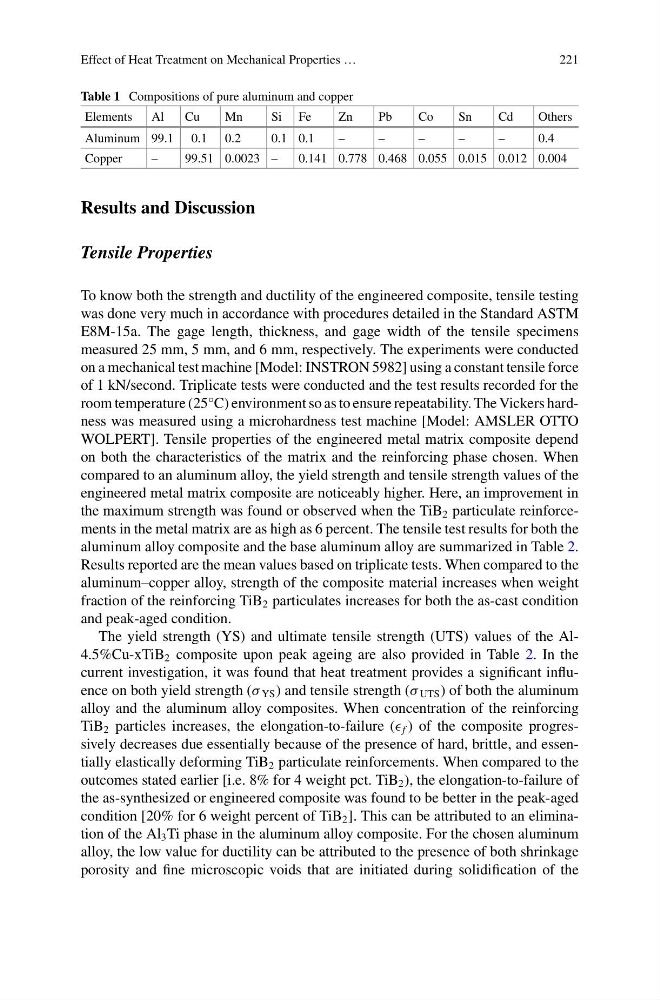
Table 1 Compositions of pure aluminum and copper
Elements
Al
Cu
Mn
Si Fe
Zn
Pb
Co
Sn
Cd
Others
Aluminum 99.1 0.1 0.2
0.1 0.1
–
–
–
–
–
0.4
Copper
–
99.51 0.0023 –
0.141 0.778 0.468 0.055 0.015 0.012 0.004
Results and Discussion
Tensile Properties
To know both the strength and ductility of the engineered composite, tensile testing
was done very much in accordance with procedures detailed in the Standard ASTM
E8M-15a. The gage length, thickness, and gage width of the tensile specimens
measured 25 mm, 5 mm, and 6 mm, respectively. The experiments were conducted
on a mechanical test machine [Model: INSTRON 5982] using a constant tensile force
of 1 kN/second. Triplicate tests were conducted and the test results recorded for the
room temperature (25°C) environment so as to ensure repeatability. The Vickers hardness was measured using a microhardness test machine [Model: AMSLER OTTO
WOLPERT]. Tensile properties of the engineered metal matrix composite depend
on both the characteristics of the matrix and the reinforcing phase chosen. When
compared to an aluminum alloy, the yield strength and tensile strength values of the
engineered metal matrix composite are noticeably higher. Here, an improvement in
the maximum strength was found or observed when the TiB 2 particulate reinforcements in the metal matrix are as high as 6 percent. The tensile test results for both the
aluminum alloy composite and the base aluminum alloy are summarized in Table 2.
Results reported are the mean values based on triplicate tests. When compared to the
aluminum–copper alloy, strength of the composite material increases when weight
fraction of the reinforcing TiB 2 particulates increases for both the as-cast condition
and peak-aged condition.
The yield strength (YS) and ultimate tensile strength (UTS) values of the Al4.5%Cu-xTiB 2 composite upon peak ageing are also provided in Table 2. In the
current investigation, it was found that heat treatment provides a significant influence on both yield strength (σ YS ) and tensile strength (σ UTS ) of both the aluminum
alloy and the aluminum alloy composites. When concentration of the reinforcing
TiB 2 particles increases, the elongation-to-failure ( f ) of the composite progressively decreases due essentially because of the presence of hard, brittle, and essentially elastically deforming TiB 2 particulate reinforcements. When compared to the
outcomes stated earlier [i.e. 8% for 4 weight pct. TiB 2 ), the elongation-to-failure of
the as-synthesized or engineered composite was found to be better in the peak-aged
condition [20% for 6 weight percent of TiB 2 ]. This can be attributed to an elimination of the Al 3 Ti phase in the aluminum alloy composite. For the chosen aluminum
alloy, the low value for ductility can be attributed to the presence of both shrinkage
porosity and fine microscopic voids that are initiated during solidification of the
221
Table 1 Compositions of pure aluminum and copper
Elements
Al
Cu
Mn
Si Fe
Zn
Pb
Co
Sn
Cd
Others
Aluminum 99.1 0.1 0.2
0.1 0.1
–
–
–
–
–
0.4
Copper
–
99.51 0.0023 –
0.141 0.778 0.468 0.055 0.015 0.012 0.004
Results and Discussion
Tensile Properties
To know both the strength and ductility of the engineered composite, tensile testing
was done very much in accordance with procedures detailed in the Standard ASTM
E8M-15a. The gage length, thickness, and gage width of the tensile specimens
measured 25 mm, 5 mm, and 6 mm, respectively. The experiments were conducted
on a mechanical test machine [Model: INSTRON 5982] using a constant tensile force
of 1 kN/second. Triplicate tests were conducted and the test results recorded for the
room temperature (25°C) environment so as to ensure repeatability. The Vickers hardness was measured using a microhardness test machine [Model: AMSLER OTTO
WOLPERT]. Tensile properties of the engineered metal matrix composite depend
on both the characteristics of the matrix and the reinforcing phase chosen. When
compared to an aluminum alloy, the yield strength and tensile strength values of the
engineered metal matrix composite are noticeably higher. Here, an improvement in
the maximum strength was found or observed when the TiB 2 particulate reinforcements in the metal matrix are as high as 6 percent. The tensile test results for both the
aluminum alloy composite and the base aluminum alloy are summarized in Table 2.
Results reported are the mean values based on triplicate tests. When compared to the
aluminum–copper alloy, strength of the composite material increases when weight
fraction of the reinforcing TiB 2 particulates increases for both the as-cast condition
and peak-aged condition.
The yield strength (YS) and ultimate tensile strength (UTS) values of the Al4.5%Cu-xTiB 2 composite upon peak ageing are also provided in Table 2. In the
current investigation, it was found that heat treatment provides a significant influence on both yield strength (σ YS ) and tensile strength (σ UTS ) of both the aluminum
alloy and the aluminum alloy composites. When concentration of the reinforcing
TiB 2 particles increases, the elongation-to-failure ( f ) of the composite progressively decreases due essentially because of the presence of hard, brittle, and essentially elastically deforming TiB 2 particulate reinforcements. When compared to the
outcomes stated earlier [i.e. 8% for 4 weight pct. TiB 2 ), the elongation-to-failure of
the as-synthesized or engineered composite was found to be better in the peak-aged
condition [20% for 6 weight percent of TiB 2 ]. This can be attributed to an elimination of the Al 3 Ti phase in the aluminum alloy composite. For the chosen aluminum
alloy, the low value for ductility can be attributed to the presence of both shrinkage
porosity and fine microscopic voids that are initiated during solidification of the