

Effect of Heat Treatment on Mechanical Properties …
219
the alloy is heated to an elevated temperature and maintained at that temperature for a
certain period of time depending on both the nature of alloy chosen and composition
of the alloy. Once the proper amount of precipitates has formed, the alloy is either
annealed or quenched. Artificial ageing is often preferred to natural ageing primarily
because of its effectiveness in ensuring an overall improvement in both the physical
properties and mechanical properties coupled with dimensional accuracy [14, 15].
Few of the aluminum alloys exhibit room temperature precipitation, which is useful
for specific applications in the industries spanning aerospace, automotive, and ground
transportation. Different types of heat treatment (HT) processes are often available
for the aluminum alloys, such as T1–T10. One of the important HT processes is
T6, which requires an artificial ageing treatment. The T4 designation is used for the
natural ageing treatment.
The focus of this research study was to understand the kinetics of precipitation
of the reinforcing titanium diboride (TiB 2 ) particles and subsequent morphological evolution that occurs during solidification. Also, the investigation was aimed
at analyzing the influence of T6 heat treatment on both the aluminum alloy and
aluminum alloy composites and comparing their mechanical response or behavior
with the as-cast counterpart.
Experimental Procedures
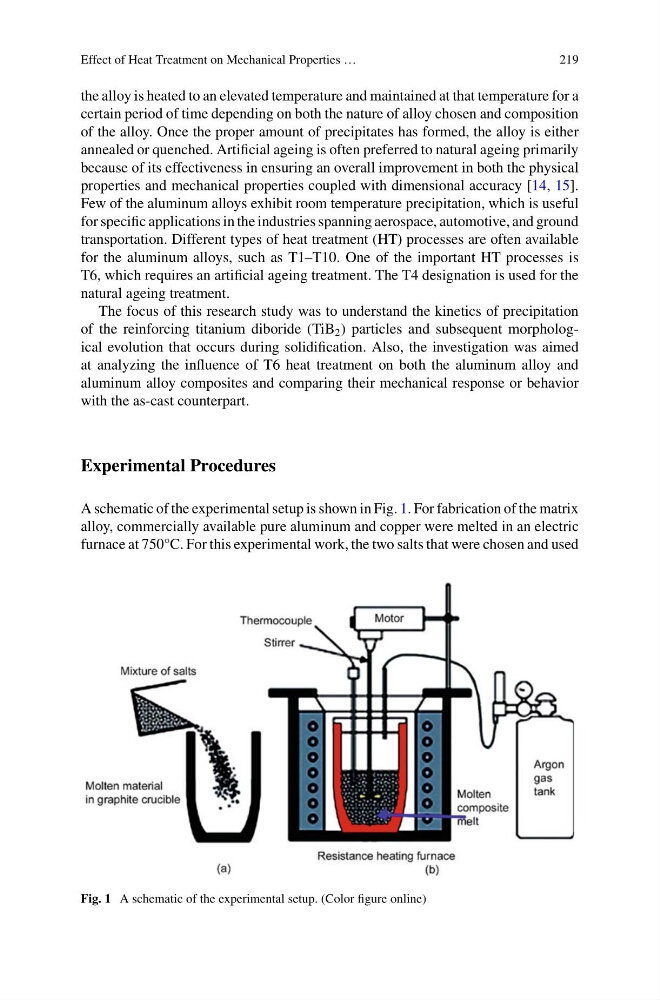
A schematic of the experimental setup is shown in Fig. 1. For fabrication of the matrix
alloy, commercially available pure aluminum and copper were melted in an electric
furnace at 750°C. For this experimental work, the two salts that were chosen and used
Fig. 1 A schematic of the experimental setup. (Color figure online)
219
the alloy is heated to an elevated temperature and maintained at that temperature for a
certain period of time depending on both the nature of alloy chosen and composition
of the alloy. Once the proper amount of precipitates has formed, the alloy is either
annealed or quenched. Artificial ageing is often preferred to natural ageing primarily
because of its effectiveness in ensuring an overall improvement in both the physical
properties and mechanical properties coupled with dimensional accuracy [14, 15].
Few of the aluminum alloys exhibit room temperature precipitation, which is useful
for specific applications in the industries spanning aerospace, automotive, and ground
transportation. Different types of heat treatment (HT) processes are often available
for the aluminum alloys, such as T1–T10. One of the important HT processes is
T6, which requires an artificial ageing treatment. The T4 designation is used for the
natural ageing treatment.
The focus of this research study was to understand the kinetics of precipitation
of the reinforcing titanium diboride (TiB 2 ) particles and subsequent morphological evolution that occurs during solidification. Also, the investigation was aimed
at analyzing the influence of T6 heat treatment on both the aluminum alloy and
aluminum alloy composites and comparing their mechanical response or behavior
with the as-cast counterpart.
Experimental Procedures
A schematic of the experimental setup is shown in Fig. 1. For fabrication of the matrix
alloy, commercially available pure aluminum and copper were melted in an electric
furnace at 750°C. For this experimental work, the two salts that were chosen and used
Fig. 1 A schematic of the experimental setup. (Color figure online)