

The Mechanical Performance of In Situ Processed …
9
peak at ~26° in the XRD pattern confirms the presence of the graphite (C) phase in
these Ni-Ti-C composites. This confirms the feasibility to engineer an extra lubricious graphite phase by altering the C/Ti ratio in Ni-Ti-C composites, as carbon does
not have solubility with nickel, and there is not much titanium available to react
and form in situ titanium carbide precipitates. The intensity of hcp (0002) carbon
peak increases with increasing carbon to titanium ratio. The Ni-5Ti-20C composites
exhibited the highest (0002) carbon peak intensity as compared to the other Ni-TiC composites, which indicates the presence higher volume fraction of the graphite
phase in Ni-5Ti-20C composites.
Microstructural Analysis
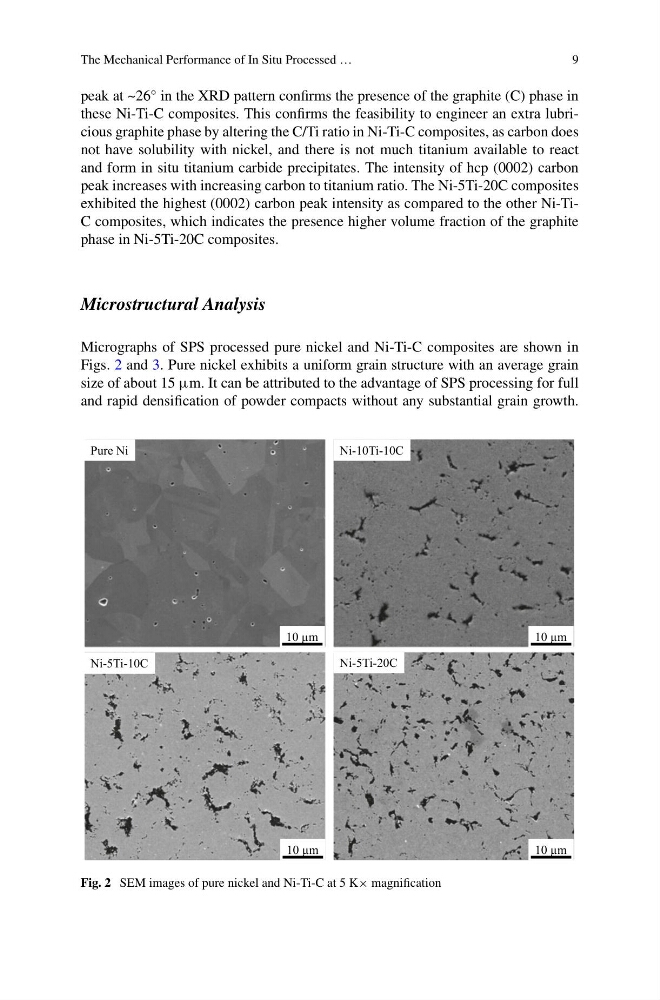
Micrographs of SPS processed pure nickel and Ni-Ti-C composites are shown in
Figs. 2 and 3. Pure nickel exhibits a uniform grain structure with an average grain
size of about 15 µm. It can be attributed to the advantage of SPS processing for full
and rapid densification of powder compacts without any substantial grain growth.
10 μm
10 μm
10 μm
10 μm
Pure Ni
Ni-10Ti-10C
Ni-5Ti-10C
Ni-5Ti-20C
Fig. 2 SEM images of pure nickel and Ni-Ti-C at 5 K× magnification
9
peak at ~26° in the XRD pattern confirms the presence of the graphite (C) phase in
these Ni-Ti-C composites. This confirms the feasibility to engineer an extra lubricious graphite phase by altering the C/Ti ratio in Ni-Ti-C composites, as carbon does
not have solubility with nickel, and there is not much titanium available to react
and form in situ titanium carbide precipitates. The intensity of hcp (0002) carbon
peak increases with increasing carbon to titanium ratio. The Ni-5Ti-20C composites
exhibited the highest (0002) carbon peak intensity as compared to the other Ni-TiC composites, which indicates the presence higher volume fraction of the graphite
phase in Ni-5Ti-20C composites.
Microstructural Analysis
Micrographs of SPS processed pure nickel and Ni-Ti-C composites are shown in
Figs. 2 and 3. Pure nickel exhibits a uniform grain structure with an average grain
size of about 15 µm. It can be attributed to the advantage of SPS processing for full
and rapid densification of powder compacts without any substantial grain growth.
10 μm
10 μm
10 μm
10 μm
Pure Ni
Ni-10Ti-10C
Ni-5Ti-10C
Ni-5Ti-20C
Fig. 2 SEM images of pure nickel and Ni-Ti-C at 5 K× magnification