

The Mechanical Performance of In Situ Processed …
7
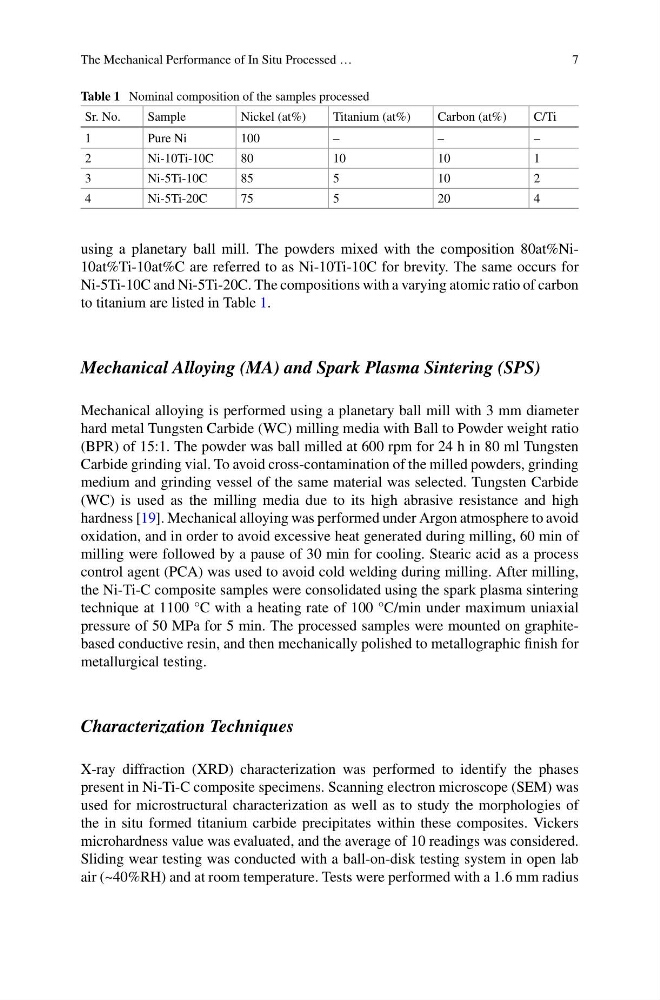
Table 1 Nominal composition of the samples processed
Sr. No.
Sample
Nickel (at%)
Titanium (at%)
Carbon (at%)
C/Ti
1
Pure Ni
100
–
–
–
2
Ni-10Ti-10C
80
10
10
1
3
Ni-5Ti-10C
85
5
10
2
4
Ni-5Ti-20C
75
5
20
4
using a planetary ball mill. The powders mixed with the composition 80at%Ni10at%Ti-10at%C are referred to as Ni-10Ti-10C for brevity. The same occurs for
Ni-5Ti-10C and Ni-5Ti-20C. The compositions with a varying atomic ratio of carbon
to titanium are listed in Table 1.
Mechanical Alloying (MA) and Spark Plasma Sintering (SPS)
Mechanical alloying is performed using a planetary ball mill with 3 mm diameter
hard metal Tungsten Carbide (WC) milling media with Ball to Powder weight ratio
(BPR) of 15:1. The powder was ball milled at 600 rpm for 24 h in 80 ml Tungsten
Carbide grinding vial. To avoid cross-contamination of the milled powders, grinding
medium and grinding vessel of the same material was selected. Tungsten Carbide
(WC) is used as the milling media due to its high abrasive resistance and high
hardness [19]. Mechanical alloying was performed under Argon atmosphere to avoid
oxidation, and in order to avoid excessive heat generated during milling, 60 min of
milling were followed by a pause of 30 min for cooling. Stearic acid as a process
control agent (PCA) was used to avoid cold welding during milling. After milling,
the Ni-Ti-C composite samples were consolidated using the spark plasma sintering
technique at 1100 °C with a heating rate of 100 °C/min under maximum uniaxial
pressure of 50 MPa for 5 min. The processed samples were mounted on graphitebased conductive resin, and then mechanically polished to metallographic finish for
metallurgical testing.
Characterization Techniques
X-ray diffraction (XRD) characterization was performed to identify the phases
present in Ni-Ti-C composite specimens. Scanning electron microscope (SEM) was
used for microstructural characterization as well as to study the morphologies of
the in situ formed titanium carbide precipitates within these composites. Vickers
microhardness value was evaluated, and the average of 10 readings was considered.
Sliding wear testing was conducted with a ball-on-disk testing system in open lab
air (~40%RH) and at room temperature. Tests were performed with a 1.6 mm radius
7
Table 1 Nominal composition of the samples processed
Sr. No.
Sample
Nickel (at%)
Titanium (at%)
Carbon (at%)
C/Ti
1
Pure Ni
100
–
–
–
2
Ni-10Ti-10C
80
10
10
1
3
Ni-5Ti-10C
85
5
10
2
4
Ni-5Ti-20C
75
5
20
4
using a planetary ball mill. The powders mixed with the composition 80at%Ni10at%Ti-10at%C are referred to as Ni-10Ti-10C for brevity. The same occurs for
Ni-5Ti-10C and Ni-5Ti-20C. The compositions with a varying atomic ratio of carbon
to titanium are listed in Table 1.
Mechanical Alloying (MA) and Spark Plasma Sintering (SPS)
Mechanical alloying is performed using a planetary ball mill with 3 mm diameter
hard metal Tungsten Carbide (WC) milling media with Ball to Powder weight ratio
(BPR) of 15:1. The powder was ball milled at 600 rpm for 24 h in 80 ml Tungsten
Carbide grinding vial. To avoid cross-contamination of the milled powders, grinding
medium and grinding vessel of the same material was selected. Tungsten Carbide
(WC) is used as the milling media due to its high abrasive resistance and high
hardness [19]. Mechanical alloying was performed under Argon atmosphere to avoid
oxidation, and in order to avoid excessive heat generated during milling, 60 min of
milling were followed by a pause of 30 min for cooling. Stearic acid as a process
control agent (PCA) was used to avoid cold welding during milling. After milling,
the Ni-Ti-C composite samples were consolidated using the spark plasma sintering
technique at 1100 °C with a heating rate of 100 °C/min under maximum uniaxial
pressure of 50 MPa for 5 min. The processed samples were mounted on graphitebased conductive resin, and then mechanically polished to metallographic finish for
metallurgical testing.
Characterization Techniques
X-ray diffraction (XRD) characterization was performed to identify the phases
present in Ni-Ti-C composite specimens. Scanning electron microscope (SEM) was
used for microstructural characterization as well as to study the morphologies of
the in situ formed titanium carbide precipitates within these composites. Vickers
microhardness value was evaluated, and the average of 10 readings was considered.
Sliding wear testing was conducted with a ball-on-disk testing system in open lab
air (~40%RH) and at room temperature. Tests were performed with a 1.6 mm radius