

Use of an Infrared Spectroscopic Method for Isotopic Analysis …
185
Methodology
High-Performance Infrared Spectrometer
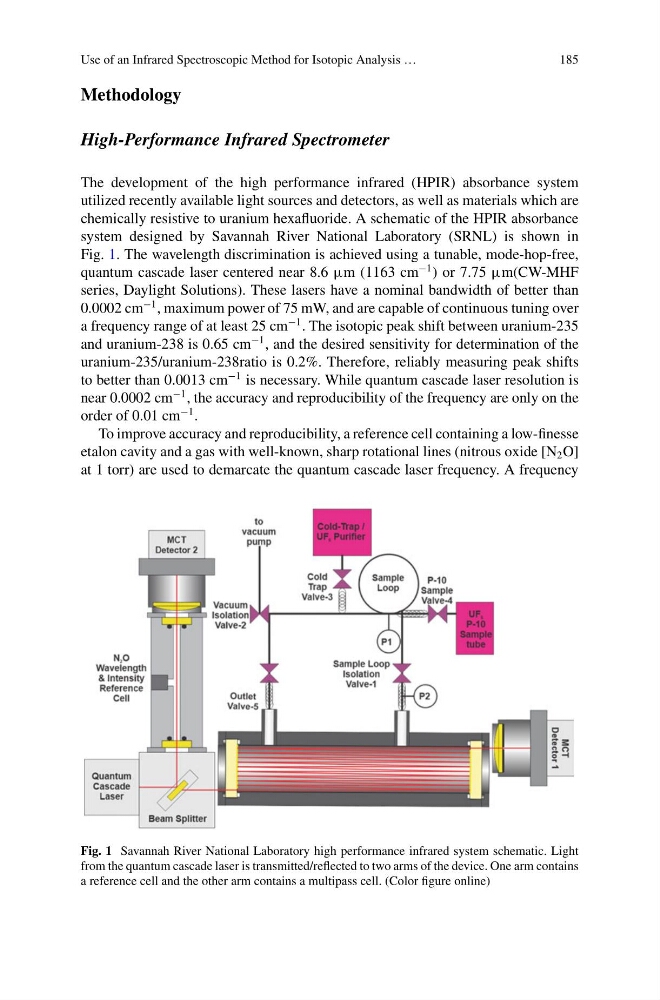
The development of the high performance infrared (HPIR) absorbance system
utilized recently available light sources and detectors, as well as materials which are
chemically resistive to uranium hexafluoride. A schematic of the HPIR absorbance
system designed by Savannah River National Laboratory (SRNL) is shown in
Fig. 1. The wavelength discrimination is achieved using a tunable, mode-hop-free,
quantum cascade laser centered near 8.6 μm (1163 cm
−1 ) or 7.75 μm(CW-MHF
series, Daylight Solutions). These lasers have a nominal bandwidth of better than
0.0002 cm
−1 , maximum power of 75 mW, and are capable of continuous tuning over
a frequency range of at least 25 cm
−1 . The isotopic peak shift between uranium-235
and uranium-238 is 0.65 cm
−1 , and the desired sensitivity for determination of the
uranium-235/uranium-238ratio is 0.2%. Therefore, reliably measuring peak shifts
to better than 0.0013 cm
−1 is necessary. While quantum cascade laser resolution is
near 0.0002 cm
−1 , the accuracy and reproducibility of the frequency are only on the
order of 0.01 cm
−1 .
To improve accuracy and reproducibility, a reference cell containing a low-finesse
etalon cavity and a gas with well-known, sharp rotational lines (nitrous oxide [N 2 O]
at 1 torr) are used to demarcate the quantum cascade laser frequency. A frequency
Fig. 1 Savannah River National Laboratory high performance infrared system schematic. Light
from the quantum cascade laser is transmitted/reflected to two arms of the device. One arm contains
a reference cell and the other arm contains a multipass cell. (Color figure online)
185
Methodology
High-Performance Infrared Spectrometer
The development of the high performance infrared (HPIR) absorbance system
utilized recently available light sources and detectors, as well as materials which are
chemically resistive to uranium hexafluoride. A schematic of the HPIR absorbance
system designed by Savannah River National Laboratory (SRNL) is shown in
Fig. 1. The wavelength discrimination is achieved using a tunable, mode-hop-free,
quantum cascade laser centered near 8.6 μm (1163 cm
−1 ) or 7.75 μm(CW-MHF
series, Daylight Solutions). These lasers have a nominal bandwidth of better than
0.0002 cm
−1 , maximum power of 75 mW, and are capable of continuous tuning over
a frequency range of at least 25 cm
−1 . The isotopic peak shift between uranium-235
and uranium-238 is 0.65 cm
−1 , and the desired sensitivity for determination of the
uranium-235/uranium-238ratio is 0.2%. Therefore, reliably measuring peak shifts
to better than 0.0013 cm
−1 is necessary. While quantum cascade laser resolution is
near 0.0002 cm
−1 , the accuracy and reproducibility of the frequency are only on the
order of 0.01 cm
−1 .
To improve accuracy and reproducibility, a reference cell containing a low-finesse
etalon cavity and a gas with well-known, sharp rotational lines (nitrous oxide [N 2 O]
at 1 torr) are used to demarcate the quantum cascade laser frequency. A frequency
Fig. 1 Savannah River National Laboratory high performance infrared system schematic. Light
from the quantum cascade laser is transmitted/reflected to two arms of the device. One arm contains
a reference cell and the other arm contains a multipass cell. (Color figure online)