

172
K. L. Meena and T. S. Srivatsan
matrix. The rapid heating experienced by the microwave (MW) sintered samples
does not give it sufficient time for the occurrence of grain growth. The microwave
(MW) sintered samples revealed a fully dense microstructure with fine grains of ZrO 2
uniformly dispersed through the matrix of the composite. The average grain size was
determined by calculating the average value of length and average value of the width
of 10 random grains in the microstructure. The average grain size of the conventional
sintered (CS) was 600 ± 50 nm and microwave (MW) sintered samples was 421 ±
30 nm. The microwave (MW) sintered sample experienced rapid heating that enabled
in suppressing grain growth and a resultant reduction in the average grain size. This
resulted in an overall improvement in surface finish of the ATZ sample. Also, no
cracking was observed for the microwave (MW) sintered sample.
Relative Density and Porosity
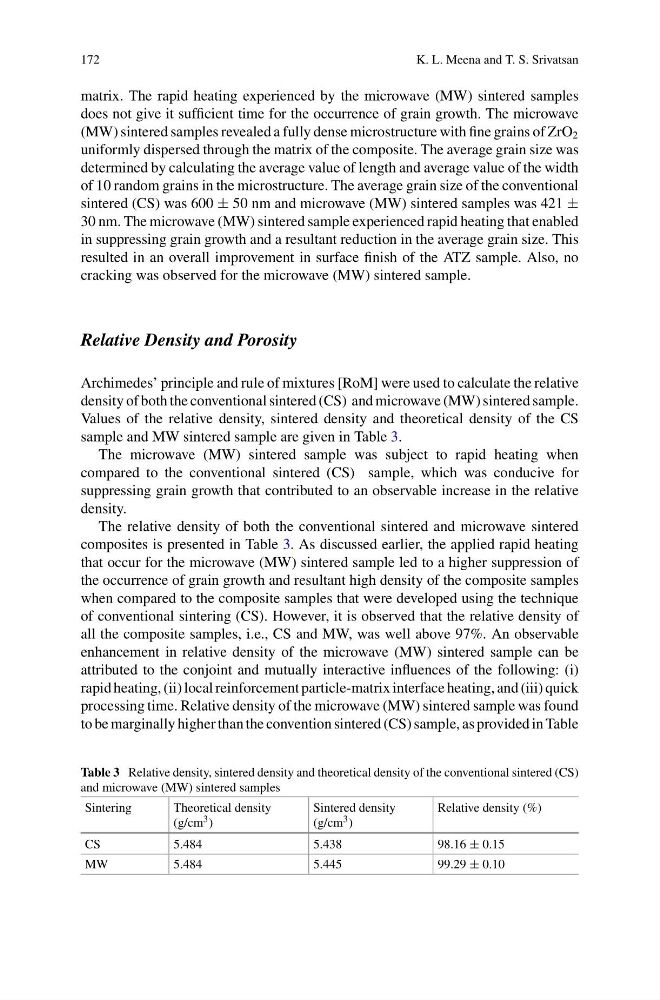
Archimedes’ principle and rule of mixtures [RoM] were used to calculate the relative
density of both the conventional sintered (CS) and microwave (MW) sintered sample.
Values of the relative density, sintered density and theoretical density of the CS
sample and MW sintered sample are given in Table 3.
The microwave (MW) sintered sample was subject to rapid heating when
compared to the conventional sintered (CS) sample, which was conducive for
suppressing grain growth that contributed to an observable increase in the relative
density.
The relative density of both the conventional sintered and microwave sintered
composites is presented in Table 3. As discussed earlier, the applied rapid heating
that occur for the microwave (MW) sintered sample led to a higher suppression of
the occurrence of grain growth and resultant high density of the composite samples
when compared to the composite samples that were developed using the technique
of conventional sintering (CS). However, it is observed that the relative density of
all the composite samples, i.e., CS and MW, was well above 97%. An observable
enhancement in relative density of the microwave (MW) sintered sample can be
attributed to the conjoint and mutually interactive influences of the following: (i)
rapid heating, (ii) local reinforcement particle-matrix interface heating, and (iii) quick
processing time. Relative density of the microwave (MW) sintered sample was found
to be marginally higher than the convention sintered (CS) sample, as provided in Table
Table 3 Relative density, sintered density and theoretical density of the conventional sintered (CS)
and microwave (MW) sintered samples
Sintering
Theoretical density
(g/cm 3 )
Sintered density
(g/cm 3 )
Relative density (%)
CS
5.484
5.438
98.16 ± 0.15
MW
5.484
5.445
99.29 ± 0.10
K. L. Meena and T. S. Srivatsan
matrix. The rapid heating experienced by the microwave (MW) sintered samples
does not give it sufficient time for the occurrence of grain growth. The microwave
(MW) sintered samples revealed a fully dense microstructure with fine grains of ZrO 2
uniformly dispersed through the matrix of the composite. The average grain size was
determined by calculating the average value of length and average value of the width
of 10 random grains in the microstructure. The average grain size of the conventional
sintered (CS) was 600 ± 50 nm and microwave (MW) sintered samples was 421 ±
30 nm. The microwave (MW) sintered sample experienced rapid heating that enabled
in suppressing grain growth and a resultant reduction in the average grain size. This
resulted in an overall improvement in surface finish of the ATZ sample. Also, no
cracking was observed for the microwave (MW) sintered sample.
Relative Density and Porosity
Archimedes’ principle and rule of mixtures [RoM] were used to calculate the relative
density of both the conventional sintered (CS) and microwave (MW) sintered sample.
Values of the relative density, sintered density and theoretical density of the CS
sample and MW sintered sample are given in Table 3.
The microwave (MW) sintered sample was subject to rapid heating when
compared to the conventional sintered (CS) sample, which was conducive for
suppressing grain growth that contributed to an observable increase in the relative
density.
The relative density of both the conventional sintered and microwave sintered
composites is presented in Table 3. As discussed earlier, the applied rapid heating
that occur for the microwave (MW) sintered sample led to a higher suppression of
the occurrence of grain growth and resultant high density of the composite samples
when compared to the composite samples that were developed using the technique
of conventional sintering (CS). However, it is observed that the relative density of
all the composite samples, i.e., CS and MW, was well above 97%. An observable
enhancement in relative density of the microwave (MW) sintered sample can be
attributed to the conjoint and mutually interactive influences of the following: (i)
rapid heating, (ii) local reinforcement particle-matrix interface heating, and (iii) quick
processing time. Relative density of the microwave (MW) sintered sample was found
to be marginally higher than the convention sintered (CS) sample, as provided in Table
Table 3 Relative density, sintered density and theoretical density of the conventional sintered (CS)
and microwave (MW) sintered samples
Sintering
Theoretical density
(g/cm 3 )
Sintered density
(g/cm 3 )
Relative density (%)
CS
5.484
5.438
98.16 ± 0.15
MW
5.484
5.445
99.29 ± 0.10