

118
A. Patil et al.
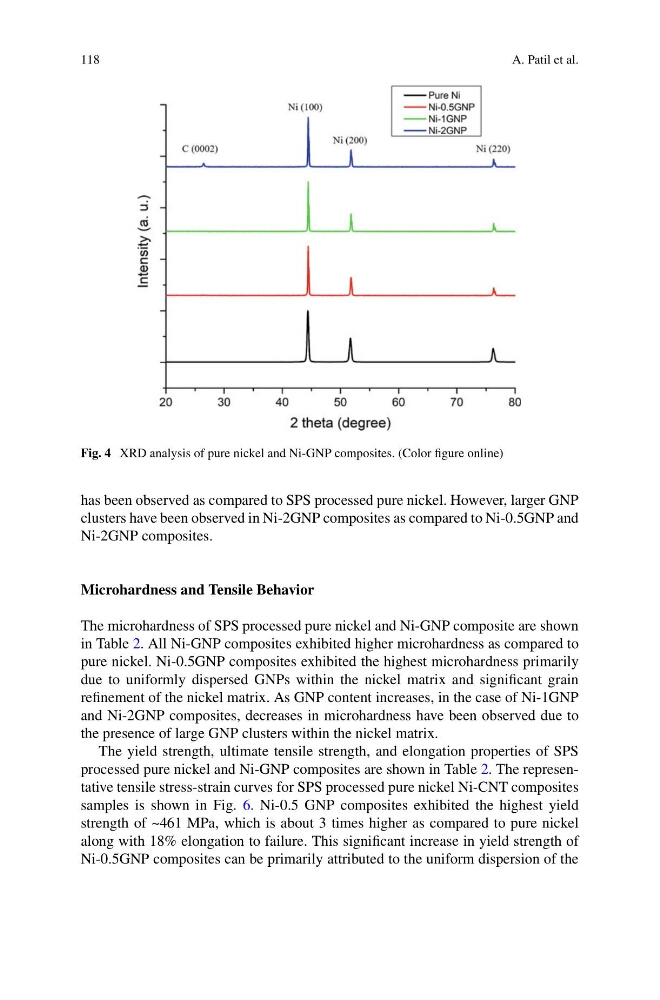
Fig. 4 XRD analysis of pure nickel and Ni-GNP composites. (Color figure online)
has been observed as compared to SPS processed pure nickel. However, larger GNP
clusters have been observed in Ni-2GNP composites as compared to Ni-0.5GNP and
Ni-2GNP composites.
Microhardness and Tensile Behavior
The microhardness of SPS processed pure nickel and Ni-GNP composite are shown
in Table 2. All Ni-GNP composites exhibited higher microhardness as compared to
pure nickel. Ni-0.5GNP composites exhibited the highest microhardness primarily
due to uniformly dispersed GNPs within the nickel matrix and significant grain
refinement of the nickel matrix. As GNP content increases, in the case of Ni-1GNP
and Ni-2GNP composites, decreases in microhardness have been observed due to
the presence of large GNP clusters within the nickel matrix.
The yield strength, ultimate tensile strength, and elongation properties of SPS
processed pure nickel and Ni-GNP composites are shown in Table 2. The representative tensile stress-strain curves for SPS processed pure nickel Ni-CNT composites
samples is shown in Fig. 6. Ni-0.5 GNP composites exhibited the highest yield
strength of ~461 MPa, which is about 3 times higher as compared to pure nickel
along with 18% elongation to failure. This significant increase in yield strength of
Ni-0.5GNP composites can be primarily attributed to the uniform dispersion of the
A. Patil et al.
Fig. 4 XRD analysis of pure nickel and Ni-GNP composites. (Color figure online)
has been observed as compared to SPS processed pure nickel. However, larger GNP
clusters have been observed in Ni-2GNP composites as compared to Ni-0.5GNP and
Ni-2GNP composites.
Microhardness and Tensile Behavior
The microhardness of SPS processed pure nickel and Ni-GNP composite are shown
in Table 2. All Ni-GNP composites exhibited higher microhardness as compared to
pure nickel. Ni-0.5GNP composites exhibited the highest microhardness primarily
due to uniformly dispersed GNPs within the nickel matrix and significant grain
refinement of the nickel matrix. As GNP content increases, in the case of Ni-1GNP
and Ni-2GNP composites, decreases in microhardness have been observed due to
the presence of large GNP clusters within the nickel matrix.
The yield strength, ultimate tensile strength, and elongation properties of SPS
processed pure nickel and Ni-GNP composites are shown in Table 2. The representative tensile stress-strain curves for SPS processed pure nickel Ni-CNT composites
samples is shown in Fig. 6. Ni-0.5 GNP composites exhibited the highest yield
strength of ~461 MPa, which is about 3 times higher as compared to pure nickel
along with 18% elongation to failure. This significant increase in yield strength of
Ni-0.5GNP composites can be primarily attributed to the uniform dispersion of the