

116
A. Patil et al.
nickel decreases and the size of CNT clusters increases with the increasing volume
fraction of CNTs in these composites. In Ni-2CNT composite, the size of CNT
clusters is increased as compared with Ni-0.5CNT and Ni-1CNT nanocomposites.
This is primarily due to the presence of a relatively higher volume of CNTs in these
composites promotes agglomeration.
Microhardness and Tensile Behavior
Vickers microhardness of SPS processed pure nickel and Ni-CNT composites is listed
in Table 1. Pure nickel exhibited around 115 HV microhardness. It is observed that
the microhardness of all Ni-CNT composites increased significantly as compared
to pure nickel primarily due to the addition of multi-walled carbon nanotubes in
the nickel matrix along with significant grain refinement as compared to pure nickel.
This primarily due to the presence of carbonaceous reinforcement, hindering the grain
growth of the nickel matrix. The refined microstructure of Ni-CNT nanocomposites
is also evident from Fig. 2. The highest microhardness value of ~195HV is observed
for Ni-1CNT as compared with other Ni-CNT composites. This is primarily due
to the uniform distribution of CNT reinforcement within the refined nickel matrix.
Ni-2CNT composites exhibited lower microhardness as compared to other Ni-CNT
composites, mainly due to the presence of large CNT clusters within the nickel
matrix.
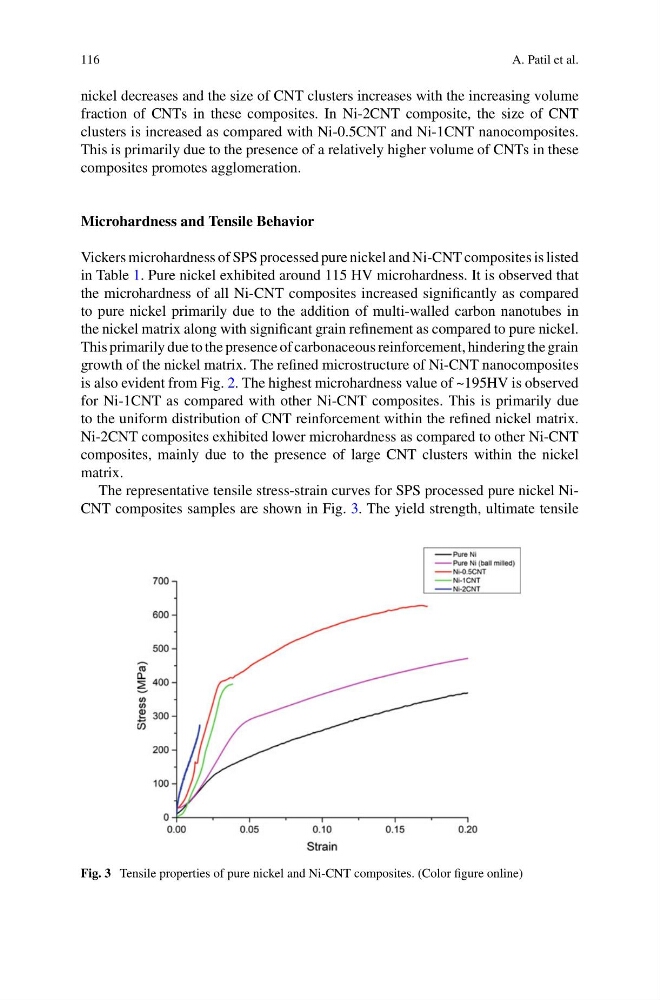
The representative tensile stress-strain curves for SPS processed pure nickel NiCNT composites samples are shown in Fig. 3. The yield strength, ultimate tensile
Fig. 3 Tensile properties of pure nickel and Ni-CNT composites. (Color figure online)
A. Patil et al.
nickel decreases and the size of CNT clusters increases with the increasing volume
fraction of CNTs in these composites. In Ni-2CNT composite, the size of CNT
clusters is increased as compared with Ni-0.5CNT and Ni-1CNT nanocomposites.
This is primarily due to the presence of a relatively higher volume of CNTs in these
composites promotes agglomeration.
Microhardness and Tensile Behavior
Vickers microhardness of SPS processed pure nickel and Ni-CNT composites is listed
in Table 1. Pure nickel exhibited around 115 HV microhardness. It is observed that
the microhardness of all Ni-CNT composites increased significantly as compared
to pure nickel primarily due to the addition of multi-walled carbon nanotubes in
the nickel matrix along with significant grain refinement as compared to pure nickel.
This primarily due to the presence of carbonaceous reinforcement, hindering the grain
growth of the nickel matrix. The refined microstructure of Ni-CNT nanocomposites
is also evident from Fig. 2. The highest microhardness value of ~195HV is observed
for Ni-1CNT as compared with other Ni-CNT composites. This is primarily due
to the uniform distribution of CNT reinforcement within the refined nickel matrix.
Ni-2CNT composites exhibited lower microhardness as compared to other Ni-CNT
composites, mainly due to the presence of large CNT clusters within the nickel
matrix.
The representative tensile stress-strain curves for SPS processed pure nickel NiCNT composites samples are shown in Fig. 3. The yield strength, ultimate tensile
Fig. 3 Tensile properties of pure nickel and Ni-CNT composites. (Color figure online)