

104
S. E. H. Murph and A. Goriounova
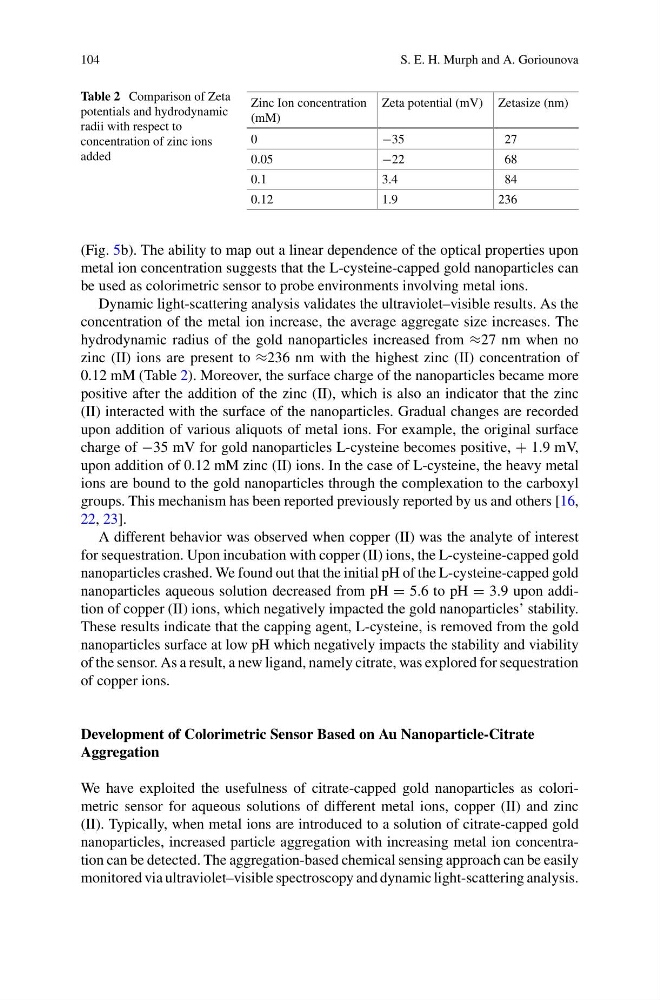
Table 2 Comparison of Zeta
potentials and hydrodynamic
radii with respect to
concentration of zinc ions
added
Zinc Ion concentration
(mM)
Zeta potential (mV) Zetasize (nm)
0
−35
27
0.05
−22
68
0.1
3.4
84
0.12
1.9
236
(Fig. 5b). The ability to map out a linear dependence of the optical properties upon
metal ion concentration suggests that the L-cysteine-capped gold nanoparticles can
be used as colorimetric sensor to probe environments involving metal ions.
Dynamic light-scattering analysis validates the ultraviolet–visible results. As the
concentration of the metal ion increase, the average aggregate size increases. The
hydrodynamic radius of the gold nanoparticles increased from ≈27 nm when no
zinc (II) ions are present to ≈236 nm with the highest zinc (II) concentration of
0.12 mM (Table 2). Moreover, the surface charge of the nanoparticles became more
positive after the addition of the zinc (II), which is also an indicator that the zinc
(II) interacted with the surface of the nanoparticles. Gradual changes are recorded
upon addition of various aliquots of metal ions. For example, the original surface
charge of −35 mV for gold nanoparticles L-cysteine becomes positive, + 1.9 mV,
upon addition of 0.12 mM zinc (II) ions. In the case of L-cysteine, the heavy metal
ions are bound to the gold nanoparticles through the complexation to the carboxyl
groups. This mechanism has been reported previously reported by us and others [16,
22, 23].
A different behavior was observed when copper (II) was the analyte of interest
for sequestration. Upon incubation with copper (II) ions, the L-cysteine-capped gold
nanoparticles crashed. We found out that the initial pH of the L-cysteine-capped gold
nanoparticles aqueous solution decreased from pH = 5.6 to pH = 3.9 upon addition of copper (II) ions, which negatively impacted the gold nanoparticles’ stability.
These results indicate that the capping agent, L-cysteine, is removed from the gold
nanoparticles surface at low pH which negatively impacts the stability and viability
of the sensor. As a result, a new ligand, namely citrate, was explored for sequestration
of copper ions.
Development of Colorimetric Sensor Based on Au Nanoparticle-Citrate
Aggregation
We have exploited the usefulness of citrate-capped gold nanoparticles as colorimetric sensor for aqueous solutions of different metal ions, copper (II) and zinc
(II). Typically, when metal ions are introduced to a solution of citrate-capped gold
nanoparticles, increased particle aggregation with increasing metal ion concentration can be detected. The aggregation-based chemical sensing approach can be easily
monitored via ultraviolet–visible spectroscopy and dynamic light-scattering analysis.
S. E. H. Murph and A. Goriounova
Table 2 Comparison of Zeta
potentials and hydrodynamic
radii with respect to
concentration of zinc ions
added
Zinc Ion concentration
(mM)
Zeta potential (mV) Zetasize (nm)
0
−35
27
0.05
−22
68
0.1
3.4
84
0.12
1.9
236
(Fig. 5b). The ability to map out a linear dependence of the optical properties upon
metal ion concentration suggests that the L-cysteine-capped gold nanoparticles can
be used as colorimetric sensor to probe environments involving metal ions.
Dynamic light-scattering analysis validates the ultraviolet–visible results. As the
concentration of the metal ion increase, the average aggregate size increases. The
hydrodynamic radius of the gold nanoparticles increased from ≈27 nm when no
zinc (II) ions are present to ≈236 nm with the highest zinc (II) concentration of
0.12 mM (Table 2). Moreover, the surface charge of the nanoparticles became more
positive after the addition of the zinc (II), which is also an indicator that the zinc
(II) interacted with the surface of the nanoparticles. Gradual changes are recorded
upon addition of various aliquots of metal ions. For example, the original surface
charge of −35 mV for gold nanoparticles L-cysteine becomes positive, + 1.9 mV,
upon addition of 0.12 mM zinc (II) ions. In the case of L-cysteine, the heavy metal
ions are bound to the gold nanoparticles through the complexation to the carboxyl
groups. This mechanism has been reported previously reported by us and others [16,
22, 23].
A different behavior was observed when copper (II) was the analyte of interest
for sequestration. Upon incubation with copper (II) ions, the L-cysteine-capped gold
nanoparticles crashed. We found out that the initial pH of the L-cysteine-capped gold
nanoparticles aqueous solution decreased from pH = 5.6 to pH = 3.9 upon addition of copper (II) ions, which negatively impacted the gold nanoparticles’ stability.
These results indicate that the capping agent, L-cysteine, is removed from the gold
nanoparticles surface at low pH which negatively impacts the stability and viability
of the sensor. As a result, a new ligand, namely citrate, was explored for sequestration
of copper ions.
Development of Colorimetric Sensor Based on Au Nanoparticle-Citrate
Aggregation
We have exploited the usefulness of citrate-capped gold nanoparticles as colorimetric sensor for aqueous solutions of different metal ions, copper (II) and zinc
(II). Typically, when metal ions are introduced to a solution of citrate-capped gold
nanoparticles, increased particle aggregation with increasing metal ion concentration can be detected. The aggregation-based chemical sensing approach can be easily
monitored via ultraviolet–visible spectroscopy and dynamic light-scattering analysis.