

78
4 Four-Dimensional Superfield Supersymmetry
two external chiral legs and no more than two , ¯
¯
propagators in a
superficially divergent supergraph). And since the number of divergent structures
is finite, the theory is renormalizable. Hence we have just shown that the N = 1
SYM theory coupled to the chiral matter with the Wess-Zumino self-interaction,
described by action (4.106) is renormalizable. This is quite natural since the
mass dimensions of all couplings in this theory are equal to zero.
However, non-renormalizable superfield theories also exist. The example is the
general chiral superfield model [62].
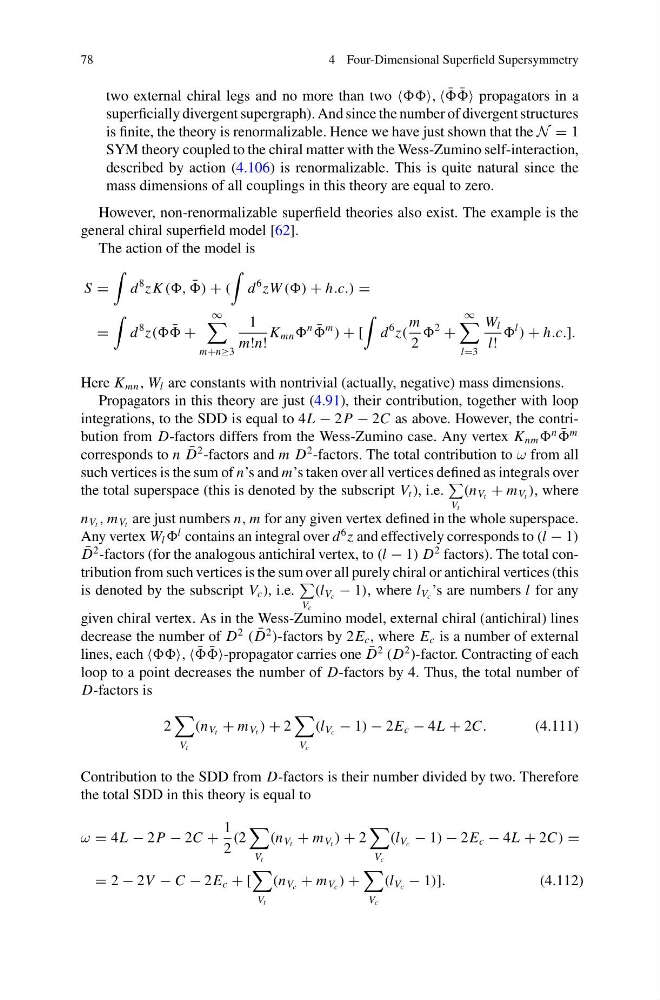
The action of the model is
S =
d
8 zK ((, ¯
) + (
d
6 zW (() + h.c.) =
=
d
8 z(( ¯
+
∞
m+n≥3
1
m!n!
K mn
n ¯
m
) + [
d
6 z(
m
2
2
+
∞
l=3
W l
l!
l
) + h.c.].
Here K mn , W l are constants with nontrivial (actually, negative) mass dimensions.
Propagators in this theory are just (4.91), their contribution, together with loop
integrations, to the SDD is equal to 4L − 2P − 2C as above. However, the contribution from D-factors differs from the Wess-Zumino case. Any vertex K nm
n ¯
m
corresponds to n ¯
D
2 -factors and m D
2 -factors. The total contribution to ω from all
such vertices is the sum of n’s and m’s taken over all vertices defined as integrals over
the total superspace (this is denoted by the subscript V t ), i.e.
V t
(n V t + m V t ), where
n V t , m V t are just numbers n, m for any given vertex defined in the whole superspace.
Any vertex W l
l contains an integral over d
6 z and effectively corresponds to (l − 1)
¯
D
2 -factors (for the analogous antichiral vertex, to (l − 1) D
2 factors). The total contribution from such vertices is the sum over all purely chiral or antichiral vertices (this
is denoted by the subscript V c ), i.e.
V c
(l V c − 1), where l V c ’s are numbers l for any
given chiral vertex. As in the Wess-Zumino model, external chiral (antichiral) lines
decrease the number of D
2
( ¯
D
2
)-factors by 2E c , where E c is a number of external
lines, each , ¯
¯
-propagator carries one ¯
D
2 (D
2 )-factor. Contracting of each
loop to a point decreases the number of D-factors by 4. Thus, the total number of
D-factors is
2
V t
(n V t + m V t ) + 2
V c
(l V c − 1) − 2E c − 4L + 2C.
(4.111)
Contribution to the SDD from D-factors is their number divided by two. Therefore
the total SDD in this theory is equal to
ω = 4L − 2P − 2C +
1
2
(2
V t
(n V t + m V t ) + 2
V c
(l V c − 1) − 2E c − 4L + 2C) =
= 2 − 2V − C − 2E c + [
V t
(n V c + m V c ) +
V c
(l V c − 1)].
(4.112)
4 Four-Dimensional Superfield Supersymmetry
two external chiral legs and no more than two , ¯
¯
propagators in a
superficially divergent supergraph). And since the number of divergent structures
is finite, the theory is renormalizable. Hence we have just shown that the N = 1
SYM theory coupled to the chiral matter with the Wess-Zumino self-interaction,
described by action (4.106) is renormalizable. This is quite natural since the
mass dimensions of all couplings in this theory are equal to zero.
However, non-renormalizable superfield theories also exist. The example is the
general chiral superfield model [62].
The action of the model is
S =
d
8 zK ((, ¯
) + (
d
6 zW (() + h.c.) =
=
d
8 z(( ¯
+
∞
m+n≥3
1
m!n!
K mn
n ¯
m
) + [
d
6 z(
m
2
2
+
∞
l=3
W l
l!
l
) + h.c.].
Here K mn , W l are constants with nontrivial (actually, negative) mass dimensions.
Propagators in this theory are just (4.91), their contribution, together with loop
integrations, to the SDD is equal to 4L − 2P − 2C as above. However, the contribution from D-factors differs from the Wess-Zumino case. Any vertex K nm
n ¯
m
corresponds to n ¯
D
2 -factors and m D
2 -factors. The total contribution to ω from all
such vertices is the sum of n’s and m’s taken over all vertices defined as integrals over
the total superspace (this is denoted by the subscript V t ), i.e.
V t
(n V t + m V t ), where
n V t , m V t are just numbers n, m for any given vertex defined in the whole superspace.
Any vertex W l
l contains an integral over d
6 z and effectively corresponds to (l − 1)
¯
D
2 -factors (for the analogous antichiral vertex, to (l − 1) D
2 factors). The total contribution from such vertices is the sum over all purely chiral or antichiral vertices (this
is denoted by the subscript V c ), i.e.
V c
(l V c − 1), where l V c ’s are numbers l for any
given chiral vertex. As in the Wess-Zumino model, external chiral (antichiral) lines
decrease the number of D
2
( ¯
D
2
)-factors by 2E c , where E c is a number of external
lines, each , ¯
¯
-propagator carries one ¯
D
2 (D
2 )-factor. Contracting of each
loop to a point decreases the number of D-factors by 4. Thus, the total number of
D-factors is
2
V t
(n V t + m V t ) + 2
V c
(l V c − 1) − 2E c − 4L + 2C.
(4.111)
Contribution to the SDD from D-factors is their number divided by two. Therefore
the total SDD in this theory is equal to
ω = 4L − 2P − 2C +
1
2
(2
V t
(n V t + m V t ) + 2
V c
(l V c − 1) − 2E c − 4L + 2C) =
= 2 − 2V − C − 2E c + [
V t
(n V c + m V c ) +
V c
(l V c − 1)].
(4.112)