

74
4 Four-Dimensional Superfield Supersymmetry
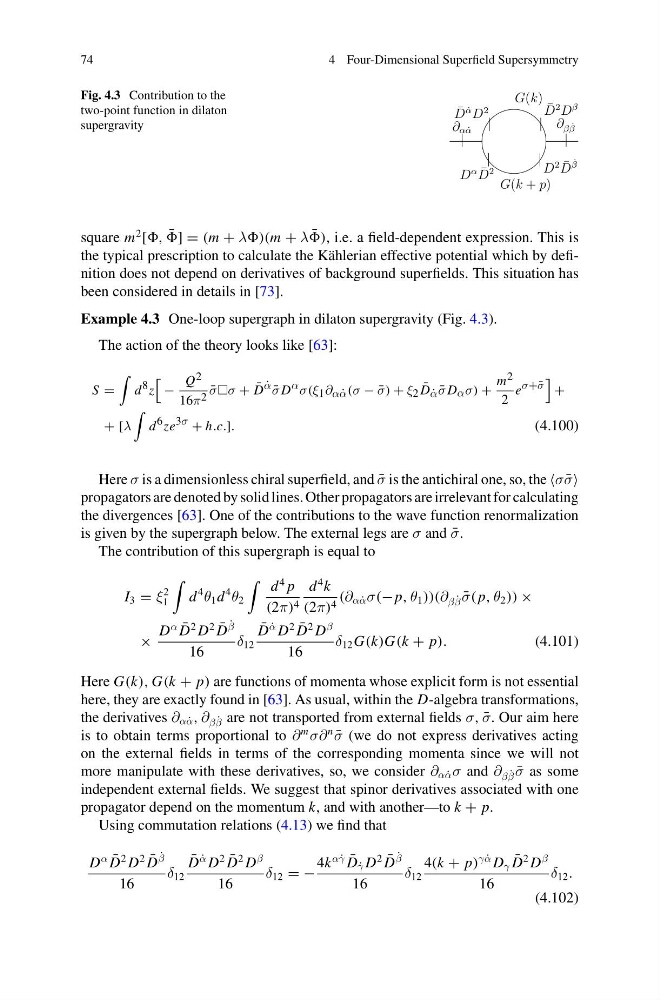
Fig. 4.3 Contribution to the
two-point function in dilaton
supergravity
|
|
¯
D
2 D
β
¯
D
˙
α D
2
|
|
D
2 ¯
D
˙
β
D
α ¯
D
2
∂ α ˙
α
|
∂ β ˙
β
|
G(k)
G(k + p)
square m
2
[, ¯
] = (m + λ + λ ¯
), i.e. a field-dependent expression. This is
the typical prescription to calculate the Kählerian effective potential which by definition does not depend on derivatives of background superfields. This situation has
been considered in details in [73].
Example 4.3 One-loop supergraph in dilaton supergravity (Fig. 4.3).
The action of the theory looks like [63]:
S =
d 8 z
−
Q 2
16π 2 ¯
σσ + ¯
D ˙
α ¯
σ D α σ(ξ 1 ∂ α ˙
α (σ − ¯
σ) + ξ 2 ¯
D ˙
α ¯
σ D α σ) +
m 2
2
e σ+ ¯
σ
+
+ [λ
d 6 ze 3σ + h.c.].
(4.100)
Here σ is a dimensionless chiral superfield, and ¯
σ is the antichiral one, so, the ¯
σ
propagators are denoted by solid lines. Other propagators are irrelevant for calculating
the divergences [63]. One of the contributions to the wave function renormalization
is given by the supergraph below. The external legs are σ and ¯
σ.
The contribution of this supergraph is equal to
I 3 = ξ
2
1
d
4
θ 1 d
4
θ 2
d
4 p
(2π) 4
d
4 k
(2π) 4 (∂ α ˙
α σ(− p, θ 1 ))(∂ β ˙
β ¯
σ( p, θ 2 )) ×
×
D
α ¯
D
2 D
2 ¯
D
˙
β
16
δ 12
¯
D
˙
α D
2 ¯
D
2 D
β
16
δ 12 G(k)G(k + p).
(4.101)
Here G(k), G(k + p) are functions of momenta whose explicit form is not essential
here, they are exactly found in [63]. As usual, within the D-algebra transformations,
the derivatives ∂ α ˙
α , ∂ β ˙
β are not transported from external fields σ, ¯
σ. Our aim here
is to obtain terms proportional to ∂
m
σ∂
n
¯
σ (we do not express derivatives acting
on the external fields in terms of the corresponding momenta since we will not
more manipulate with these derivatives, so, we consider ∂ α ˙
α σ and ∂ β ˙
β ¯
σ as some
independent external fields. We suggest that spinor derivatives associated with one
propagator depend on the momentum k, and with another—to k + p.
Using commutation relations (4.13) we find that
D
α ¯
D
2 D
2 ¯
D
˙
β
16
δ 12
¯
D
˙
α D
2 ¯
D
2 D
β
16
δ 12 = −
4k
α ˙
γ ¯
D ˙
γ D
2 ¯
D
˙
β
16
δ 12
4(k + p)
γ ˙
α D γ ¯
D
2 D
β
16
δ 12 .
(4.102)
4 Four-Dimensional Superfield Supersymmetry
Fig. 4.3 Contribution to the
two-point function in dilaton
supergravity
|
|
¯
D
2 D
β
¯
D
˙
α D
2
|
|
D
2 ¯
D
˙
β
D
α ¯
D
2
∂ α ˙
α
|
∂ β ˙
β
|
G(k)
G(k + p)
square m
2
[, ¯
] = (m + λ + λ ¯
), i.e. a field-dependent expression. This is
the typical prescription to calculate the Kählerian effective potential which by definition does not depend on derivatives of background superfields. This situation has
been considered in details in [73].
Example 4.3 One-loop supergraph in dilaton supergravity (Fig. 4.3).
The action of the theory looks like [63]:
S =
d 8 z
−
Q 2
16π 2 ¯
σσ + ¯
D ˙
α ¯
σ D α σ(ξ 1 ∂ α ˙
α (σ − ¯
σ) + ξ 2 ¯
D ˙
α ¯
σ D α σ) +
m 2
2
e σ+ ¯
σ
+
+ [λ
d 6 ze 3σ + h.c.].
(4.100)
Here σ is a dimensionless chiral superfield, and ¯
σ is the antichiral one, so, the ¯
σ
propagators are denoted by solid lines. Other propagators are irrelevant for calculating
the divergences [63]. One of the contributions to the wave function renormalization
is given by the supergraph below. The external legs are σ and ¯
σ.
The contribution of this supergraph is equal to
I 3 = ξ
2
1
d
4
θ 1 d
4
θ 2
d
4 p
(2π) 4
d
4 k
(2π) 4 (∂ α ˙
α σ(− p, θ 1 ))(∂ β ˙
β ¯
σ( p, θ 2 )) ×
×
D
α ¯
D
2 D
2 ¯
D
˙
β
16
δ 12
¯
D
˙
α D
2 ¯
D
2 D
β
16
δ 12 G(k)G(k + p).
(4.101)
Here G(k), G(k + p) are functions of momenta whose explicit form is not essential
here, they are exactly found in [63]. As usual, within the D-algebra transformations,
the derivatives ∂ α ˙
α , ∂ β ˙
β are not transported from external fields σ, ¯
σ. Our aim here
is to obtain terms proportional to ∂
m
σ∂
n
¯
σ (we do not express derivatives acting
on the external fields in terms of the corresponding momenta since we will not
more manipulate with these derivatives, so, we consider ∂ α ˙
α σ and ∂ β ˙
β ¯
σ as some
independent external fields. We suggest that spinor derivatives associated with one
propagator depend on the momentum k, and with another—to k + p.
Using commutation relations (4.13) we find that
D
α ¯
D
2 D
2 ¯
D
˙
β
16
δ 12
¯
D
˙
α D
2 ¯
D
2 D
β
16
δ 12 = −
4k
α ˙
γ ¯
D ˙
γ D
2 ¯
D
˙
β
16
δ 12
4(k + p)
γ ˙
α D γ ¯
D
2 D
β
16
δ 12 .
(4.102)