

70
4 Four-Dimensional Superfield Supersymmetry
S int =
g
16
tr
d
8 z( ¯
D
2 D
α V )[V, D α V ] + . . .
(4.87)
Here dots denote higher orders in V . The vertices of any order involve two D factors
and two ¯
D factors. The D-factors in vertices involving both real and chiral (antichiral)
superfields are arranged in a way described above, i.e. any vertex ¯
V
n involves
one factor (−
1
4
¯
D
2
) corresponding to a chiral superfield when it is contracted to
the propagator and one factor (−
1
4
D
2
) corresponding to the ¯
antichiral superfield
when it is contracted to the propagator. As a result, we can formulate Feynman rules.
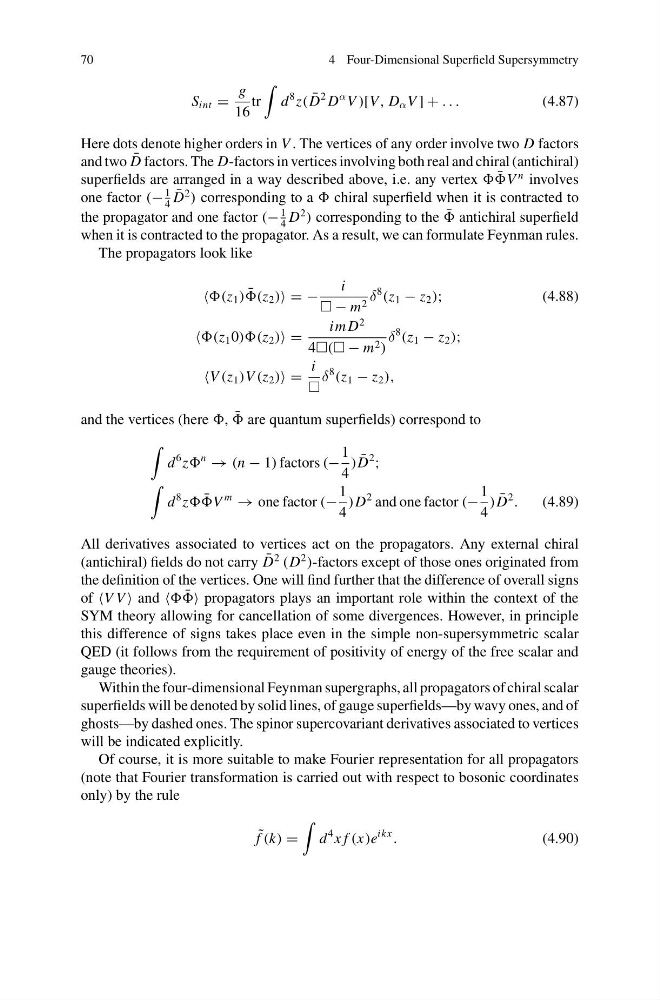
The propagators look like
(z 1 ) ¯
(z 2 ) = −
i
− m 2 δ
8
(z 1 − z 2 );
(4.88)
(z 1 0))(z 2 ) =
im D
2
4( − m 2 )
δ
8
(z 1 − z 2 );
V (z 1 )V (z 2 ) =
i
δ
8
(z 1 − z 2 ),
and the vertices (here , ¯
are quantum superfields) correspond to
d
6 z
n
→ (n − 1) factors (−
1
4
) ¯
D
2
;
d
8 z ¯
V
m
→ one factor (−
1
4
)D
2 and one factor (−
1
4
) ¯
D
2
.
(4.89)
All derivatives associated to vertices act on the propagators. Any external chiral
(antichiral) fields do not carry ¯
D
2
(D
2
)-factors except of those ones originated from
the definition of the vertices. One will find further that the difference of overall signs
of V V and ¯
propagators plays an important role within the context of the
SYM theory allowing for cancellation of some divergences. However, in principle
this difference of signs takes place even in the simple non-supersymmetric scalar
QED (it follows from the requirement of positivity of energy of the free scalar and
gauge theories).
Within the four-dimensional Feynman supergraphs, all propagators of chiral scalar
superfields will be denoted by solid lines, of gauge superfields—by wavy ones, and of
ghosts—by dashed ones. The spinor supercovariant derivatives associated to vertices
will be indicated explicitly.
Of course, it is more suitable to make Fourier representation for all propagators
(note that Fourier transformation is carried out with respect to bosonic coordinates
only) by the rule
˜
f (k) =
d
4 x f (x)e
ikx
.
(4.90)
4 Four-Dimensional Superfield Supersymmetry
S int =
g
16
tr
d
8 z( ¯
D
2 D
α V )[V, D α V ] + . . .
(4.87)
Here dots denote higher orders in V . The vertices of any order involve two D factors
and two ¯
D factors. The D-factors in vertices involving both real and chiral (antichiral)
superfields are arranged in a way described above, i.e. any vertex ¯
V
n involves
one factor (−
1
4
¯
D
2
) corresponding to a chiral superfield when it is contracted to
the propagator and one factor (−
1
4
D
2
) corresponding to the ¯
antichiral superfield
when it is contracted to the propagator. As a result, we can formulate Feynman rules.
The propagators look like
(z 1 ) ¯
(z 2 ) = −
i
− m 2 δ
8
(z 1 − z 2 );
(4.88)
(z 1 0))(z 2 ) =
im D
2
4( − m 2 )
δ
8
(z 1 − z 2 );
V (z 1 )V (z 2 ) =
i
δ
8
(z 1 − z 2 ),
and the vertices (here , ¯
are quantum superfields) correspond to
d
6 z
n
→ (n − 1) factors (−
1
4
) ¯
D
2
;
d
8 z ¯
V
m
→ one factor (−
1
4
)D
2 and one factor (−
1
4
) ¯
D
2
.
(4.89)
All derivatives associated to vertices act on the propagators. Any external chiral
(antichiral) fields do not carry ¯
D
2
(D
2
)-factors except of those ones originated from
the definition of the vertices. One will find further that the difference of overall signs
of V V and ¯
propagators plays an important role within the context of the
SYM theory allowing for cancellation of some divergences. However, in principle
this difference of signs takes place even in the simple non-supersymmetric scalar
QED (it follows from the requirement of positivity of energy of the free scalar and
gauge theories).
Within the four-dimensional Feynman supergraphs, all propagators of chiral scalar
superfields will be denoted by solid lines, of gauge superfields—by wavy ones, and of
ghosts—by dashed ones. The spinor supercovariant derivatives associated to vertices
will be indicated explicitly.
Of course, it is more suitable to make Fourier representation for all propagators
(note that Fourier transformation is carried out with respect to bosonic coordinates
only) by the rule
˜
f (k) =
d
4 x f (x)e
ikx
.
(4.90)