

68
4 Four-Dimensional Superfield Supersymmetry
˜
A[J, ¯
J ] =
d
8 z
(
D
2
4
)J (z) (
¯
D
2
4
) ¯
J (z)
m ¯
D
2
4(−m 2 )
−m 2
−m 2
m D
2
4(−m 2 )
(
D
2
4
)J (z)
(
¯
D
2
4
) ¯
J (z)
,
(4.83)
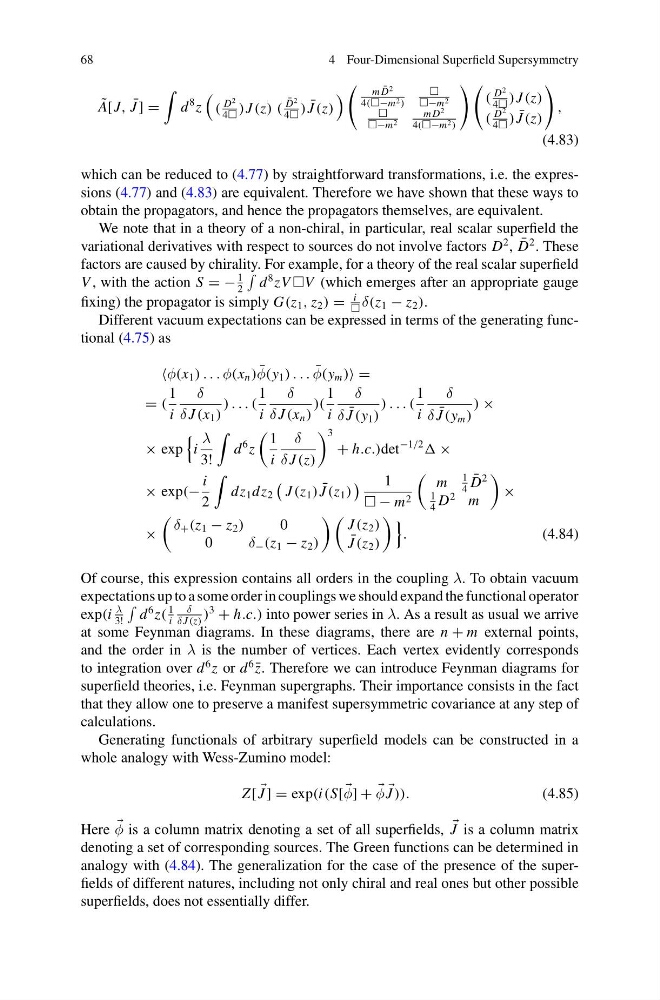
which can be reduced to (4.77) by straightforward transformations, i.e. the expressions (4.77) and (4.83) are equivalent. Therefore we have shown that these ways to
obtain the propagators, and hence the propagators themselves, are equivalent.
We note that in a theory of a non-chiral, in particular, real scalar superfield the
variational derivatives with respect to sources do not involve factors D
2 , ¯
D
2 . These
factors are caused by chirality. For example, for a theory of the real scalar superfield
V , with the action S = −
1
2
d
8 zV V (which emerges after an appropriate gauge
fixing) the propagator is simply G(z 1 , z 2 ) =
i
δ(z 1 − z 2 ).
Different vacuum expectations can be expressed in terms of the generating functional (4.75) as
φ(x 1 ) . . . φ(x n ) ¯
φ(y 1 ) . . . ¯
φ(y m ) =
= (
1
i
δ
δ J (x 1 )
) . . . (
1
i
δ
δ J (x n )
)(
1
i
δ
δ ¯
J (y 1 )
) . . . (
1
i
δ
δ ¯
J (y m )
) ×
× exp
i
λ
3!
d
6 z
1
i
δ
δ J (z)
3
+ h.c.)det
−1/2
×
× exp(−
i
2
dz 1 dz 2
J (z 1 ) ¯
J (z 1 )
1
− m 2
m
1
4
¯
D
2
1
4
D
2 m
×
×
δ + (z 1 − z 2 )
0
0
δ − (z 1 − z 2 )
J (z 2 )
¯
J (z 2 )
.
(4.84)
Of course, this expression contains all orders in the coupling λ. To obtain vacuum
expectations up to a some order in couplings we should expand the functional operator
exp(i
λ
3!
d
6 z(
1
i
δ
δ J (z)
)
3
+ h.c.) into power series in λ. As a result as usual we arrive
at some Feynman diagrams. In these diagrams, there are n + m external points,
and the order in λ is the number of vertices. Each vertex evidently corresponds
to integration over d
6 z or d
6
¯
z. Therefore we can introduce Feynman diagrams for
superfield theories, i.e. Feynman supergraphs. Their importance consists in the fact
that they allow one to preserve a manifest supersymmetric covariance at any step of
calculations.
Generating functionals of arbitrary superfield models can be constructed in a
whole analogy with Wess-Zumino model:
Z [
J ] = exp(i(S[
φ] +
φ
J )).
(4.85)
Here
φ is a column matrix denoting a set of all superfields,
J is a column matrix
denoting a set of corresponding sources. The Green functions can be determined in
analogy with (4.84). The generalization for the case of the presence of the superfields of different natures, including not only chiral and real ones but other possible
superfields, does not essentially differ.
4 Four-Dimensional Superfield Supersymmetry
˜
A[J, ¯
J ] =
d
8 z
(
D
2
4
)J (z) (
¯
D
2
4
) ¯
J (z)
m ¯
D
2
4(−m 2 )
−m 2
−m 2
m D
2
4(−m 2 )
(
D
2
4
)J (z)
(
¯
D
2
4
) ¯
J (z)
,
(4.83)
which can be reduced to (4.77) by straightforward transformations, i.e. the expressions (4.77) and (4.83) are equivalent. Therefore we have shown that these ways to
obtain the propagators, and hence the propagators themselves, are equivalent.
We note that in a theory of a non-chiral, in particular, real scalar superfield the
variational derivatives with respect to sources do not involve factors D
2 , ¯
D
2 . These
factors are caused by chirality. For example, for a theory of the real scalar superfield
V , with the action S = −
1
2
d
8 zV V (which emerges after an appropriate gauge
fixing) the propagator is simply G(z 1 , z 2 ) =
i
δ(z 1 − z 2 ).
Different vacuum expectations can be expressed in terms of the generating functional (4.75) as
φ(x 1 ) . . . φ(x n ) ¯
φ(y 1 ) . . . ¯
φ(y m ) =
= (
1
i
δ
δ J (x 1 )
) . . . (
1
i
δ
δ J (x n )
)(
1
i
δ
δ ¯
J (y 1 )
) . . . (
1
i
δ
δ ¯
J (y m )
) ×
× exp
i
λ
3!
d
6 z
1
i
δ
δ J (z)
3
+ h.c.)det
−1/2
×
× exp(−
i
2
dz 1 dz 2
J (z 1 ) ¯
J (z 1 )
1
− m 2
m
1
4
¯
D
2
1
4
D
2 m
×
×
δ + (z 1 − z 2 )
0
0
δ − (z 1 − z 2 )
J (z 2 )
¯
J (z 2 )
.
(4.84)
Of course, this expression contains all orders in the coupling λ. To obtain vacuum
expectations up to a some order in couplings we should expand the functional operator
exp(i
λ
3!
d
6 z(
1
i
δ
δ J (z)
)
3
+ h.c.) into power series in λ. As a result as usual we arrive
at some Feynman diagrams. In these diagrams, there are n + m external points,
and the order in λ is the number of vertices. Each vertex evidently corresponds
to integration over d
6 z or d
6
¯
z. Therefore we can introduce Feynman diagrams for
superfield theories, i.e. Feynman supergraphs. Their importance consists in the fact
that they allow one to preserve a manifest supersymmetric covariance at any step of
calculations.
Generating functionals of arbitrary superfield models can be constructed in a
whole analogy with Wess-Zumino model:
Z [
J ] = exp(i(S[
φ] +
φ
J )).
(4.85)
Here
φ is a column matrix denoting a set of all superfields,
J is a column matrix
denoting a set of corresponding sources. The Green functions can be determined in
analogy with (4.84). The generalization for the case of the presence of the superfields of different natures, including not only chiral and real ones but other possible
superfields, does not essentially differ.