

40
3 Superfield Description of Three-Dimensional Supersymmetric Theories
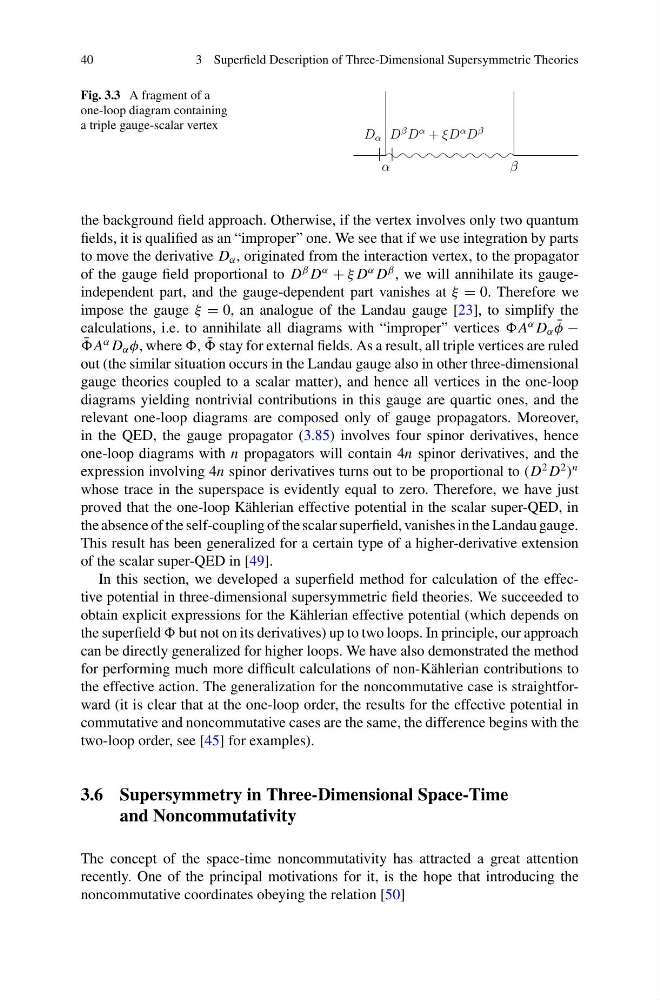
Fig. 3.3 A fragment of a
one-loop diagram containing
a triple gauge-scalar vertex
| |
D α D
β
D
α
+ ξD
α
D
β
α
β
the background field approach. Otherwise, if the vertex involves only two quantum
fields, it is qualified as an “improper” one. We see that if we use integration by parts
to move the derivative D α , originated from the interaction vertex, to the propagator
of the gauge field proportional to D
β D
α
+ ξ D
α D
β , we will annihilate its gaugeindependent part, and the gauge-dependent part vanishes at ξ = 0. Therefore we
impose the gauge ξ = 0, an analogue of the Landau gauge [23], to simplify the
calculations, i.e. to annihilate all diagrams with “improper” vertices
α D α ¯
φ −
¯
α D α φ, where ¯
stay for external fields. As a result, all triple vertices are ruled
out (the similar situation occurs in the Landau gauge also in other three-dimensional
gauge theories coupled to a scalar matter), and hence all vertices in the one-loop
diagrams yielding nontrivial contributions in this gauge are quartic ones, and the
relevant one-loop diagrams are composed only of gauge propagators. Moreover,
in the QED, the gauge propagator (3.85) involves four spinor derivatives, hence
one-loop diagrams with n propagators will contain 4n spinor derivatives, and the
expression involving 4n spinor derivatives turns out to be proportional to (D
2 D
2
)
n
whose trace in the superspace is evidently equal to zero. Therefore, we have just
proved that the one-loop Kählerian effective potential in the scalar super-QED, in
the absence of the self-coupling of the scalar superfield, vanishes in the Landau gauge.
This result has been generalized for a certain type of a higher-derivative extension
of the scalar super-QED in [49].
In this section, we developed a superfield method for calculation of the effective potential in three-dimensional supersymmetric field theories. We succeeded to
obtain explicit expressions for the Kählerian effective potential (which depends on
the superfield but not on its derivatives) up to two loops. In principle, our approach
can be directly generalized for higher loops. We have also demonstrated the method
for performing much more difficult calculations of non-Kählerian contributions to
the effective action. The generalization for the noncommutative case is straightforward (it is clear that at the one-loop order, the results for the effective potential in
commutative and noncommutative cases are the same, the difference begins with the
two-loop order, see [45] for examples).
3.6 Supersymmetry in Three-Dimensional Space-Time
and Noncommutativity
The concept of the space-time noncommutativity has attracted a great attention
recently. One of the principal motivations for it, is the hope that introducing the
noncommutative coordinates obeying the relation [50]
3 Superfield Description of Three-Dimensional Supersymmetric Theories
Fig. 3.3 A fragment of a
one-loop diagram containing
a triple gauge-scalar vertex
| |
D α D
β
D
α
+ ξD
α
D
β
α
β
the background field approach. Otherwise, if the vertex involves only two quantum
fields, it is qualified as an “improper” one. We see that if we use integration by parts
to move the derivative D α , originated from the interaction vertex, to the propagator
of the gauge field proportional to D
β D
α
+ ξ D
α D
β , we will annihilate its gaugeindependent part, and the gauge-dependent part vanishes at ξ = 0. Therefore we
impose the gauge ξ = 0, an analogue of the Landau gauge [23], to simplify the
calculations, i.e. to annihilate all diagrams with “improper” vertices
α D α ¯
φ −
¯
α D α φ, where ¯
stay for external fields. As a result, all triple vertices are ruled
out (the similar situation occurs in the Landau gauge also in other three-dimensional
gauge theories coupled to a scalar matter), and hence all vertices in the one-loop
diagrams yielding nontrivial contributions in this gauge are quartic ones, and the
relevant one-loop diagrams are composed only of gauge propagators. Moreover,
in the QED, the gauge propagator (3.85) involves four spinor derivatives, hence
one-loop diagrams with n propagators will contain 4n spinor derivatives, and the
expression involving 4n spinor derivatives turns out to be proportional to (D
2 D
2
)
n
whose trace in the superspace is evidently equal to zero. Therefore, we have just
proved that the one-loop Kählerian effective potential in the scalar super-QED, in
the absence of the self-coupling of the scalar superfield, vanishes in the Landau gauge.
This result has been generalized for a certain type of a higher-derivative extension
of the scalar super-QED in [49].
In this section, we developed a superfield method for calculation of the effective potential in three-dimensional supersymmetric field theories. We succeeded to
obtain explicit expressions for the Kählerian effective potential (which depends on
the superfield but not on its derivatives) up to two loops. In principle, our approach
can be directly generalized for higher loops. We have also demonstrated the method
for performing much more difficult calculations of non-Kählerian contributions to
the effective action. The generalization for the noncommutative case is straightforward (it is clear that at the one-loop order, the results for the effective potential in
commutative and noncommutative cases are the same, the difference begins with the
two-loop order, see [45] for examples).
3.6 Supersymmetry in Three-Dimensional Space-Time
and Noncommutativity
The concept of the space-time noncommutativity has attracted a great attention
recently. One of the principal motivations for it, is the hope that introducing the
noncommutative coordinates obeying the relation [50]