

3.2 Field Theory Models
23
This action can be treated as a gauge-fixed Chern-Simons theory, with a Proca mass
term. However, the theory (3.58), up to now, has been discussed only within the
duality context [40].
3.3 Non-Abelian Gauge Models
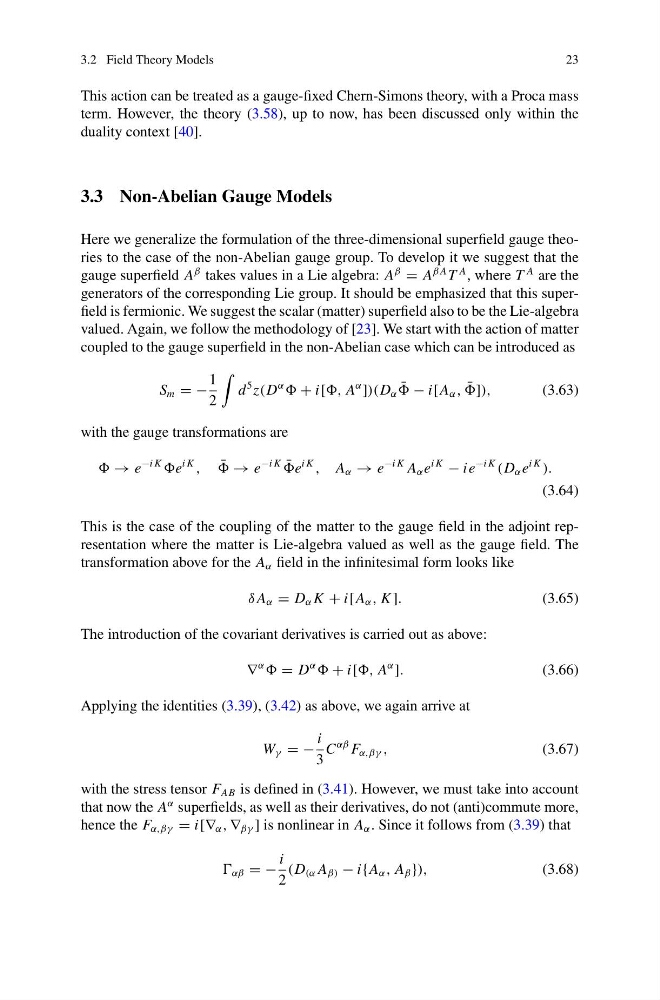
Here we generalize the formulation of the three-dimensional superfield gauge theories to the case of the non-Abelian gauge group. To develop it we suggest that the
gauge superfield A
β takes values in a Lie algebra: A
β
= A
β A T
A , where T
A are the
generators of the corresponding Lie group. It should be emphasized that this superfield is fermionic. We suggest the scalar (matter) superfield also to be the Lie-algebra
valued. Again, we follow the methodology of [23]. We start with the action of matter
coupled to the gauge superfield in the non-Abelian case which can be introduced as
S m = −
1
2
d
5 z(D
α
+ i[, A
α
])(D α ¯
− i[A α , ¯
]),
(3.63)
with the gauge transformations are
→ e
−i K
e
i K
, ¯
→ e
−i K ¯
e
i K
, A α → e
−i K A α e
i K
− ie
−i K
(D α e
i K
).
(3.64)
This is the case of the coupling of the matter to the gauge field in the adjoint representation where the matter is Lie-algebra valued as well as the gauge field. The
transformation above for the A α field in the infinitesimal form looks like
δ A α = D α K + i[A α , K ].
(3.65)
The introduction of the covariant derivatives is carried out as above:
∇
α
= D
α
+ i[, A
α
].
(3.66)
Applying the identities (3.39), (3.42) as above, we again arrive at
W γ = −
i
3
C
αβ F α,βγ ,
(3.67)
with the stress tensor F AB is defined in (3.41). However, we must take into account
that now the A
α superfields, as well as their derivatives, do not (anti)commute more,
hence the F α,βγ = i[∇ α , ∇ βγ ] is nonlinear in A α . Since it follows from (3.39) that
αβ = −
i
2
(D (α A β) − i{A α , A β }),
(3.68)
23
This action can be treated as a gauge-fixed Chern-Simons theory, with a Proca mass
term. However, the theory (3.58), up to now, has been discussed only within the
duality context [40].
3.3 Non-Abelian Gauge Models
Here we generalize the formulation of the three-dimensional superfield gauge theories to the case of the non-Abelian gauge group. To develop it we suggest that the
gauge superfield A
β takes values in a Lie algebra: A
β
= A
β A T
A , where T
A are the
generators of the corresponding Lie group. It should be emphasized that this superfield is fermionic. We suggest the scalar (matter) superfield also to be the Lie-algebra
valued. Again, we follow the methodology of [23]. We start with the action of matter
coupled to the gauge superfield in the non-Abelian case which can be introduced as
S m = −
1
2
d
5 z(D
α
+ i[, A
α
])(D α ¯
− i[A α , ¯
]),
(3.63)
with the gauge transformations are
→ e
−i K
e
i K
, ¯
→ e
−i K ¯
e
i K
, A α → e
−i K A α e
i K
− ie
−i K
(D α e
i K
).
(3.64)
This is the case of the coupling of the matter to the gauge field in the adjoint representation where the matter is Lie-algebra valued as well as the gauge field. The
transformation above for the A α field in the infinitesimal form looks like
δ A α = D α K + i[A α , K ].
(3.65)
The introduction of the covariant derivatives is carried out as above:
∇
α
= D
α
+ i[, A
α
].
(3.66)
Applying the identities (3.39), (3.42) as above, we again arrive at
W γ = −
i
3
C
αβ F α,βγ ,
(3.67)
with the stress tensor F AB is defined in (3.41). However, we must take into account
that now the A
α superfields, as well as their derivatives, do not (anti)commute more,
hence the F α,βγ = i[∇ α , ∇ βγ ] is nonlinear in A α . Since it follows from (3.39) that
αβ = −
i
2
(D (α A β) − i{A α , A β }),
(3.68)