

8
2 Effective Action and Loop Expansion: General Formulation
Dφ exp(
i
2
S
[]φ
2
) = Det
−1/2 S
[],
(2.9)
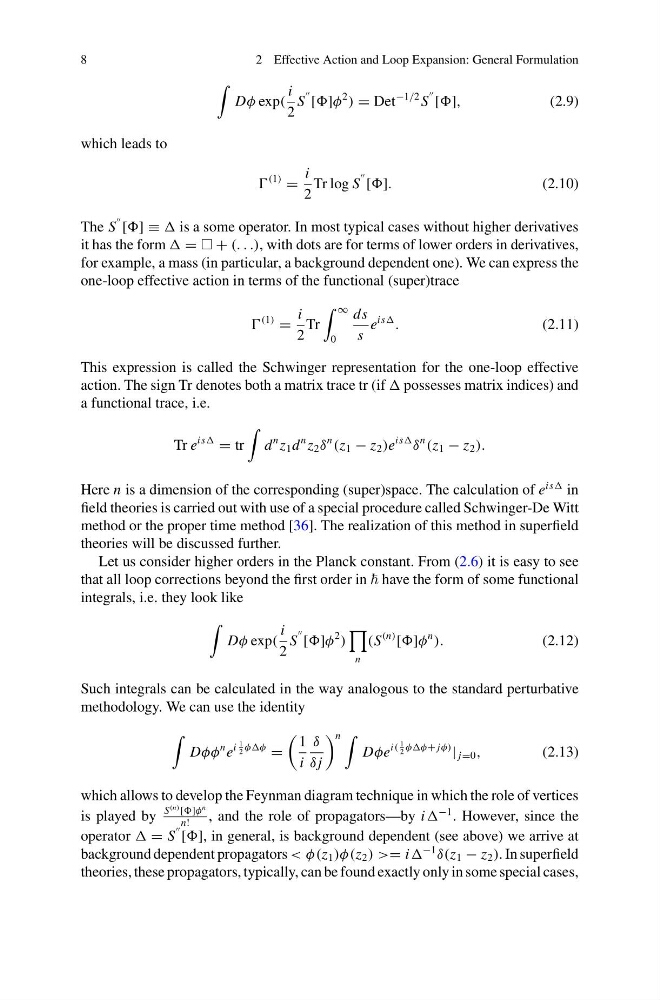
which leads to
(1)
=
i
2
Tr log S
[].
(2.10)
The S
[] ≡ is a some operator. In most typical cases without higher derivatives
it has the form = + (. . .), with dots are for terms of lower orders in derivatives,
for example, a mass (in particular, a background dependent one). We can express the
one-loop effective action in terms of the functional (super)trace
(1)
=
i
2
Tr
∞
0
ds
s
e
is
.
(2.11)
This expression is called the Schwinger representation for the one-loop effective
action. The sign Tr denotes both a matrix trace tr (if possesses matrix indices) and
a functional trace, i.e.
Tr e
is
= tr
d
n z 1 d
n z 2 δ
n
(z 1 − z 2 )e
is
δ
n
(z 1 − z 2 ).
Here n is a dimension of the corresponding (super)space. The calculation of e
is in
field theories is carried out with use of a special procedure called Schwinger-De Witt
method or the proper time method [36]. The realization of this method in superfield
theories will be discussed further.
Let us consider higher orders in the Planck constant. From (2.6) it is easy to see
that all loop corrections beyond the first order in have the form of some functional
integrals, i.e. they look like
Dφ exp(
i
2
S
[]φ
2
)
n
(S
(n)
[]φ
n
).
(2.12)
Such integrals can be calculated in the way analogous to the standard perturbative
methodology. We can use the identity
Dφφ
n e
i
1
2 φφφ
=
1
i
δ
δ j
n
Dφe
i(
1
2 φφφ+ jφ)
| j=0 ,
(2.13)
which allows to develop the Feynman diagram technique in which the role of vertices
is played by
S
(n) []φ
n
n!
, and the role of propagators—by i
−1 . However, since the
operator = S
[], in general, is background dependent (see above) we arrive at
background dependent propagators < φ(z 1 )φ(z 2 ) >= i
−1
δ(z 1 − z 2 ). In superfield
theories, these propagators, typically, can be found exactly only in some special cases,
2 Effective Action and Loop Expansion: General Formulation
Dφ exp(
i
2
S
[]φ
2
) = Det
−1/2 S
[],
(2.9)
which leads to
(1)
=
i
2
Tr log S
[].
(2.10)
The S
[] ≡ is a some operator. In most typical cases without higher derivatives
it has the form = + (. . .), with dots are for terms of lower orders in derivatives,
for example, a mass (in particular, a background dependent one). We can express the
one-loop effective action in terms of the functional (super)trace
(1)
=
i
2
Tr
∞
0
ds
s
e
is
.
(2.11)
This expression is called the Schwinger representation for the one-loop effective
action. The sign Tr denotes both a matrix trace tr (if possesses matrix indices) and
a functional trace, i.e.
Tr e
is
= tr
d
n z 1 d
n z 2 δ
n
(z 1 − z 2 )e
is
δ
n
(z 1 − z 2 ).
Here n is a dimension of the corresponding (super)space. The calculation of e
is in
field theories is carried out with use of a special procedure called Schwinger-De Witt
method or the proper time method [36]. The realization of this method in superfield
theories will be discussed further.
Let us consider higher orders in the Planck constant. From (2.6) it is easy to see
that all loop corrections beyond the first order in have the form of some functional
integrals, i.e. they look like
Dφ exp(
i
2
S
[]φ
2
)
n
(S
(n)
[]φ
n
).
(2.12)
Such integrals can be calculated in the way analogous to the standard perturbative
methodology. We can use the identity
Dφφ
n e
i
1
2 φφφ
=
1
i
δ
δ j
n
Dφe
i(
1
2 φφφ+ jφ)
| j=0 ,
(2.13)
which allows to develop the Feynman diagram technique in which the role of vertices
is played by
S
(n) []φ
n
n!
, and the role of propagators—by i
−1 . However, since the
operator = S
[], in general, is background dependent (see above) we arrive at
background dependent propagators < φ(z 1 )φ(z 2 ) >= i
−1
δ(z 1 − z 2 ). In superfield
theories, these propagators, typically, can be found exactly only in some special cases,