

4.11 Supergauge Theories
133
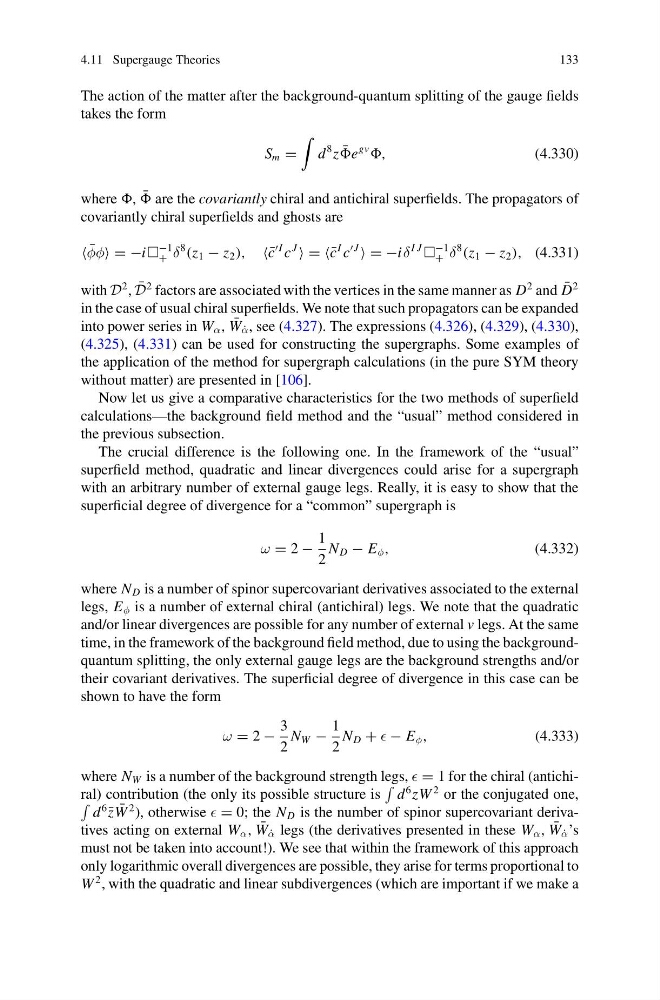
The action of the matter after the background-quantum splitting of the gauge fields
takes the form
S m =
d
8 z ¯
e
gv
,
(4.330)
where , ¯
are the covariantly chiral and antichiral superfields. The propagators of
covariantly chiral superfields and ghosts are
¯
φφ = −i
−1
+ δ
8
(z 1 − z 2 ), ¯
c
I c
J
= =¯ c
I c
J
= −iδ
I J
−1
+ δ
8
(z 1 − z 2 ), (4.331)
with D
2 , ¯
D
2 factors are associated with the vertices in the same manner as D
2 and ¯
D
2
in the case of usual chiral superfields. We note that such propagators can be expanded
into power series in W α , ¯
W ˙
α , see (4.327). The expressions (4.326), (4.329), (4.330),
(4.325), (4.331) can be used for constructing the supergraphs. Some examples of
the application of the method for supergraph calculations (in the pure SYM theory
without matter) are presented in [106].
Now let us give a comparative characteristics for the two methods of superfield
calculations—the background field method and the “usual” method considered in
the previous subsection.
The crucial difference is the following one. In the framework of the “usual”
superfield method, quadratic and linear divergences could arise for a supergraph
with an arbitrary number of external gauge legs. Really, it is easy to show that the
superficial degree of divergence for a “common” supergraph is
ω = 2 −
1
2
N D − E φ ,
(4.332)
where N D is a number of spinor supercovariant derivatives associated to the external
legs, E φ is a number of external chiral (antichiral) legs. We note that the quadratic
and/or linear divergences are possible for any number of external v legs. At the same
time, in the framework of the background field method, due to using the backgroundquantum splitting, the only external gauge legs are the background strengths and/or
their covariant derivatives. The superficial degree of divergence in this case can be
shown to have the form
ω = 2 −
3
2
N W −
1
2
N D + − E φ ,
(4.333)
where N W is a number of the background strength legs, = 1 for the chiral (antichiral) contribution (the only its possible structure is
d
6 zW
2 or the conjugated one,
d
6
¯
z ¯
W
2 ), otherwise = 0; the N D is the number of spinor supercovariant derivatives acting on external W α , ¯
W ˙
α legs (the derivatives presented in these W α , ¯
W ˙
α ’s
must not be taken into account!). We see that within the framework of this approach
only logarithmic overall divergences are possible, they arise for terms proportional to
W
2 , with the quadratic and linear subdivergences (which are important if we make a
133
The action of the matter after the background-quantum splitting of the gauge fields
takes the form
S m =
d
8 z ¯
e
gv
,
(4.330)
where , ¯
are the covariantly chiral and antichiral superfields. The propagators of
covariantly chiral superfields and ghosts are
¯
φφ = −i
−1
+ δ
8
(z 1 − z 2 ), ¯
c
I c
J
= =¯ c
I c
J
= −iδ
I J
−1
+ δ
8
(z 1 − z 2 ), (4.331)
with D
2 , ¯
D
2 factors are associated with the vertices in the same manner as D
2 and ¯
D
2
in the case of usual chiral superfields. We note that such propagators can be expanded
into power series in W α , ¯
W ˙
α , see (4.327). The expressions (4.326), (4.329), (4.330),
(4.325), (4.331) can be used for constructing the supergraphs. Some examples of
the application of the method for supergraph calculations (in the pure SYM theory
without matter) are presented in [106].
Now let us give a comparative characteristics for the two methods of superfield
calculations—the background field method and the “usual” method considered in
the previous subsection.
The crucial difference is the following one. In the framework of the “usual”
superfield method, quadratic and linear divergences could arise for a supergraph
with an arbitrary number of external gauge legs. Really, it is easy to show that the
superficial degree of divergence for a “common” supergraph is
ω = 2 −
1
2
N D − E φ ,
(4.332)
where N D is a number of spinor supercovariant derivatives associated to the external
legs, E φ is a number of external chiral (antichiral) legs. We note that the quadratic
and/or linear divergences are possible for any number of external v legs. At the same
time, in the framework of the background field method, due to using the backgroundquantum splitting, the only external gauge legs are the background strengths and/or
their covariant derivatives. The superficial degree of divergence in this case can be
shown to have the form
ω = 2 −
3
2
N W −
1
2
N D + − E φ ,
(4.333)
where N W is a number of the background strength legs, = 1 for the chiral (antichiral) contribution (the only its possible structure is
d
6 zW
2 or the conjugated one,
d
6
¯
z ¯
W
2 ), otherwise = 0; the N D is the number of spinor supercovariant derivatives acting on external W α , ¯
W ˙
α legs (the derivatives presented in these W α , ¯
W ˙
α ’s
must not be taken into account!). We see that within the framework of this approach
only logarithmic overall divergences are possible, they arise for terms proportional to
W
2 , with the quadratic and linear subdivergences (which are important if we make a