

130
4 Four-Dimensional Superfield Supersymmetry
Here the v is a quantum field, the , ¯
are the background superfields (they are not
required to be chiral/antichiral ones, the only restriction is e
g e
g ¯
= e
gV , with V is
now a background gauge field, so, in principle one can have = ¯
, or e.g. = 0).
After such a background-quantum splitting (unfortunately, the complete proof of this
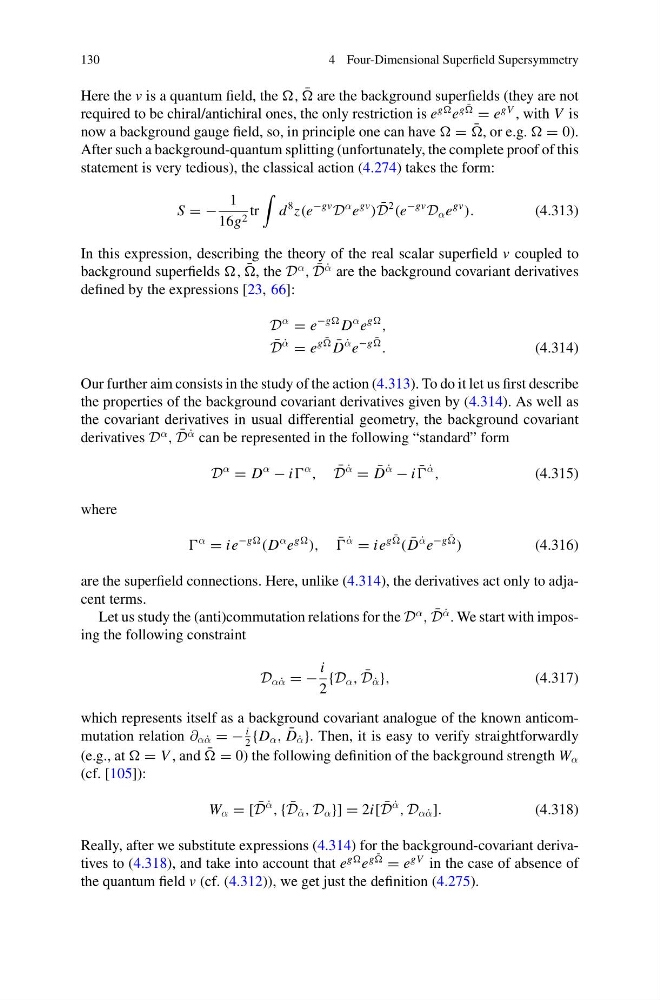
statement is very tedious), the classical action (4.274) takes the form:
S = −
1
16g 2 tr
d
8 z(e
−gv
D
α e
gv
) ¯
D
2
(e
−gv
D α e
gv
).
(4.313)
In this expression, describing the theory of the real scalar superfield v coupled to
background superfields , ¯
, the D
α
, ¯
D
˙
α are the background covariant derivatives
defined by the expressions [23, 66]:
D
α
= e
−g D
α e
g
,
¯
D
˙
α
= e
g ¯
¯
D
˙
α e
−g ¯
.
(4.314)
Our further aim consists in the study of the action (4.313). To do it let us first describe
the properties of the background covariant derivatives given by (4.314). As well as
the covariant derivatives in usual differential geometry, the background covariant
derivatives D
α
, ¯
D
˙
α can be represented in the following “standard” form
D
α
= D
α
− i
α
, ¯
D
˙
α
= ¯
D
˙
α
− i ¯
˙
α
,
(4.315)
where
α
= ie
−g
(D
α e
g
), ¯
˙
α
= ie
g ¯
( ¯
D
˙
α e
−g ¯
)
(4.316)
are the superfield connections. Here, unlike (4.314), the derivatives act only to adjacent terms.
Let us study the (anti)commutation relations for the D
α
, ¯
D
˙
α . We start with imposing the following constraint
D α ˙
α = −
i
2
{D α , ¯
D ˙
α },
(4.317)
which represents itself as a background covariant analogue of the known anticommutation relation ∂ α ˙
α = −
i
2
{D α , ¯
D ˙
α }. Then, it is easy to verify straightforwardly
(e.g., at = V , and ¯
= 0) the following definition of the background strength W α
(cf. [105]):
W α = [ ¯
D
˙
α
, { ¯
D ˙
α , D α }] = 2i[ ¯
D
˙
α
, D α ˙
α ].
(4.318)
Really, after we substitute expressions (4.314) for the background-covariant derivatives to (4.318), and take into account that e
g e
g ¯
= e
gV in the case of absence of
the quantum field v (cf. (4.312)), we get just the definition (4.275).
4 Four-Dimensional Superfield Supersymmetry
Here the v is a quantum field, the , ¯
are the background superfields (they are not
required to be chiral/antichiral ones, the only restriction is e
g e
g ¯
= e
gV , with V is
now a background gauge field, so, in principle one can have = ¯
, or e.g. = 0).
After such a background-quantum splitting (unfortunately, the complete proof of this
statement is very tedious), the classical action (4.274) takes the form:
S = −
1
16g 2 tr
d
8 z(e
−gv
D
α e
gv
) ¯
D
2
(e
−gv
D α e
gv
).
(4.313)
In this expression, describing the theory of the real scalar superfield v coupled to
background superfields , ¯
, the D
α
, ¯
D
˙
α are the background covariant derivatives
defined by the expressions [23, 66]:
D
α
= e
−g D
α e
g
,
¯
D
˙
α
= e
g ¯
¯
D
˙
α e
−g ¯
.
(4.314)
Our further aim consists in the study of the action (4.313). To do it let us first describe
the properties of the background covariant derivatives given by (4.314). As well as
the covariant derivatives in usual differential geometry, the background covariant
derivatives D
α
, ¯
D
˙
α can be represented in the following “standard” form
D
α
= D
α
− i
α
, ¯
D
˙
α
= ¯
D
˙
α
− i ¯
˙
α
,
(4.315)
where
α
= ie
−g
(D
α e
g
), ¯
˙
α
= ie
g ¯
( ¯
D
˙
α e
−g ¯
)
(4.316)
are the superfield connections. Here, unlike (4.314), the derivatives act only to adjacent terms.
Let us study the (anti)commutation relations for the D
α
, ¯
D
˙
α . We start with imposing the following constraint
D α ˙
α = −
i
2
{D α , ¯
D ˙
α },
(4.317)
which represents itself as a background covariant analogue of the known anticommutation relation ∂ α ˙
α = −
i
2
{D α , ¯
D ˙
α }. Then, it is easy to verify straightforwardly
(e.g., at = V , and ¯
= 0) the following definition of the background strength W α
(cf. [105]):
W α = [ ¯
D
˙
α
, { ¯
D ˙
α , D α }] = 2i[ ¯
D
˙
α
, D α ˙
α ].
(4.318)
Really, after we substitute expressions (4.314) for the background-covariant derivatives to (4.318), and take into account that e
g e
g ¯
= e
gV in the case of absence of
the quantum field v (cf. (4.312)), we get just the definition (4.275).