

6
2 Effective Action and Loop Expansion: General Formulation
δδ[]
δδ(x)
= −J (x).
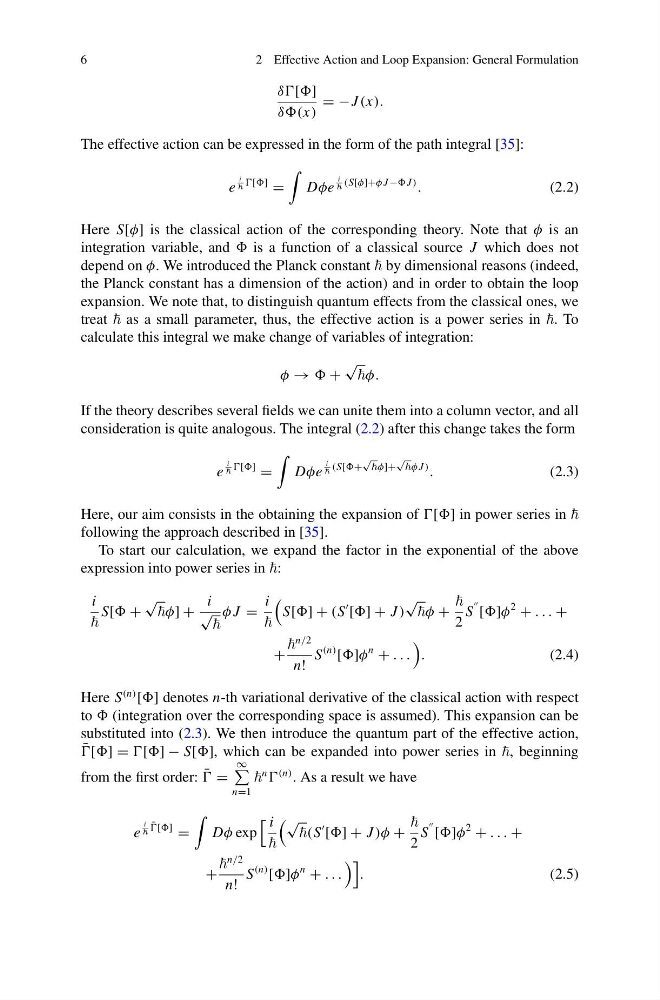
The effective action can be expressed in the form of the path integral [35]:
e
i
[]
=
Dφe
i
(S[φ]+φ J −J )
.
(2.2)
Here S[φ] is the classical action of the corresponding theory. Note that φ is an
integration variable, and is a function of a classical source J which does not
depend on φ. We introduced the Planck constant by dimensional reasons (indeed,
the Planck constant has a dimension of the action) and in order to obtain the loop
expansion. We note that, to distinguish quantum effects from the classical ones, we
treat as a small parameter, thus, the effective action is a power series in . To
calculate this integral we make change of variables of integration:
φ → +
√ φ.
If the theory describes several fields we can unite them into a column vector, and all
consideration is quite analogous. The integral (2.2) after this change takes the form
e
i
[]
=
Dφe
i
(S[+
√ φ]+
√ φ J )
.
(2.3)
Here, our aim consists in the obtaining the expansion of [] in power series in
following the approach described in [35].
To start our calculation, we expand the factor in the exponential of the above
expression into power series in :
i
S[ +
√ φ] +
i
√
φ J =
i
S[] + (S
[] + J )
√ φ +
2
S
[]φ
2
+ . . . +
+
n/2
n!
S
(n)
[]φ
n
+ . . .
.
(2.4)
Here S
(n)
[] denotes n-th variational derivative of the classical action with respect
to (integration over the corresponding space is assumed). This expansion can be
substituted into (2.3). We then introduce the quantum part of the effective action,
¯
[] = [] − S[], which can be expanded into power series in , beginning
from the first order: ¯
=
∞
n=1
n
(n) . As a result we have
e
i
¯
[]
=
Dφ exp
i
√
(S
[] + J )φ +
2
S
[]φ
2
+ . . . +
+
n/2
n!
S
(n)
[]φ
n
+ . . .
.
(2.5)
2 Effective Action and Loop Expansion: General Formulation
δδ[]
δδ(x)
= −J (x).
The effective action can be expressed in the form of the path integral [35]:
e
i
[]
=
Dφe
i
(S[φ]+φ J −J )
.
(2.2)
Here S[φ] is the classical action of the corresponding theory. Note that φ is an
integration variable, and is a function of a classical source J which does not
depend on φ. We introduced the Planck constant by dimensional reasons (indeed,
the Planck constant has a dimension of the action) and in order to obtain the loop
expansion. We note that, to distinguish quantum effects from the classical ones, we
treat as a small parameter, thus, the effective action is a power series in . To
calculate this integral we make change of variables of integration:
φ → +
√ φ.
If the theory describes several fields we can unite them into a column vector, and all
consideration is quite analogous. The integral (2.2) after this change takes the form
e
i
[]
=
Dφe
i
(S[+
√ φ]+
√ φ J )
.
(2.3)
Here, our aim consists in the obtaining the expansion of [] in power series in
following the approach described in [35].
To start our calculation, we expand the factor in the exponential of the above
expression into power series in :
i
S[ +
√ φ] +
i
√
φ J =
i
S[] + (S
[] + J )
√ φ +
2
S
[]φ
2
+ . . . +
+
n/2
n!
S
(n)
[]φ
n
+ . . .
.
(2.4)
Here S
(n)
[] denotes n-th variational derivative of the classical action with respect
to (integration over the corresponding space is assumed). This expansion can be
substituted into (2.3). We then introduce the quantum part of the effective action,
¯
[] = [] − S[], which can be expanded into power series in , beginning
from the first order: ¯
=
∞
n=1
n
(n) . As a result we have
e
i
¯
[]
=
Dφ exp
i
√
(S
[] + J )φ +
2
S
[]φ
2
+ . . . +
+
n/2
n!
S
(n)
[]φ
n
+ . . .
.
(2.5)