

120
4 Four-Dimensional Superfield Supersymmetry
K
(1)
=
1
32π 2
¯
M 4
∞
n=0
∞
¯
L 2
M 4
du
u
(−1)
n u
n
(n + 1)!
(2n + 2)!
.
(4.267)
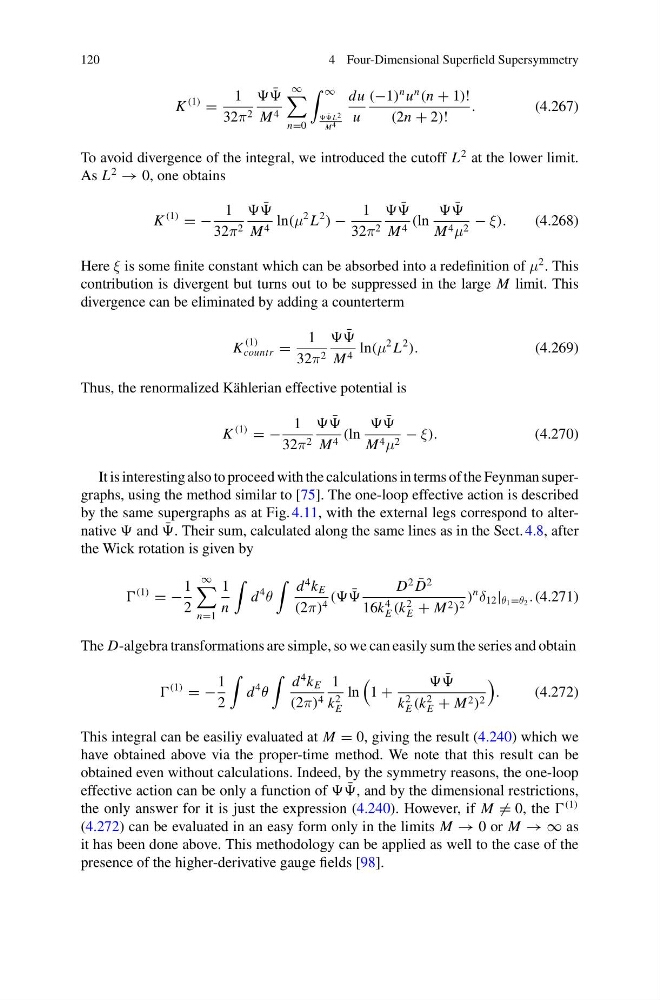
To avoid divergence of the integral, we introduced the cutoff L
2 at the lower limit.
As L
2
→ 0, one obtains
K
(1)
= −
1
32π 2
¯
M 4 ln(μ
2 L
2
) −
1
32π 2
¯
M 4 (ln
¯
M 4 μ 2 − ξ).
(4.268)
Here ξ is some finite constant which can be absorbed into a redefinition of μ
2 . This
contribution is divergent but turns out to be suppressed in the large M limit. This
divergence can be eliminated by adding a counterterm
K
(1)
countr =
1
32π 2
¯
M 4 ln(μ
2 L
2
).
(4.269)
Thus, the renormalized Kählerian effective potential is
K
(1)
= −
1
32π 2
¯
M 4 (ln
¯
M 4 μ 2 − ξ).
(4.270)
It is interesting also to proceed with the calculations in terms of the Feynman supergraphs, using the method similar to [75]. The one-loop effective action is described
by the same supergraphs as at Fig. 4.11, with the external legs correspond to alternative and ¯
. Their sum, calculated along the same lines as in the Sect. 4.8, after
the Wick rotation is given by
(1)
= −
1
2
∞
n=1
1
n
d
4
θ
d
4 k E
(2π) 4 (( ¯
D
2 ¯
D
2
16k
4
E (k
2
E + M 2 ) 2 )
n
δ 12 | θ 1 =θ 2 . (4.271)
The D-algebra transformations are simple, so we can easily sum the series and obtain
(1)
= −
1
2
d
4
θ
d
4 k E
(2π) 4
1
k
2
E
ln
1 +
¯
k
2
E (k
2
E + M 2 ) 2
.
(4.272)
This integral can be easiliy evaluated at M = 0, giving the result (4.240) which we
have obtained above via the proper-time method. We note that this result can be
obtained even without calculations. Indeed, by the symmetry reasons, the one-loop
effective action can be only a function of ¯
, and by the dimensional restrictions,
the only answer for it is just the expression (4.240). However, if M = 0, the
(1)
(4.272) can be evaluated in an easy form only in the limits M → 0 or M → ∞ as
it has been done above. This methodology can be applied as well to the case of the
presence of the higher-derivative gauge fields [98].
4 Four-Dimensional Superfield Supersymmetry
K
(1)
=
1
32π 2
¯
M 4
∞
n=0
∞
¯
L 2
M 4
du
u
(−1)
n u
n
(n + 1)!
(2n + 2)!
.
(4.267)
To avoid divergence of the integral, we introduced the cutoff L
2 at the lower limit.
As L
2
→ 0, one obtains
K
(1)
= −
1
32π 2
¯
M 4 ln(μ
2 L
2
) −
1
32π 2
¯
M 4 (ln
¯
M 4 μ 2 − ξ).
(4.268)
Here ξ is some finite constant which can be absorbed into a redefinition of μ
2 . This
contribution is divergent but turns out to be suppressed in the large M limit. This
divergence can be eliminated by adding a counterterm
K
(1)
countr =
1
32π 2
¯
M 4 ln(μ
2 L
2
).
(4.269)
Thus, the renormalized Kählerian effective potential is
K
(1)
= −
1
32π 2
¯
M 4 (ln
¯
M 4 μ 2 − ξ).
(4.270)
It is interesting also to proceed with the calculations in terms of the Feynman supergraphs, using the method similar to [75]. The one-loop effective action is described
by the same supergraphs as at Fig. 4.11, with the external legs correspond to alternative and ¯
. Their sum, calculated along the same lines as in the Sect. 4.8, after
the Wick rotation is given by
(1)
= −
1
2
∞
n=1
1
n
d
4
θ
d
4 k E
(2π) 4 (( ¯
D
2 ¯
D
2
16k
4
E (k
2
E + M 2 ) 2 )
n
δ 12 | θ 1 =θ 2 . (4.271)
The D-algebra transformations are simple, so we can easily sum the series and obtain
(1)
= −
1
2
d
4
θ
d
4 k E
(2π) 4
1
k
2
E
ln
1 +
¯
k
2
E (k
2
E + M 2 ) 2
.
(4.272)
This integral can be easiliy evaluated at M = 0, giving the result (4.240) which we
have obtained above via the proper-time method. We note that this result can be
obtained even without calculations. Indeed, by the symmetry reasons, the one-loop
effective action can be only a function of ¯
, and by the dimensional restrictions,
the only answer for it is just the expression (4.240). However, if M = 0, the
(1)
(4.272) can be evaluated in an easy form only in the limits M → 0 or M → ∞ as
it has been done above. This methodology can be applied as well to the case of the
presence of the higher-derivative gauge fields [98].