

4.9 General Chiral Superfield Model
107
K
(1)
= −
1
32π 2 tr
W
¯
W
K
2
¯
ln
W
¯
W
μ 2 K
2
¯
,
(4.211)
where tr denotes trace of product of the given matrices. This form is more convenient
for the analysis of a many-field generalization of our model than that one given in [62,
82], it is evident that this result reduces to the known expression for the Wess-Zumino
model (4.180), for the choice W
= λ
Let us consider the chiral (holomorphic) effective potential W e f f ((). The mechanism of its arising is just the same than in Wess-Zumino model. We note again that the
chiral contributions to effective action can be generated by supergraphs containing
massless propagators only. To find such corrections to effective action we put ¯
= 0
in Eq. (4.206). Therefore here and further all derivatives of K , W and ¯
W in (4.206)
will be taken at ¯
= 0. We refer to the theory as to the massless one if W
| = 0.
Further we consider only a massless theory and follow [83].
To construct supergraphs which yield chiral contributions one splits the action
(4.206) into sum of the free part and vertices of interaction. As a free part we take the
action S 0 =
d
8 zK ¯
φ ¯
φ. And the term S[ ¯
φ, φ, ,] − S 0 will be treated as vertices
where S[ ¯
φ, φ, ,] is given by Eq. (4.206). Our purpose is to find the first leading
contribution to W e f f ((). The straightforward inspection shows that there is no oneloop contributions to the chiral effective potential, just as in the Wess-Zumino model.
As we will show, in a whole analogy with it, chiral contributions in our theory begin at
two loops. Therefore we keep in Eq. (4.206) only the terms of second, third and fourth
orders in quantum fields which are sufficient in the two-loop approximation. Also,
the vertex K φ
2 evidently yields zero contribution to the chiral effective potential.
As for vertices K ¯
¯
¯
φ
2 , they cannot contribute to the chiral effective potential as it
follows from a straightforward calculation of numbers of quantum fields φ, ¯
φ (which
should be equal) and D-factors [83].
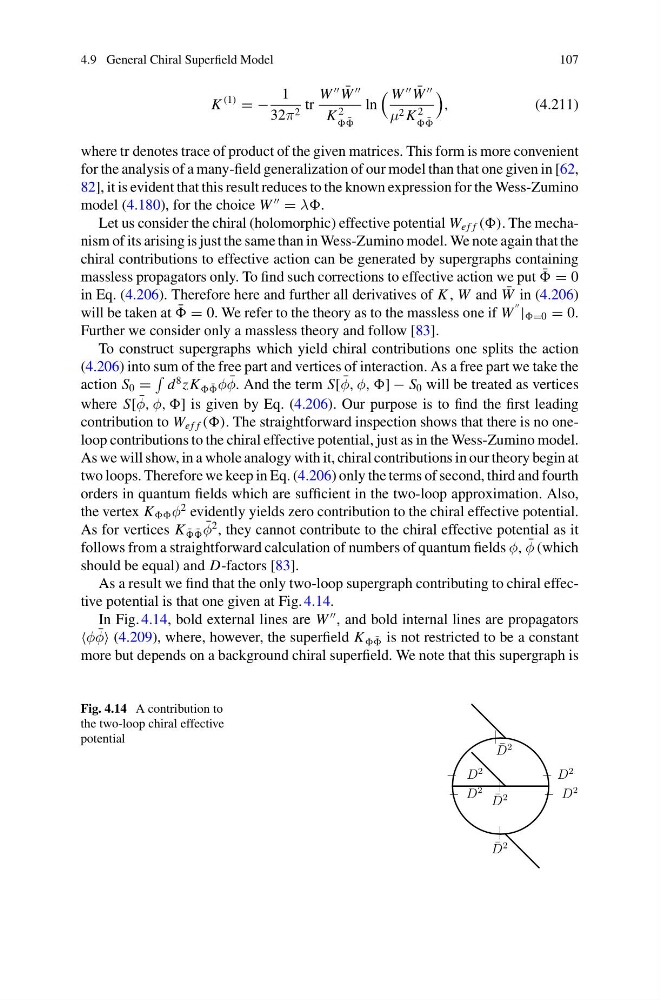
As a result we find that the only two-loop supergraph contributing to chiral effective potential is that one given at Fig. 4.14.
In Fig. 4.14, bold external lines are W
, and bold internal lines are propagators
¯
φ (4.209), where, however, the superfield K ¯
is not restricted to be a constant
more but depends on a background chiral superfield. We note that this supergraph is
Fig. 4.14 A contribution to
the two-loop chiral effective
potential
|
¯
D
2
|
|
¯
D
2
¯
D
2
D
2
D
2
D
2
D
2
−
−
−
−
107
K
(1)
= −
1
32π 2 tr
W
¯
W
K
2
¯
ln
W
¯
W
μ 2 K
2
¯
,
(4.211)
where tr denotes trace of product of the given matrices. This form is more convenient
for the analysis of a many-field generalization of our model than that one given in [62,
82], it is evident that this result reduces to the known expression for the Wess-Zumino
model (4.180), for the choice W
= λ
Let us consider the chiral (holomorphic) effective potential W e f f ((). The mechanism of its arising is just the same than in Wess-Zumino model. We note again that the
chiral contributions to effective action can be generated by supergraphs containing
massless propagators only. To find such corrections to effective action we put ¯
= 0
in Eq. (4.206). Therefore here and further all derivatives of K , W and ¯
W in (4.206)
will be taken at ¯
= 0. We refer to the theory as to the massless one if W
| = 0.
Further we consider only a massless theory and follow [83].
To construct supergraphs which yield chiral contributions one splits the action
(4.206) into sum of the free part and vertices of interaction. As a free part we take the
action S 0 =
d
8 zK ¯
φ ¯
φ. And the term S[ ¯
φ, φ, ,] − S 0 will be treated as vertices
where S[ ¯
φ, φ, ,] is given by Eq. (4.206). Our purpose is to find the first leading
contribution to W e f f ((). The straightforward inspection shows that there is no oneloop contributions to the chiral effective potential, just as in the Wess-Zumino model.
As we will show, in a whole analogy with it, chiral contributions in our theory begin at
two loops. Therefore we keep in Eq. (4.206) only the terms of second, third and fourth
orders in quantum fields which are sufficient in the two-loop approximation. Also,
the vertex K φ
2 evidently yields zero contribution to the chiral effective potential.
As for vertices K ¯
¯
¯
φ
2 , they cannot contribute to the chiral effective potential as it
follows from a straightforward calculation of numbers of quantum fields φ, ¯
φ (which
should be equal) and D-factors [83].
As a result we find that the only two-loop supergraph contributing to chiral effective potential is that one given at Fig. 4.14.
In Fig. 4.14, bold external lines are W
, and bold internal lines are propagators
¯
φ (4.209), where, however, the superfield K ¯
is not restricted to be a constant
more but depends on a background chiral superfield. We note that this supergraph is
Fig. 4.14 A contribution to
the two-loop chiral effective
potential
|
¯
D
2
|
|
¯
D
2
¯
D
2
D
2
D
2
D
2
D
2
−
−
−
−