

4.8 The Wess-Zumino Model and a Problem of the Chiral Effective Potential
101
a
−
¯
D
2
−
D
2
− ¯
D
2
−D
2
|
D
2
b
|
|
D
2
|
D
2
¯
D
2
D
2
¯
D
2
¯
D
2
D
2
|
|
−
−
c
|
|
D
2
|
D
2
¯
D
2
D
2
¯
D
2
¯
D
2
D
2
−
−
|
|
d
|
|
D
2
|
D
2
¯
D
2
D β
¯
D
2 D
β
¯
D
2 D
α
D α
−
−
−
−
e
|
|
D
2
|
D
2
¯
D
2
D
2
¯
D
2
¯
D
2
D
2
−
−
−
−
f
|
|
¯
D
2
|
D
2
D
2
D
2
D
2
¯
D
2
¯
D
2
−
−
−
−
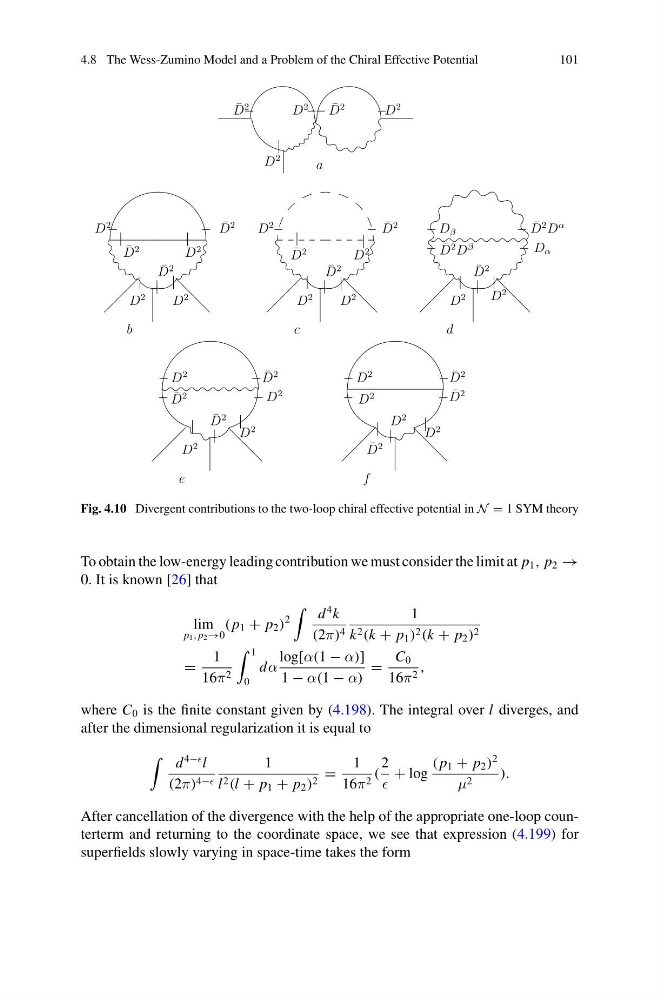
Fig. 4.10 Divergent contributions to the two-loop chiral effective potential in N = 1 SYM theory
To obtain the low-energy leading contribution we must consider the limit at p 1 , p 2 →
0. It is known [26] that
lim
p 1 , p 2 →0
( p 1 + p 2 )
2
d
4 k
(2π) 4
1
k 2 (k + p 1 ) 2 (k + p 2 ) 2
=
1
16π 2
1
0
dα
log[α(1 − α)]
1 − α(1 − α)
=
C 0
16π 2 ,
where C 0 is the finite constant given by (4.198). The integral over l diverges, and
after the dimensional regularization it is equal to
d
4− l
(2π) 4−
1
l 2 (l + p 1 + p 2 ) 2 =
1
16π 2 (
2
+ log
( p 1 + p 2 )
2
μ 2
).
After cancellation of the divergence with the help of the appropriate one-loop counterterm and returning to the coordinate space, we see that expression (4.199) for
superfields slowly varying in space-time takes the form
101
a
−
¯
D
2
−
D
2
− ¯
D
2
−D
2
|
D
2
b
|
|
D
2
|
D
2
¯
D
2
D
2
¯
D
2
¯
D
2
D
2
|
|
−
−
c
|
|
D
2
|
D
2
¯
D
2
D
2
¯
D
2
¯
D
2
D
2
−
−
|
|
d
|
|
D
2
|
D
2
¯
D
2
D β
¯
D
2 D
β
¯
D
2 D
α
D α
−
−
−
−
e
|
|
D
2
|
D
2
¯
D
2
D
2
¯
D
2
¯
D
2
D
2
−
−
−
−
f
|
|
¯
D
2
|
D
2
D
2
D
2
D
2
¯
D
2
¯
D
2
−
−
−
−
Fig. 4.10 Divergent contributions to the two-loop chiral effective potential in N = 1 SYM theory
To obtain the low-energy leading contribution we must consider the limit at p 1 , p 2 →
0. It is known [26] that
lim
p 1 , p 2 →0
( p 1 + p 2 )
2
d
4 k
(2π) 4
1
k 2 (k + p 1 ) 2 (k + p 2 ) 2
=
1
16π 2
1
0
dα
log[α(1 − α)]
1 − α(1 − α)
=
C 0
16π 2 ,
where C 0 is the finite constant given by (4.198). The integral over l diverges, and
after the dimensional regularization it is equal to
d
4− l
(2π) 4−
1
l 2 (l + p 1 + p 2 ) 2 =
1
16π 2 (
2
+ log
( p 1 + p 2 )
2
μ 2
).
After cancellation of the divergence with the help of the appropriate one-loop counterterm and returning to the coordinate space, we see that expression (4.199) for
superfields slowly varying in space-time takes the form