

84
3 Berggren Basis and Completeness Relations
and denominator are equal to zero therein. In fact, Eq. (3.4) for k a = k b can be
evaluated with l’Hôpital rule. In the following, one will then always assume that the
l’Hôpital rule is implicitly applied in this case.
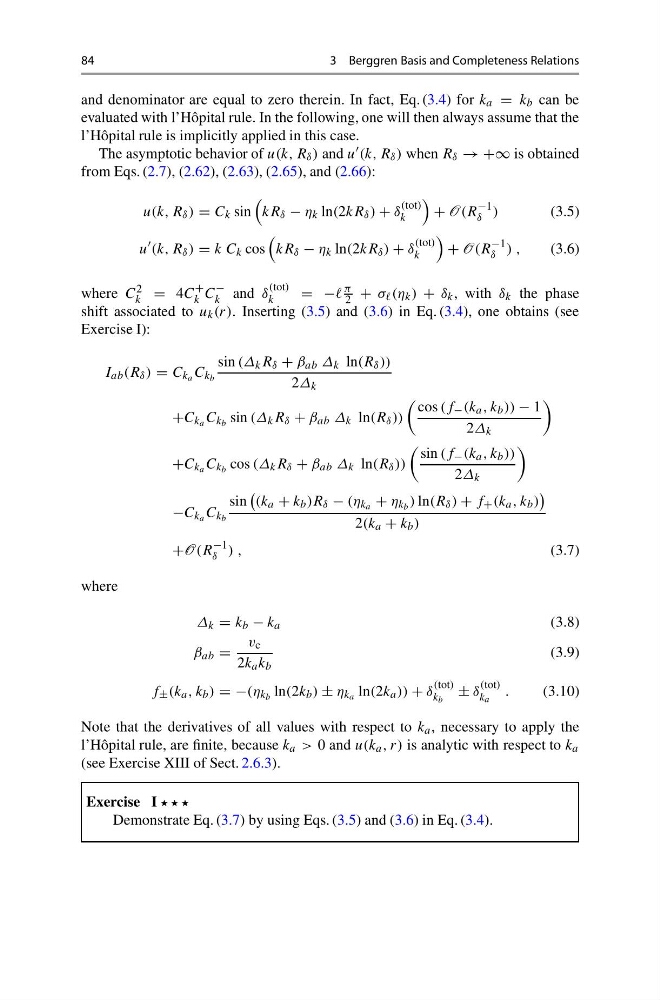
The asymptotic behavior of u(k, R δ ) and u (k, R δ ) when R δ → +∞ is obtained
from Eqs. (2.7), (2.62), (2.63), (2.65), and (2.66):
u(k, R δ ) = C k sin
kR δ − η k ln(2kR δ ) + δ
(tot)
k
+ O(R
−1
δ )
(3.5)
u
(k, R δ ) = k C k cos
kR δ − η k ln(2kR δ ) + δ
(tot)
k
+ O(R
−1
δ ) ,
(3.6)
where C 2
k = 4C
+
k C
−
k and δ
(tot)
k
= −
π
2 + σ (η k ) + δ k , with δ k the phase
shift associated to u k (r). Inserting (3.5) and (3.6) in Eq. (3.4), one obtains (see
Exercise I):
I ab (R δ ) = C k a C k b
sin (Δ k R δ + β ab Δ k ln(R δ ))
2Δ k
+C k a C k b sin (Δ k R δ + β ab Δ k ln(R δ ))
cos (f − (k a , k b )) − 1
2Δ k
+C k a C k b cos (Δ k R δ + β ab Δ k ln(R δ ))
sin (f − (k a , k b ))
2Δ k
−C k a C k b
sin
(k a + k b )R δ − (η k a + η k b ) ln(R δ ) + f + (k a , k b )
2(k a + k b )
+O(R
−1
δ ) ,
(3.7)
where
Δ k = k b − k a
(3.8)
β ab =
v c
2k a k b
(3.9)
f ± (k a , k b ) = −(η k b ln(2k b ) ± η k a ln(2k a )) + δ
(tot)
k b
± δ
(tot)
k a
.
(3.10)
Note that the derivatives of all values with respect to k a , necessary to apply the
l’Hôpital rule, are finite, because k a > 0 and u(k a , r) is analytic with respect to k a
(see Exercise XIII of Sect. 2.6.3).
Exercise I
Demonstrate Eq. (3.7) by using Eqs. (3.5) and (3.6) in Eq. (3.4).
3 Berggren Basis and Completeness Relations
and denominator are equal to zero therein. In fact, Eq. (3.4) for k a = k b can be
evaluated with l’Hôpital rule. In the following, one will then always assume that the
l’Hôpital rule is implicitly applied in this case.
The asymptotic behavior of u(k, R δ ) and u (k, R δ ) when R δ → +∞ is obtained
from Eqs. (2.7), (2.62), (2.63), (2.65), and (2.66):
u(k, R δ ) = C k sin
kR δ − η k ln(2kR δ ) + δ
(tot)
k
+ O(R
−1
δ )
(3.5)
u
(k, R δ ) = k C k cos
kR δ − η k ln(2kR δ ) + δ
(tot)
k
+ O(R
−1
δ ) ,
(3.6)
where C 2
k = 4C
+
k C
−
k and δ
(tot)
k
= −
π
2 + σ (η k ) + δ k , with δ k the phase
shift associated to u k (r). Inserting (3.5) and (3.6) in Eq. (3.4), one obtains (see
Exercise I):
I ab (R δ ) = C k a C k b
sin (Δ k R δ + β ab Δ k ln(R δ ))
2Δ k
+C k a C k b sin (Δ k R δ + β ab Δ k ln(R δ ))
cos (f − (k a , k b )) − 1
2Δ k
+C k a C k b cos (Δ k R δ + β ab Δ k ln(R δ ))
sin (f − (k a , k b ))
2Δ k
−C k a C k b
sin
(k a + k b )R δ − (η k a + η k b ) ln(R δ ) + f + (k a , k b )
2(k a + k b )
+O(R
−1
δ ) ,
(3.7)
where
Δ k = k b − k a
(3.8)
β ab =
v c
2k a k b
(3.9)
f ± (k a , k b ) = −(η k b ln(2k b ) ± η k a ln(2k a )) + δ
(tot)
k b
± δ
(tot)
k a
.
(3.10)
Note that the derivatives of all values with respect to k a , necessary to apply the
l’Hôpital rule, are finite, because k a > 0 and u(k a , r) is analytic with respect to k a
(see Exercise XIII of Sect. 2.6.3).
Exercise I
Demonstrate Eq. (3.7) by using Eqs. (3.5) and (3.6) in Eq. (3.4).