

Solutions to Exercises
75
Exercise XII.
A. Let us show that Eq. (2.159) is equivalent to Eq. (2.2) with the boundary
conditions of Eq. (2.6). If one differentiates twice Eq. (2.159), one obtains
Eq. (2.2). Moreover, the boundary conditions of Eq. (2.6) are shown to be
fulfilled by Eq. (2.159) by considering u(k, r) and u (k, r) in r = r 0 . Therefore,
due to the unicity of solutions of Eq. (2.2) for fixed boundary conditions (see
Exercise I), the solutions of Eq. (2.159), and of Eq. (2.2) using the boundary
conditions of Eq. (2.6), are the same.
B. The inequality majorizing
g(r, r ) ΔV (r )
is obtained using the asymptotic
expansions of F 0 ,η 0 (k 0 r) and G 0 ,η 0 (k 0 r) of Eqs. (2.62) and (2.63) for |k| →
+∞.
One will reuse the method and notations of Exercise I to show the requested
inequality. Let us firstly consider the n = 0 case. One has u (0) (k, r) = 0 and
u (1) (k, r) = C 0 F 0 ,η 0 (k 0 r), so that |u (1) (k, r) − u (0) (k, r)| ≤ 2 |C 0 | e ||(k)|r
when |k| is sufficiently large (see Eq. (2.62)). The inequality involving
|u (n+1) (k, r) − u (n) (k, r)| is then obtained similarly to that of I. Following
the method described in Exercise I, one has then:
|u(k, r)| ≤ 2 exp
Cr|k|
−1
|C 0 | e
||(k)|r .
(2.220)
The first exponential term is equal to 1 + O(k −1 ) when |k| → +∞. Consequently, u(k, r) cannot diverge faster than |C 0 | e ||(k)|r when |k| → +∞ and
r 0 ≤ r ≤ R. Therefore, this is the case if 0 < r ≤ R because u(k, r) =
C 0 F 0 ,η 0 (k 0 r) when 0 < r ≤ r 0 .
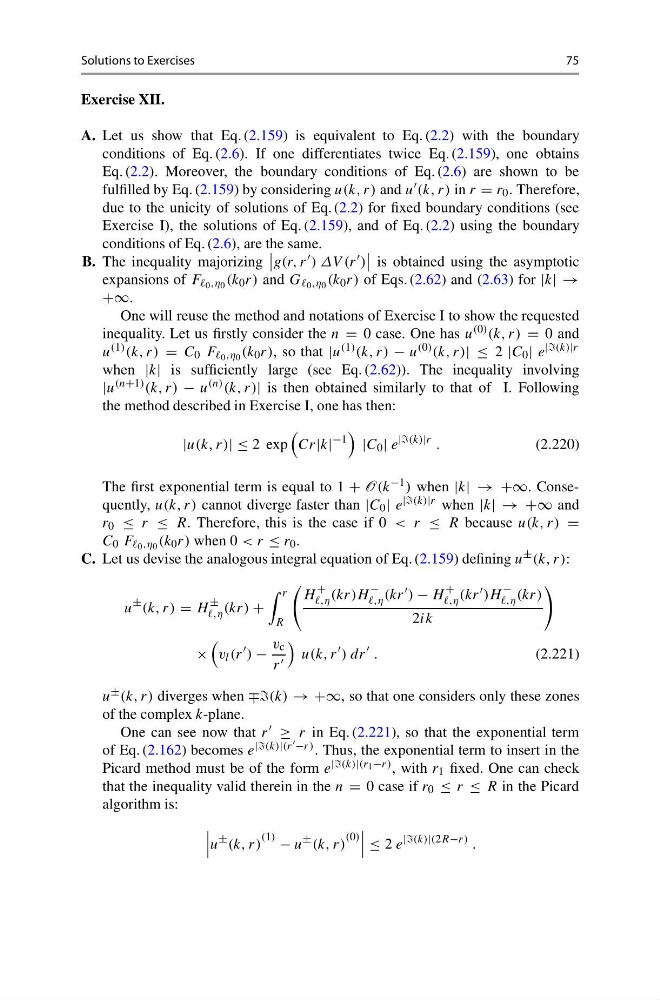
C. Let us devise the analogous integral equation of Eq. (2.159) defining u ± (k, r):
u
± (k, r) = H
±
,η (kr) +
r
R
H
+
,η (kr)H
−
,η (kr ) − H
+
,η (kr )H
−
,η (kr)
2ik
×
v l (r
) −
v c
r
u(k, r
) dr
.
(2.221)
u ± (k, r) diverges when ∓∓(k) → +∞, so that one considers only these zones
of the complex k-plane.
One can see now that r ≥ r in Eq. (2.221), so that the exponential term
of Eq. (2.162) becomes e ||(k)|(r −r) . Thus, the exponential term to insert in the
Picard method must be of the form e ||(k)|(r 1 −r) , with r 1 fixed. One can check
that the inequality valid therein in the n = 0 case if r 0 ≤ r ≤ R in the Picard
algorithm is:
u
± (k, r)
(1) − u
± (k, r)
(0)
≤ 2 e
||(k)|(2R−r) .
75
Exercise XII.
A. Let us show that Eq. (2.159) is equivalent to Eq. (2.2) with the boundary
conditions of Eq. (2.6). If one differentiates twice Eq. (2.159), one obtains
Eq. (2.2). Moreover, the boundary conditions of Eq. (2.6) are shown to be
fulfilled by Eq. (2.159) by considering u(k, r) and u (k, r) in r = r 0 . Therefore,
due to the unicity of solutions of Eq. (2.2) for fixed boundary conditions (see
Exercise I), the solutions of Eq. (2.159), and of Eq. (2.2) using the boundary
conditions of Eq. (2.6), are the same.
B. The inequality majorizing
g(r, r ) ΔV (r )
is obtained using the asymptotic
expansions of F 0 ,η 0 (k 0 r) and G 0 ,η 0 (k 0 r) of Eqs. (2.62) and (2.63) for |k| →
+∞.
One will reuse the method and notations of Exercise I to show the requested
inequality. Let us firstly consider the n = 0 case. One has u (0) (k, r) = 0 and
u (1) (k, r) = C 0 F 0 ,η 0 (k 0 r), so that |u (1) (k, r) − u (0) (k, r)| ≤ 2 |C 0 | e ||(k)|r
when |k| is sufficiently large (see Eq. (2.62)). The inequality involving
|u (n+1) (k, r) − u (n) (k, r)| is then obtained similarly to that of I. Following
the method described in Exercise I, one has then:
|u(k, r)| ≤ 2 exp
Cr|k|
−1
|C 0 | e
||(k)|r .
(2.220)
The first exponential term is equal to 1 + O(k −1 ) when |k| → +∞. Consequently, u(k, r) cannot diverge faster than |C 0 | e ||(k)|r when |k| → +∞ and
r 0 ≤ r ≤ R. Therefore, this is the case if 0 < r ≤ R because u(k, r) =
C 0 F 0 ,η 0 (k 0 r) when 0 < r ≤ r 0 .
C. Let us devise the analogous integral equation of Eq. (2.159) defining u ± (k, r):
u
± (k, r) = H
±
,η (kr) +
r
R
H
+
,η (kr)H
−
,η (kr ) − H
+
,η (kr )H
−
,η (kr)
2ik
×
v l (r
) −
v c
r
u(k, r
) dr
.
(2.221)
u ± (k, r) diverges when ∓∓(k) → +∞, so that one considers only these zones
of the complex k-plane.
One can see now that r ≥ r in Eq. (2.221), so that the exponential term
of Eq. (2.162) becomes e ||(k)|(r −r) . Thus, the exponential term to insert in the
Picard method must be of the form e ||(k)|(r 1 −r) , with r 1 fixed. One can check
that the inequality valid therein in the n = 0 case if r 0 ≤ r ≤ R in the Picard
algorithm is:
u
± (k, r)
(1) − u
± (k, r)
(0)
≤ 2 e
||(k)|(2R−r) .