

54
2 The Discrete Spectrum and the Continuum
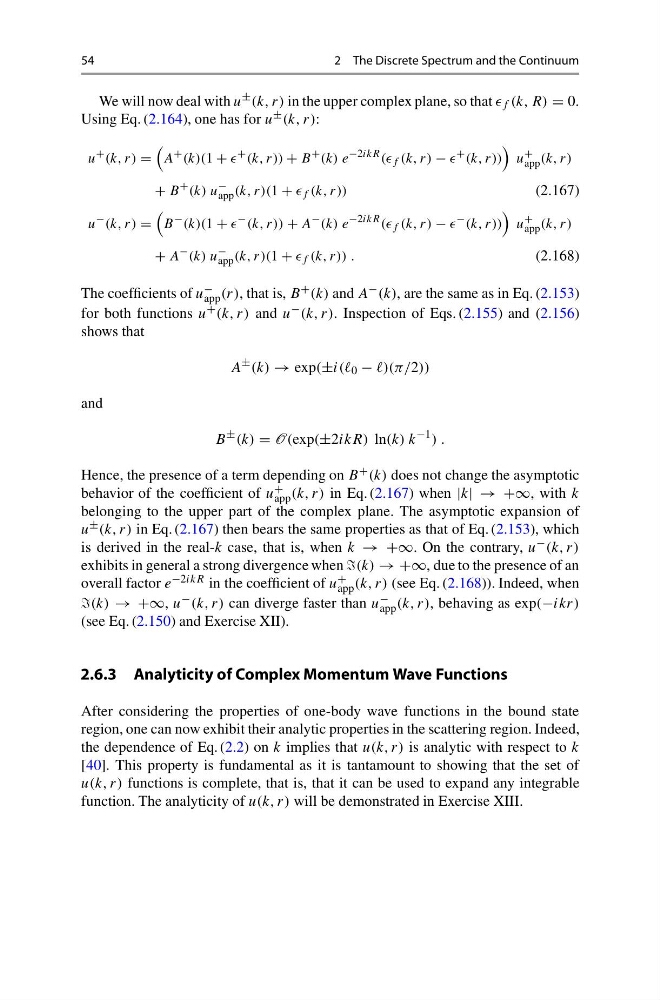
We will now deal with u ± (k, r) in the upper complex plane, so that f (k, R) = 0.
Using Eq. (2.164), one has for u ± (k, r):
u
+ (k, r) =
A
+ (k)(1 +
+ (k, r)) + B
+ (k) e
−2ikR (( f (k, r) −
+ (k, r))
u
+
app (k, r)
+ B
+ (k) u
−
app (k, r)(1 + f (k, r))
(2.167)
u
− (k, r) =
B
− (k)(1 +
− (k, r)) + A
− (k) e
−2ikR (( f (k, r) −
− (k, r))
u
+
app (k, r)
+ A
− (k) u
−
app (k, r)(1 + f (k, r)) .
(2.168)
The coefficients of u −
app (r), that is, B + (k) and A − (k), are the same as in Eq. (2.153)
for both functions u + (k, r) and u − (k, r). Inspection of Eqs. (2.155) and (2.156)
shows that
A
± (k) → exp(±i(( 0 − )(π/2))
and
B
± (k) = O(exp(±2ikR) ln(k) k
−1 ) .
Hence, the presence of a term depending on B + (k) does not change the asymptotic
behavior of the coefficient of u +
app (k, r) in Eq. (2.167) when |k| → +∞, with k
belonging to the upper part of the complex plane. The asymptotic expansion of
u ± (k, r) in Eq. (2.167) then bears the same properties as that of Eq. (2.153), which
is derived in the real-k case, that is, when k → +∞. On the contrary, u − (k, r)
exhibits in general a strong divergence when (k) → +∞, due to the presence of an
overall factor e −2ikR in the coefficient of u +
app (k, r) (see Eq. (2.168)). Indeed, when
(k) → +∞, u − (k, r) can diverge faster than u −
app (k, r), behaving as exp(−ikr)
(see Eq. (2.150) and Exercise XII).
2.6.3 Analyticity of Complex Momentum Wave Functions
After considering the properties of one-body wave functions in the bound state
region, one can now exhibit their analytic properties in the scattering region. Indeed,
the dependence of Eq. (2.2) on k implies that u(k, r) is analytic with respect to k
[40]. This property is fundamental as it is tantamount to showing that the set of
u(k, r) functions is complete, that is, that it can be used to expand any integrable
function. The analyticity of u(k, r) will be demonstrated in Exercise XIII.
2 The Discrete Spectrum and the Continuum
We will now deal with u ± (k, r) in the upper complex plane, so that f (k, R) = 0.
Using Eq. (2.164), one has for u ± (k, r):
u
+ (k, r) =
A
+ (k)(1 +
+ (k, r)) + B
+ (k) e
−2ikR (( f (k, r) −
+ (k, r))
u
+
app (k, r)
+ B
+ (k) u
−
app (k, r)(1 + f (k, r))
(2.167)
u
− (k, r) =
B
− (k)(1 +
− (k, r)) + A
− (k) e
−2ikR (( f (k, r) −
− (k, r))
u
+
app (k, r)
+ A
− (k) u
−
app (k, r)(1 + f (k, r)) .
(2.168)
The coefficients of u −
app (r), that is, B + (k) and A − (k), are the same as in Eq. (2.153)
for both functions u + (k, r) and u − (k, r). Inspection of Eqs. (2.155) and (2.156)
shows that
A
± (k) → exp(±i(( 0 − )(π/2))
and
B
± (k) = O(exp(±2ikR) ln(k) k
−1 ) .
Hence, the presence of a term depending on B + (k) does not change the asymptotic
behavior of the coefficient of u +
app (k, r) in Eq. (2.167) when |k| → +∞, with k
belonging to the upper part of the complex plane. The asymptotic expansion of
u ± (k, r) in Eq. (2.167) then bears the same properties as that of Eq. (2.153), which
is derived in the real-k case, that is, when k → +∞. On the contrary, u − (k, r)
exhibits in general a strong divergence when (k) → +∞, due to the presence of an
overall factor e −2ikR in the coefficient of u +
app (k, r) (see Eq. (2.168)). Indeed, when
(k) → +∞, u − (k, r) can diverge faster than u −
app (k, r), behaving as exp(−ikr)
(see Eq. (2.150) and Exercise XII).
2.6.3 Analyticity of Complex Momentum Wave Functions
After considering the properties of one-body wave functions in the bound state
region, one can now exhibit their analytic properties in the scattering region. Indeed,
the dependence of Eq. (2.2) on k implies that u(k, r) is analytic with respect to k
[40]. This property is fundamental as it is tantamount to showing that the set of
u(k, r) functions is complete, that is, that it can be used to expand any integrable
function. The analyticity of u(k, r) will be demonstrated in Exercise XIII.