

Solutions to Exercises
491
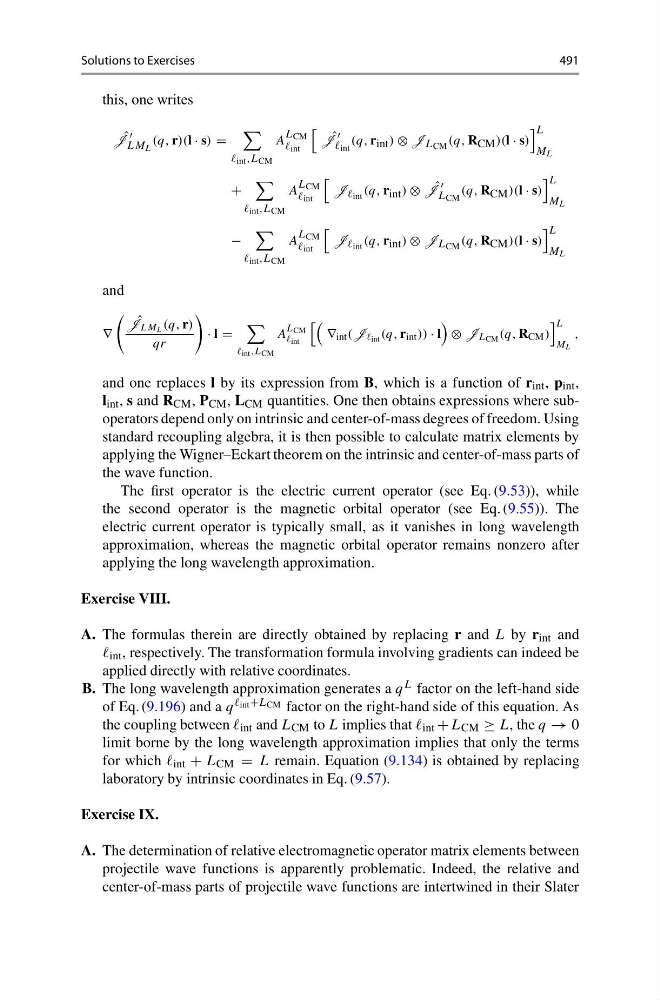
this, one writes
ˆ
J
LM L
(q, r)(l · s) =
int ,L CM
A
L CM
int
ˆ
J
int
(q, r int ) ⊗ J L CM (q, R CM )(l · s)
L
M L
+
int ,L CM
A
L CM
int
J int (q, r int ) ⊗ ˆ
J
L CM
(q, R CM )(l · s)
L
M L
−
int ,L CM
A
L CM
int
J int (q, r int ) ⊗ J L CM (q, R CM )(l · s)
L
M L
and
∇
ˆ
J LM L (q, r)
qr
· l =
int ,L CM
A
L CM
int
∇ int (J int (q, r int )) · l
⊗ J L CM (q, R CM )
L
M L
,
and one replaces l by its expression from B, which is a function of r int , p int ,
l int , s and R CM , P CM , L CM quantities. One then obtains expressions where suboperators depend only on intrinsic and center-of-mass degrees of freedom. Using
standard recoupling algebra, it is then possible to calculate matrix elements by
applying the Wigner–Eckart theorem on the intrinsic and center-of-mass parts of
the wave function.
The first operator is the electric current operator (see Eq. (9.53)), while
the second operator is the magnetic orbital operator (see Eq. (9.55)). The
electric current operator is typically small, as it vanishes in long wavelength
approximation, whereas the magnetic orbital operator remains nonzero after
applying the long wavelength approximation.
Exercise VIII.
A. The formulas therein are directly obtained by replacing r and L by r int and
int , respectively. The transformation formula involving gradients can indeed be
applied directly with relative coordinates.
B. The long wavelength approximation generates a q L factor on the left-hand side
of Eq. (9.196) and a q int +L CM factor on the right-hand side of this equation. As
the coupling between int and L CM to L implies that int + L CM ≥ L, the q → 0
limit borne by the long wavelength approximation implies that only the terms
for which int + L CM = L remain. Equation (9.134) is obtained by replacing
laboratory by intrinsic coordinates in Eq. (9.57).
Exercise IX.
A. The determination of relative electromagnetic operator matrix elements between
projectile wave functions is apparently problematic. Indeed, the relative and
center-of-mass parts of projectile wave functions are intertwined in their Slater