

Solutions to Exercises
489
One obtains the result by using the Clebsch–Gordan coefficient present in the
Gaunt coefficient to couple spherical harmonics to L and M L .
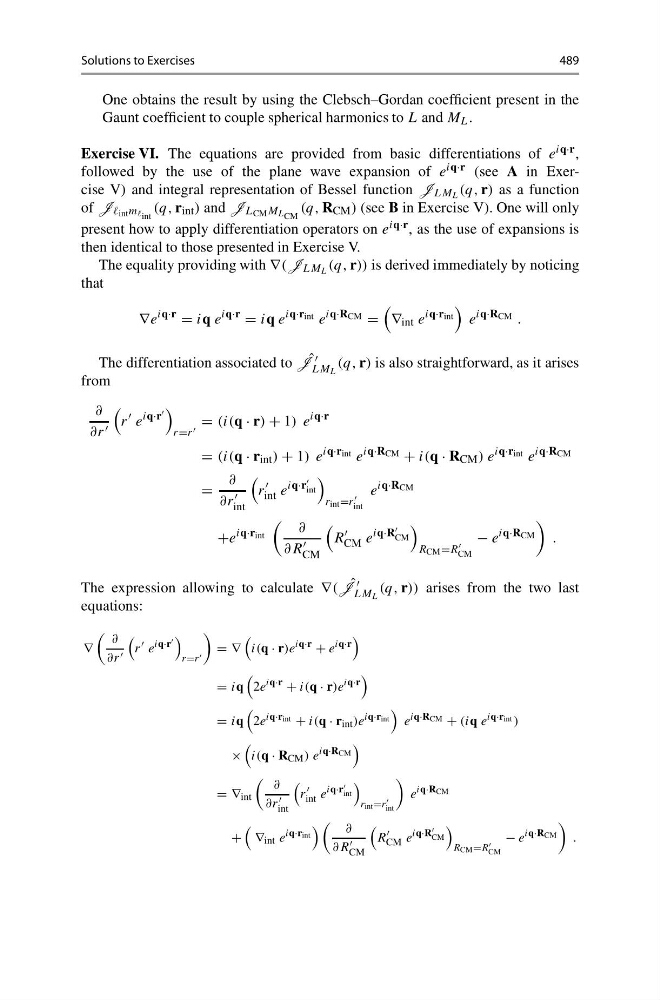
Exercise VI. The equations are provided from basic differentiations of e iq·r ,
followed by the use of the plane wave expansion of e iq·r (see A in Exercise V) and integral representation of Bessel function J LM L (q, r) as a function
of J int m int (q, r int ) and J L CM M L CM (q, R CM ) (see B in Exercise V). One will only
present how to apply differentiation operators on e iq·r , as the use of expansions is
then identical to those presented in Exercise V.
The equality providing with ∇(J LM L (q, r)) is derived immediately by noticing
that
∇e
iq·r
= iq e
iq·r
= iq e
iq·r int e
iq·R CM =
∇ int e
iq·r int
e
iq·R CM .
The differentiation associated to ˆ
J
LM L
(q, r) is also straightforward, as it arises
from
∂
∂r
r
e
iq·r
r=r
= (i(q · r) + 1) e
iq·r
= (i(q · r int ) + 1) e
iq·r int e
iq·R CM + i(q · R CM ) e
iq·r int e
iq·R CM
=
∂
∂r
int
r
int e
iq·r
int
r int =r
int
e
iq·R CM
+e
iq·r int
∂
∂R
CM
R
CM e
iq·R
CM
R CM =R
CM
− e
iq·R CM
.
The expression allowing to calculate ∇( ˆ
J
LM L
(q, r)) arises from the two last
equations:
∇
∂
∂r
r
e
iq·r
r=r
= ∇
i(q · r)e
iq·r + e
iq·r
= iq
2e
iq·r + i(q · r)e
iq·r
= iq
2e
iq·r int + i(q · r int )e
iq·r int
e
iq·R CM + (iq e
iq·r int )
×
i(q · R CM ) e
iq·R CM
= ∇ int
∂
∂r
int
r
int e
iq·r
int
r int =r
int
e
iq·R CM
+
∇ int e
iq·r int
∂
∂R
CM
R
CM e
iq·R
CM
R CM =R
CM
− e
iq·R CM
.
489
One obtains the result by using the Clebsch–Gordan coefficient present in the
Gaunt coefficient to couple spherical harmonics to L and M L .
Exercise VI. The equations are provided from basic differentiations of e iq·r ,
followed by the use of the plane wave expansion of e iq·r (see A in Exercise V) and integral representation of Bessel function J LM L (q, r) as a function
of J int m int (q, r int ) and J L CM M L CM (q, R CM ) (see B in Exercise V). One will only
present how to apply differentiation operators on e iq·r , as the use of expansions is
then identical to those presented in Exercise V.
The equality providing with ∇(J LM L (q, r)) is derived immediately by noticing
that
∇e
iq·r
= iq e
iq·r
= iq e
iq·r int e
iq·R CM =
∇ int e
iq·r int
e
iq·R CM .
The differentiation associated to ˆ
J
LM L
(q, r) is also straightforward, as it arises
from
∂
∂r
r
e
iq·r
r=r
= (i(q · r) + 1) e
iq·r
= (i(q · r int ) + 1) e
iq·r int e
iq·R CM + i(q · R CM ) e
iq·r int e
iq·R CM
=
∂
∂r
int
r
int e
iq·r
int
r int =r
int
e
iq·R CM
+e
iq·r int
∂
∂R
CM
R
CM e
iq·R
CM
R CM =R
CM
− e
iq·R CM
.
The expression allowing to calculate ∇( ˆ
J
LM L
(q, r)) arises from the two last
equations:
∇
∂
∂r
r
e
iq·r
r=r
= ∇
i(q · r)e
iq·r + e
iq·r
= iq
2e
iq·r + i(q · r)e
iq·r
= iq
2e
iq·r int + i(q · r int )e
iq·r int
e
iq·R CM + (iq e
iq·r int )
×
i(q · R CM ) e
iq·R CM
= ∇ int
∂
∂r
int
r
int e
iq·r
int
r int =r
int
e
iq·R CM
+
∇ int e
iq·r int
∂
∂R
CM
R
CM e
iq·R
CM
R CM =R
CM
− e
iq·R CM
.