

Solutions to Exercises
487
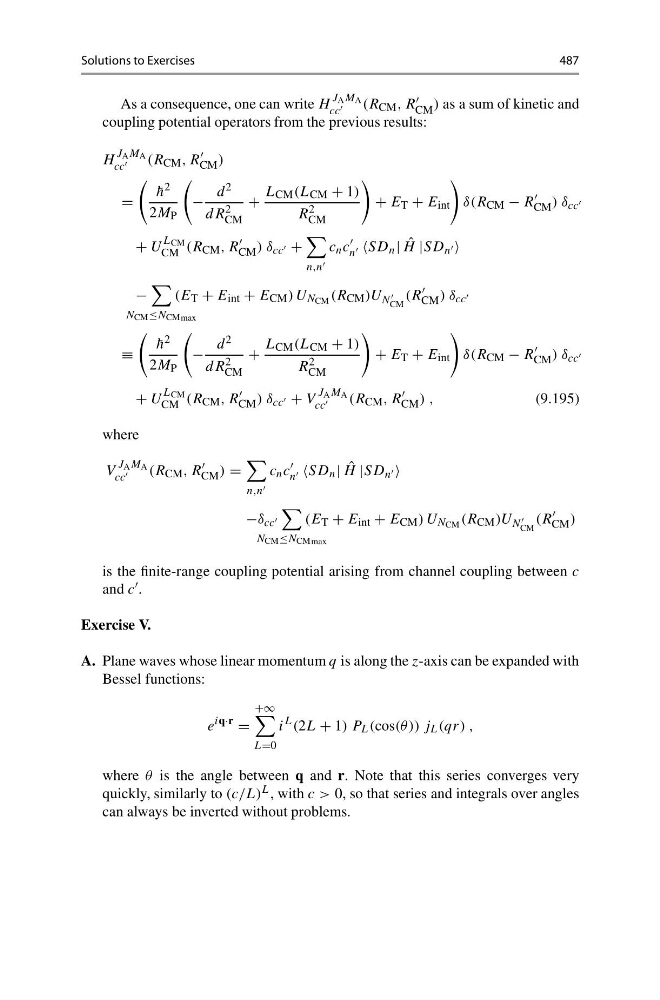
As a consequence, one can write H
J A M A
cc
(R CM , R
CM ) as a sum of kinetic and
coupling potential operators from the previous results:
H
J A M A
cc
(R CM , R
CM )
=
¯
h 2
2M P
−
d 2
dR 2
CM
+
L CM (L CM + 1)
R 2
CM
+ E T + E int
δ(R CM − R
CM ) δ cc
+ U
L CM
CM (R CM , R
CM ) δ cc +
n,n
c n c
n SD n | ˆ
H |SD n
−
N CM ≤N CMmax
(E T + E int + E CM ) U N CM (R CM )U N
CM
(R
CM ) δ cc
≡
¯
h 2
2M P
−
d 2
dR 2
CM
+
L CM (L CM + 1)
R 2
CM
+ E T + E int
δ(R CM − R
CM ) δ cc
+ U
L CM
CM (R CM , R
CM ) δ cc + V
J A M A
cc
(R CM , R
CM ) ,
(9.195)
where
V
J A M A
cc
(R CM , R
CM ) =
n,n
c n c
n SD n | ˆ
H |SD n
−δ cc
N CM ≤N CMmax
(E T + E int + E CM ) U N CM (R CM )U N
CM
(R
CM )
is the finite-range coupling potential arising from channel coupling between c
and c .
Exercise V.
A. Plane waves whose linear momentum q is along the z-axis can be expanded with
Bessel functions:
e
iq·r
=
+∞
L=0
i
L (2L + 1) P L (cos(θ )) j L (qr) ,
where θ is the angle between q and r. Note that this series converges very
quickly, similarly to (c/L) L , with c > 0, so that series and integrals over angles
can always be inverted without problems.
487
As a consequence, one can write H
J A M A
cc
(R CM , R
CM ) as a sum of kinetic and
coupling potential operators from the previous results:
H
J A M A
cc
(R CM , R
CM )
=
¯
h 2
2M P
−
d 2
dR 2
CM
+
L CM (L CM + 1)
R 2
CM
+ E T + E int
δ(R CM − R
CM ) δ cc
+ U
L CM
CM (R CM , R
CM ) δ cc +
n,n
c n c
n SD n | ˆ
H |SD n
−
N CM ≤N CMmax
(E T + E int + E CM ) U N CM (R CM )U N
CM
(R
CM ) δ cc
≡
¯
h 2
2M P
−
d 2
dR 2
CM
+
L CM (L CM + 1)
R 2
CM
+ E T + E int
δ(R CM − R
CM ) δ cc
+ U
L CM
CM (R CM , R
CM ) δ cc + V
J A M A
cc
(R CM , R
CM ) ,
(9.195)
where
V
J A M A
cc
(R CM , R
CM ) =
n,n
c n c
n SD n | ˆ
H |SD n
−δ cc
N CM ≤N CMmax
(E T + E int + E CM ) U N CM (R CM )U N
CM
(R
CM )
is the finite-range coupling potential arising from channel coupling between c
and c .
Exercise V.
A. Plane waves whose linear momentum q is along the z-axis can be expanded with
Bessel functions:
e
iq·r
=
+∞
L=0
i
L (2L + 1) P L (cos(θ )) j L (qr) ,
where θ is the angle between q and r. Note that this series converges very
quickly, similarly to (c/L) L , with c > 0, so that series and integrals over angles
can always be inverted without problems.