

Solutions to Exercises
485
Antisymmetrizers have been suppressed in Eq. (9.187) except for ˆ
H TP due to
Eqs. (9.117) and (9.118).
Due to the finite range of ˆ
H TP , the coefficients c n and c
n decrease exponentially with the energy of basis scattering Slater determinants, so that they can
be considered to be in finite number up to an error that can be made arbitrarily
small. As ˆ
H TP couples target and projectile states, using the fact that targets are
low-energy many-body states and that N
CM > N CMmax , the product c n c
n in
the last sum of Eq. (9.189) is non-negligible only if k α k max , k β k max ,
k γ k max , and k δ k max . In this case, αβ| ˆ
V res − ˆ
U 0 |γ δ 0 in the last sum
of Eq. (9.189) because the conditions of Eq. (9.96) are then verified.
As a consequence, the second sum of Eq. (9.188) is equal to zero. The third
sum of Eq. (9.188) can be treated identically for symmetry reasons and then
vanishes as well.
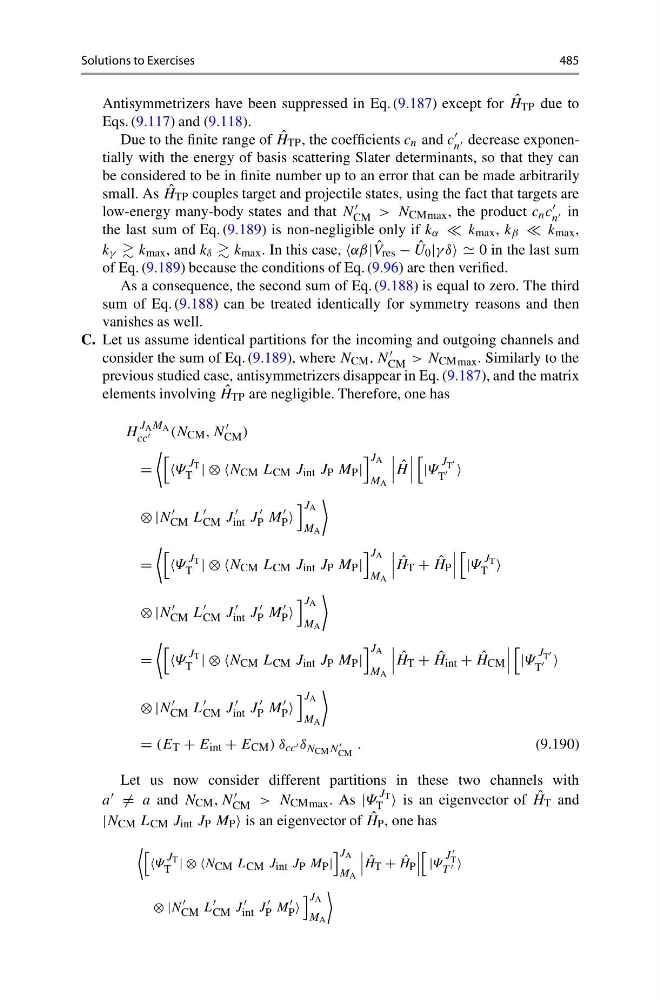
C. Let us assume identical partitions for the incoming and outgoing channels and
consider the sum of Eq. (9.189), where N CM , N
CM > N CMmax . Similarly to the
previous studied case, antisymmetrizers disappear in Eq. (9.187), and the matrix
elements involving ˆ
H TP are negligible. Therefore, one has
H
J A M A
cc
(N CM , N
CM )
=
J T
T | ⊗ ⊗N CM L CM J int J P M P |
J A
M A
ˆ
H
|Ψ
J T
T
⊗ |N
CM L
CM J
int J
P M
P
J A
M A
=
J T
T | ⊗ ⊗N CM L CM J int J P M P |
J A
M A
ˆ
H T + ˆ
H P
|Ψ
J T
T
⊗ |N
CM L
CM J
int J
P M
P
J A
M A
=
J T
T | ⊗ ⊗N CM L CM J int J P M P |
J A
M A
ˆ
H T + ˆ
H int + ˆ
H CM
|Ψ
J T
T
⊗ |N
CM L
CM J
int J
P M
P
J A
M A
= (E T + E int + E CM ) δ cc δ N CM N
CM
.
(9.190)
Let us now consider different partitions in these two channels with
a = a and N CM , N
CM > N CMmax . As |Ψ
J T
T is an eigenvector of ˆ
H T and
|N CM L CM J int J P M P is an eigenvector of ˆ
H P , one has
J T
T | ⊗ ⊗N CM L CM J int J P M P |
J A
M A
ˆ
H T + ˆ
H P
|Ψ
J
T
T
⊗ |N
CM L
CM J
int J
P M
P
J A
M A
485
Antisymmetrizers have been suppressed in Eq. (9.187) except for ˆ
H TP due to
Eqs. (9.117) and (9.118).
Due to the finite range of ˆ
H TP , the coefficients c n and c
n decrease exponentially with the energy of basis scattering Slater determinants, so that they can
be considered to be in finite number up to an error that can be made arbitrarily
small. As ˆ
H TP couples target and projectile states, using the fact that targets are
low-energy many-body states and that N
CM > N CMmax , the product c n c
n in
the last sum of Eq. (9.189) is non-negligible only if k α k max , k β k max ,
k γ k max , and k δ k max . In this case, αβ| ˆ
V res − ˆ
U 0 |γ δ 0 in the last sum
of Eq. (9.189) because the conditions of Eq. (9.96) are then verified.
As a consequence, the second sum of Eq. (9.188) is equal to zero. The third
sum of Eq. (9.188) can be treated identically for symmetry reasons and then
vanishes as well.
C. Let us assume identical partitions for the incoming and outgoing channels and
consider the sum of Eq. (9.189), where N CM , N
CM > N CMmax . Similarly to the
previous studied case, antisymmetrizers disappear in Eq. (9.187), and the matrix
elements involving ˆ
H TP are negligible. Therefore, one has
H
J A M A
cc
(N CM , N
CM )
=
J T
T | ⊗ ⊗N CM L CM J int J P M P |
J A
M A
ˆ
H
|Ψ
J T
T
⊗ |N
CM L
CM J
int J
P M
P
J A
M A
=
J T
T | ⊗ ⊗N CM L CM J int J P M P |
J A
M A
ˆ
H T + ˆ
H P
|Ψ
J T
T
⊗ |N
CM L
CM J
int J
P M
P
J A
M A
=
J T
T | ⊗ ⊗N CM L CM J int J P M P |
J A
M A
ˆ
H T + ˆ
H int + ˆ
H CM
|Ψ
J T
T
⊗ |N
CM L
CM J
int J
P M
P
J A
M A
= (E T + E int + E CM ) δ cc δ N CM N
CM
.
(9.190)
Let us now consider different partitions in these two channels with
a = a and N CM , N
CM > N CMmax . As |Ψ
J T
T is an eigenvector of ˆ
H T and
|N CM L CM J int J P M P is an eigenvector of ˆ
H P , one has
J T
T | ⊗ ⊗N CM L CM J int J P M P |
J A
M A
ˆ
H T + ˆ
H P
|Ψ
J
T
T
⊗ |N
CM L
CM J
int J
P M
P
J A
M A