

9.4 Calculation of Spectra and Reaction Cross Sections in the Coupled-. . .
463
0
1
2
3
4
5
E c.m. (MeV)
0.0
0.2
0.4
0.6
0.8
1.0
1.2
dσ/dΩ
c.m. (barn/sr)
GSM-CC
Exp. data
4.5
4.9
0
0.01
0.02
0.03
0.04
0.05
0.06
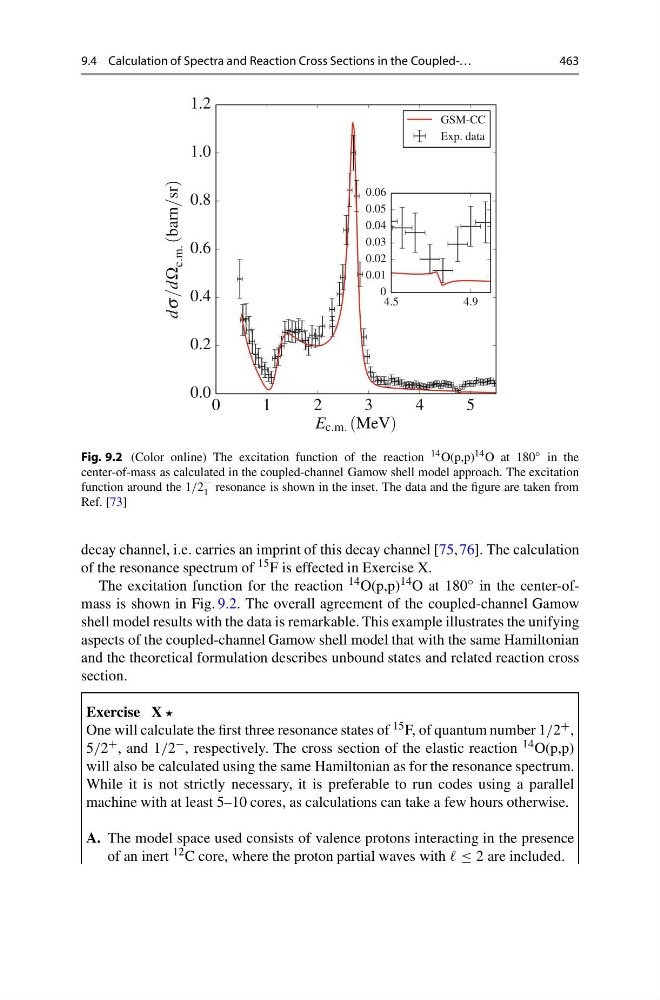
Fig. 9.2 (Color online) The excitation function of the reaction 14 O(p,p) 14 O at 180 ◦ in the
center-of-mass as calculated in the coupled-channel Gamow shell model approach. The excitation
function around the 1/2
−
1 resonance is shown in the inset. The data and the figure are taken from
Ref. [73]
decay channel, i.e. carries an imprint of this decay channel [75, 76]. The calculation
of the resonance spectrum of 15 F is effected in Exercise X.
The excitation function for the reaction 14 O(p,p) 14 O at 180 ◦ in the center-ofmass is shown in Fig. 9.2. The overall agreement of the coupled-channel Gamow
shell model results with the data is remarkable. This example illustrates the unifying
aspects of the coupled-channel Gamow shell model that with the same Hamiltonian
and the theoretical formulation describes unbound states and related reaction cross
section.
Exercise X
One will calculate the first three resonance states of 15 F, of quantum number 1/2 + ,
5/2 + , and 1/2 − , respectively. The cross section of the elastic reaction 14 O(p,p)
will also be calculated using the same Hamiltonian as for the resonance spectrum.
While it is not strictly necessary, it is preferable to run codes using a parallel
machine with at least 5–10 cores, as calculations can take a few hours otherwise.
A. The model space used consists of valence protons interacting in the presence
of an inert 12 C core, where the proton partial waves with ≤ 2 are included.
463
0
1
2
3
4
5
E c.m. (MeV)
0.0
0.2
0.4
0.6
0.8
1.0
1.2
dσ/dΩ
c.m. (barn/sr)
GSM-CC
Exp. data
4.5
4.9
0
0.01
0.02
0.03
0.04
0.05
0.06
Fig. 9.2 (Color online) The excitation function of the reaction 14 O(p,p) 14 O at 180 ◦ in the
center-of-mass as calculated in the coupled-channel Gamow shell model approach. The excitation
function around the 1/2
−
1 resonance is shown in the inset. The data and the figure are taken from
Ref. [73]
decay channel, i.e. carries an imprint of this decay channel [75, 76]. The calculation
of the resonance spectrum of 15 F is effected in Exercise X.
The excitation function for the reaction 14 O(p,p) 14 O at 180 ◦ in the center-ofmass is shown in Fig. 9.2. The overall agreement of the coupled-channel Gamow
shell model results with the data is remarkable. This example illustrates the unifying
aspects of the coupled-channel Gamow shell model that with the same Hamiltonian
and the theoretical formulation describes unbound states and related reaction cross
section.
Exercise X
One will calculate the first three resonance states of 15 F, of quantum number 1/2 + ,
5/2 + , and 1/2 − , respectively. The cross section of the elastic reaction 14 O(p,p)
will also be calculated using the same Hamiltonian as for the resonance spectrum.
While it is not strictly necessary, it is preferable to run codes using a parallel
machine with at least 5–10 cores, as calculations can take a few hours otherwise.
A. The model space used consists of valence protons interacting in the presence
of an inert 12 C core, where the proton partial waves with ≤ 2 are included.