

32
2 The Discrete Spectrum and the Continuum
level before considering the general spherical potential, which will be the topic of
the following sections.
The Pöschl-Teller-Ginocchio potential V PTG depends on four parameters, which
is standard to denote as Λ, s, ν, and a. Λ determines the overall shape of the
potential. For small Λ, the Pöschl-Teller-Ginocchio potential is very diffuse. Λ = 1
corresponds to a standard Pöschl-Teller potential. If Λ is large, a flat bottom is
generated in the Pöschl-Teller-Ginocchio potential. s is a scaling parameter as
V PTG (r) ∝ s 2 . ν fixes the depth of the potential and a is the strength of the effective
mass, with 0 ≤ a ≤ 1. The effective mass at r = 0 is given by (1 − a)m 0 .
These four parameters allow the Pöschl-Teller-Ginocchio potential to cover many
physical situations. While Λ ≤ 1 provides with a potential mimicking that of a
crystal acting on an electron, potentials with Λ ∼ 5 are very close to a WoodsSaxon potential and hence are more suitable for the study of nuclei. The parameters
s and ν play the same role as the Woods-Saxon potential depth, so that all the
situations that can be described with a Woods-Saxon potential can also be modeled
by a Pöschl-Teller-Ginocchio potential. However, the Λ, s, and ν parameters are
not as intuitive as the diffuseness, radius, and depth of the Woods-Saxon potential,
so that the physical properties of the Pöschl-Teller-Ginocchio potential are rather
implicit. Consequently, in practical calculations, the Λ, s, and ν parameters of the
Pöschl-Teller-Ginocchio potential are typically fitted from a given Woods-Saxon
potential.
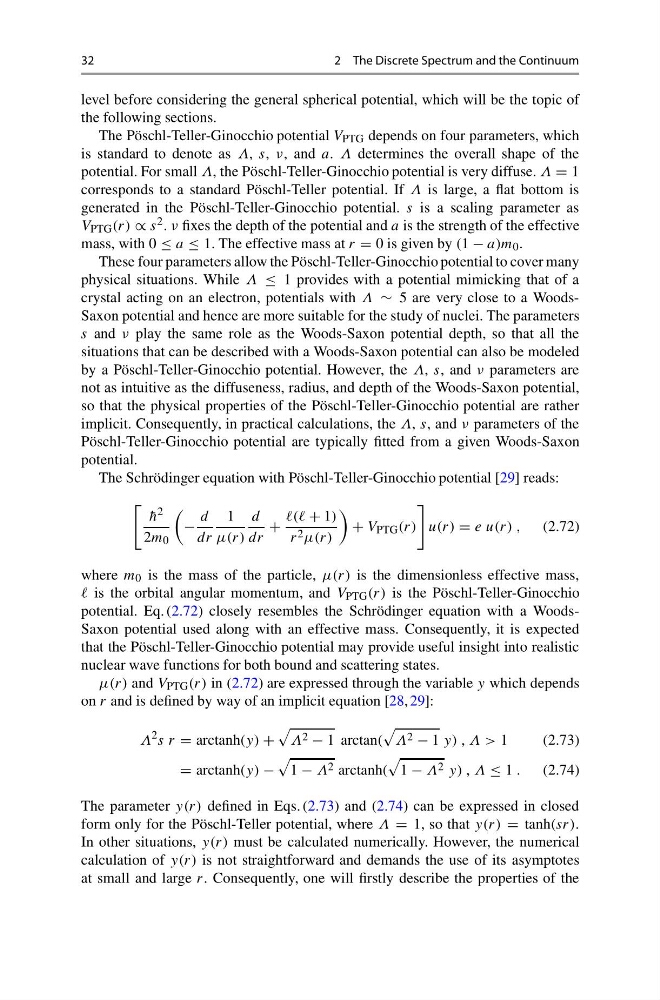
The Schrödinger equation with Pöschl-Teller-Ginocchio potential [29] reads:
¯
h 2
2m 0
−
d
dr
1
μ(r)
d
dr
+
+ 1)
r 2 μ(r)
+ V PTG (r)
u(r) = e u(r) , (2.72)
where m 0 is the mass of the particle, μ(r) is the dimensionless effective mass,
is the orbital angular momentum, and V PTG (r) is the Pöschl-Teller-Ginocchio
potential. Eq. (2.72) closely resembles the Schrödinger equation with a WoodsSaxon potential used along with an effective mass. Consequently, it is expected
that the Pöschl-Teller-Ginocchio potential may provide useful insight into realistic
nuclear wave functions for both bound and scattering states.
μ(r) and V PTG (r) in (2.72) are expressed through the variable y which depends
on r and is defined by way of an implicit equation [28, 29]:
Λ
2 s r = arctanh(y) +
Λ 2 − 1 arctan(
Λ 2 − 1 y) , Λ > 1
(2.73)
= arctanh(y) −
1 − Λ 2 arctanh(
1 − Λ 2 y) , Λ ≤ 1 . (2.74)
The parameter y(r) defined in Eqs. (2.73) and (2.74) can be expressed in closed
form only for the Pöschl-Teller potential, where Λ = 1, so that y(r) = tanh(sr).
In other situations, y(r) must be calculated numerically. However, the numerical
calculation of y(r) is not straightforward and demands the use of its asymptotes
at small and large r. Consequently, one will firstly describe the properties of the
2 The Discrete Spectrum and the Continuum
level before considering the general spherical potential, which will be the topic of
the following sections.
The Pöschl-Teller-Ginocchio potential V PTG depends on four parameters, which
is standard to denote as Λ, s, ν, and a. Λ determines the overall shape of the
potential. For small Λ, the Pöschl-Teller-Ginocchio potential is very diffuse. Λ = 1
corresponds to a standard Pöschl-Teller potential. If Λ is large, a flat bottom is
generated in the Pöschl-Teller-Ginocchio potential. s is a scaling parameter as
V PTG (r) ∝ s 2 . ν fixes the depth of the potential and a is the strength of the effective
mass, with 0 ≤ a ≤ 1. The effective mass at r = 0 is given by (1 − a)m 0 .
These four parameters allow the Pöschl-Teller-Ginocchio potential to cover many
physical situations. While Λ ≤ 1 provides with a potential mimicking that of a
crystal acting on an electron, potentials with Λ ∼ 5 are very close to a WoodsSaxon potential and hence are more suitable for the study of nuclei. The parameters
s and ν play the same role as the Woods-Saxon potential depth, so that all the
situations that can be described with a Woods-Saxon potential can also be modeled
by a Pöschl-Teller-Ginocchio potential. However, the Λ, s, and ν parameters are
not as intuitive as the diffuseness, radius, and depth of the Woods-Saxon potential,
so that the physical properties of the Pöschl-Teller-Ginocchio potential are rather
implicit. Consequently, in practical calculations, the Λ, s, and ν parameters of the
Pöschl-Teller-Ginocchio potential are typically fitted from a given Woods-Saxon
potential.
The Schrödinger equation with Pöschl-Teller-Ginocchio potential [29] reads:
¯
h 2
2m 0
−
d
dr
1
μ(r)
d
dr
+
+ 1)
r 2 μ(r)
+ V PTG (r)
u(r) = e u(r) , (2.72)
where m 0 is the mass of the particle, μ(r) is the dimensionless effective mass,
is the orbital angular momentum, and V PTG (r) is the Pöschl-Teller-Ginocchio
potential. Eq. (2.72) closely resembles the Schrödinger equation with a WoodsSaxon potential used along with an effective mass. Consequently, it is expected
that the Pöschl-Teller-Ginocchio potential may provide useful insight into realistic
nuclear wave functions for both bound and scattering states.
μ(r) and V PTG (r) in (2.72) are expressed through the variable y which depends
on r and is defined by way of an implicit equation [28, 29]:
Λ
2 s r = arctanh(y) +
Λ 2 − 1 arctan(
Λ 2 − 1 y) , Λ > 1
(2.73)
= arctanh(y) −
1 − Λ 2 arctanh(
1 − Λ 2 y) , Λ ≤ 1 . (2.74)
The parameter y(r) defined in Eqs. (2.73) and (2.74) can be expressed in closed
form only for the Pöschl-Teller potential, where Λ = 1, so that y(r) = tanh(sr).
In other situations, y(r) must be calculated numerically. However, the numerical
calculation of y(r) is not straightforward and demands the use of its asymptotes
at small and large r. Consequently, one will firstly describe the properties of the