

458
9 The Unification of Structure and Reaction Frameworks
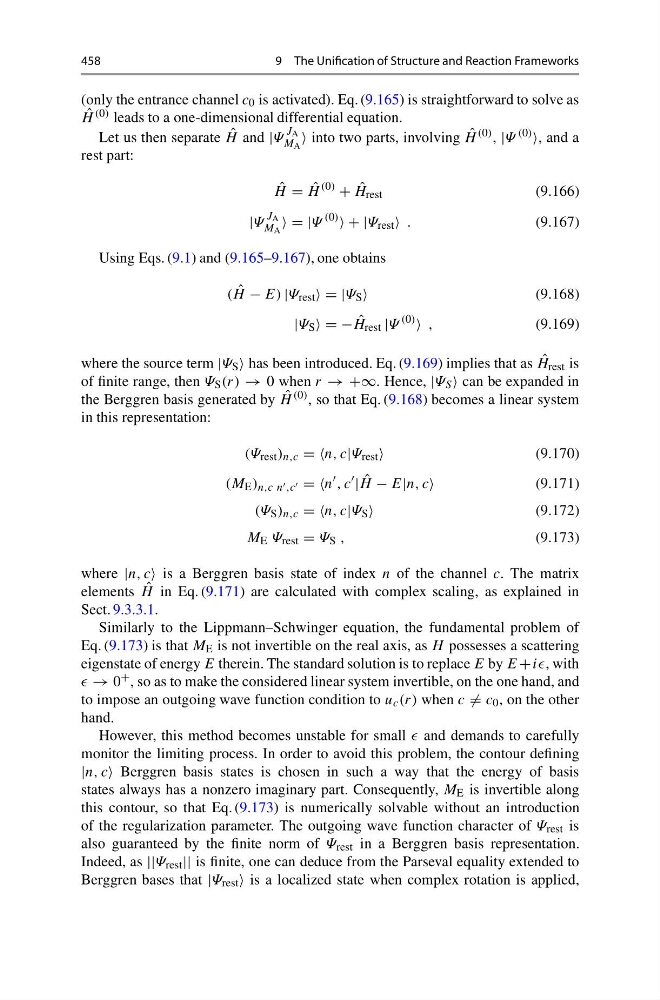
(only the entrance channel c 0 is activated). Eq. (9.165) is straightforward to solve as
ˆ
H (0) leads to a one-dimensional differential equation.
Let us then separate ˆ
H and |Ψ
J A
M A
into two parts, involving ˆ
H (0) , |Ψ (0) , and a
rest part:
ˆ
H = ˆ
H
(0)
+ ˆ
H rest
(9.166)
|Ψ
J A
M A
= |Ψ
(0)
+ |Ψ rest .
(9.167)
Using Eqs. (9.1) and (9.165–9.167), one obtains
( ˆ
H − E) |Ψ rest = |Ψ S
(9.168)
|Ψ S = − ˆ
H rest |Ψ
(0)
,
(9.169)
where the source term |Ψ S has been introduced. Eq. (9.169) implies that as ˆ
H rest is
of finite range, then Ψ S (r) → 0 when r → +∞. Hence, |Ψ S can be expanded in
the Berggren basis generated by ˆ
H (0) , so that Eq. (9.168) becomes a linear system
in this representation:
(Ψ rest ) n,c = =n, c|Ψ rest
(9.170)
(M E ) n,c n ,c = =n
, c
| ˆ
H − E|n, c
(9.171)
(Ψ S ) n,c = =n, c|Ψ S
(9.172)
M E Ψ rest = Ψ S ,
(9.173)
where |n, c is a Berggren basis state of index n of the channel c. The matrix
elements ˆ
H in Eq. (9.171) are calculated with complex scaling, as explained in
Sect. 9.3.3.1.
Similarly to the Lippmann–Schwinger equation, the fundamental problem of
Eq. (9.173) is that M E is not invertible on the real axis, as H possesses a scattering
eigenstate of energy E therein. The standard solution is to replace E by E +ii, with
→ 0 + , so as to make the considered linear system invertible, on the one hand, and
to impose an outgoing wave function condition to u c (r) when c = c 0 , on the other
hand.
However, this method becomes unstable for small and demands to carefully
monitor the limiting process. In order to avoid this problem, the contour defining
|n, c Berggren basis states is chosen in such a way that the energy of basis
states always has a nonzero imaginary part. Consequently, M E is invertible along
this contour, so that Eq. (9.173) is numerically solvable without an introduction
of the regularization parameter. The outgoing wave function character of Ψ rest is
also guaranteed by the finite norm of Ψ rest in a Berggren basis representation.
Indeed, as ||Ψ rest || is finite, one can deduce from the Parseval equality extended to
Berggren bases that |Ψ rest is a localized state when complex rotation is applied,
9 The Unification of Structure and Reaction Frameworks
(only the entrance channel c 0 is activated). Eq. (9.165) is straightforward to solve as
ˆ
H (0) leads to a one-dimensional differential equation.
Let us then separate ˆ
H and |Ψ
J A
M A
into two parts, involving ˆ
H (0) , |Ψ (0) , and a
rest part:
ˆ
H = ˆ
H
(0)
+ ˆ
H rest
(9.166)
|Ψ
J A
M A
= |Ψ
(0)
+ |Ψ rest .
(9.167)
Using Eqs. (9.1) and (9.165–9.167), one obtains
( ˆ
H − E) |Ψ rest = |Ψ S
(9.168)
|Ψ S = − ˆ
H rest |Ψ
(0)
,
(9.169)
where the source term |Ψ S has been introduced. Eq. (9.169) implies that as ˆ
H rest is
of finite range, then Ψ S (r) → 0 when r → +∞. Hence, |Ψ S can be expanded in
the Berggren basis generated by ˆ
H (0) , so that Eq. (9.168) becomes a linear system
in this representation:
(Ψ rest ) n,c = =n, c|Ψ rest
(9.170)
(M E ) n,c n ,c = =n
, c
| ˆ
H − E|n, c
(9.171)
(Ψ S ) n,c = =n, c|Ψ S
(9.172)
M E Ψ rest = Ψ S ,
(9.173)
where |n, c is a Berggren basis state of index n of the channel c. The matrix
elements ˆ
H in Eq. (9.171) are calculated with complex scaling, as explained in
Sect. 9.3.3.1.
Similarly to the Lippmann–Schwinger equation, the fundamental problem of
Eq. (9.173) is that M E is not invertible on the real axis, as H possesses a scattering
eigenstate of energy E therein. The standard solution is to replace E by E +ii, with
→ 0 + , so as to make the considered linear system invertible, on the one hand, and
to impose an outgoing wave function condition to u c (r) when c = c 0 , on the other
hand.
However, this method becomes unstable for small and demands to carefully
monitor the limiting process. In order to avoid this problem, the contour defining
|n, c Berggren basis states is chosen in such a way that the energy of basis
states always has a nonzero imaginary part. Consequently, M E is invertible along
this contour, so that Eq. (9.173) is numerically solvable without an introduction
of the regularization parameter. The outgoing wave function character of Ψ rest is
also guaranteed by the finite norm of Ψ rest in a Berggren basis representation.
Indeed, as ||Ψ rest || is finite, one can deduce from the Parseval equality extended to
Berggren bases that |Ψ rest is a localized state when complex rotation is applied,