

9.2 Generalization to Many-Nucleon Projectiles
439
derivation of Eq. (9.120) is analogous to the one-nucleon case and is the subject of
Exercise IV. This exercise is difficult, but it resembles Exercise I. Hence, readers can
admit results therein if they did not complete Exercise I, but should be able to solve
Exercise IV without too many problems if they have already finished Exercise I.
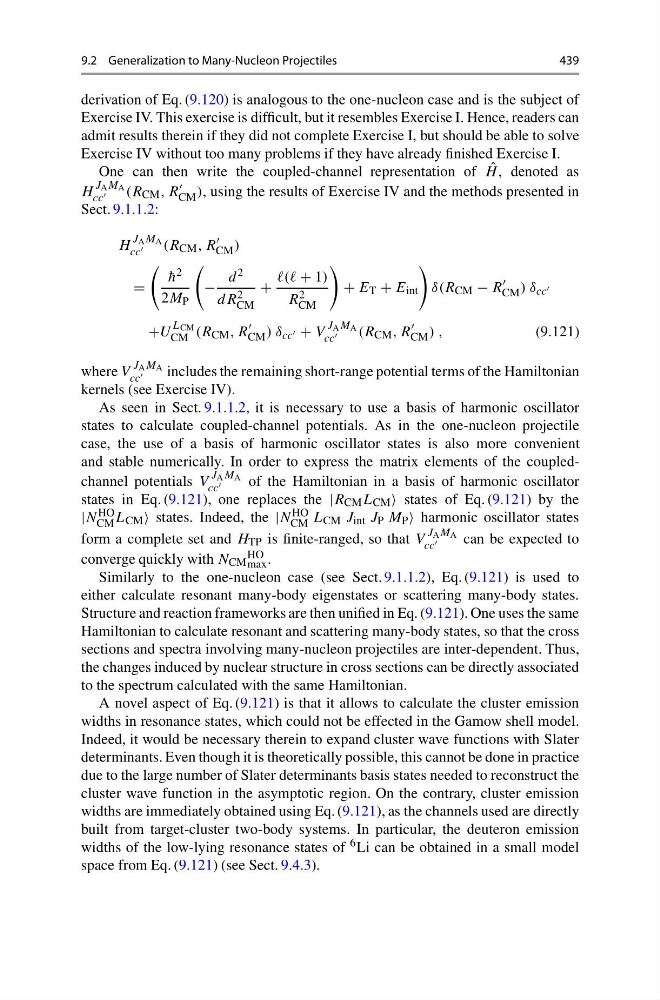
One can then write the coupled-channel representation of ˆ
H , denoted as
H
J A M A
cc
(R CM , R
CM ), using the results of Exercise IV and the methods presented in
Sect. 9.1.1.2:
H
J A M A
cc
(R CM , R
CM )
=
¯
h 2
2M P
−
d 2
dR 2
CM
+
+ 1)
R 2
CM
+ E T + E int
δ(R CM − R
CM ) δ cc
+U
L CM
CM (R CM , R
CM ) δ cc + V
J A M A
cc
(R CM , R
CM ) ,
(9.121)
where V
J A M A
cc
includes the remaining short-range potential terms of the Hamiltonian
kernels (see Exercise IV).
As seen in Sect. 9.1.1.2, it is necessary to use a basis of harmonic oscillator
states to calculate coupled-channel potentials. As in the one-nucleon projectile
case, the use of a basis of harmonic oscillator states is also more convenient
and stable numerically. In order to express the matrix elements of the coupledchannel potentials V
J A M A
cc
of the Hamiltonian in a basis of harmonic oscillator
states in Eq. (9.121), one replaces the |R CM L CM states of Eq. (9.121) by the
|N HO
CM L CM states. Indeed, the |N HO
CM L CM J int J P M P harmonic oscillator states
form a complete set and H TP is finite-ranged, so that V
J A M A
cc
can be expected to
converge quickly with N CM
HO
max .
Similarly to the one-nucleon case (see Sect. 9.1.1.2), Eq. (9.121) is used to
either calculate resonant many-body eigenstates or scattering many-body states.
Structure and reaction frameworks are then unified in Eq. (9.121). One uses the same
Hamiltonian to calculate resonant and scattering many-body states, so that the cross
sections and spectra involving many-nucleon projectiles are inter-dependent. Thus,
the changes induced by nuclear structure in cross sections can be directly associated
to the spectrum calculated with the same Hamiltonian.
A novel aspect of Eq. (9.121) is that it allows to calculate the cluster emission
widths in resonance states, which could not be effected in the Gamow shell model.
Indeed, it would be necessary therein to expand cluster wave functions with Slater
determinants. Even though it is theoretically possible, this cannot be done in practice
due to the large number of Slater determinants basis states needed to reconstruct the
cluster wave function in the asymptotic region. On the contrary, cluster emission
widths are immediately obtained using Eq. (9.121), as the channels used are directly
built from target-cluster two-body systems. In particular, the deuteron emission
widths of the low-lying resonance states of 6 Li can be obtained in a small model
space from Eq. (9.121) (see Sect. 9.4.3).
439
derivation of Eq. (9.120) is analogous to the one-nucleon case and is the subject of
Exercise IV. This exercise is difficult, but it resembles Exercise I. Hence, readers can
admit results therein if they did not complete Exercise I, but should be able to solve
Exercise IV without too many problems if they have already finished Exercise I.
One can then write the coupled-channel representation of ˆ
H , denoted as
H
J A M A
cc
(R CM , R
CM ), using the results of Exercise IV and the methods presented in
Sect. 9.1.1.2:
H
J A M A
cc
(R CM , R
CM )
=
¯
h 2
2M P
−
d 2
dR 2
CM
+
+ 1)
R 2
CM
+ E T + E int
δ(R CM − R
CM ) δ cc
+U
L CM
CM (R CM , R
CM ) δ cc + V
J A M A
cc
(R CM , R
CM ) ,
(9.121)
where V
J A M A
cc
includes the remaining short-range potential terms of the Hamiltonian
kernels (see Exercise IV).
As seen in Sect. 9.1.1.2, it is necessary to use a basis of harmonic oscillator
states to calculate coupled-channel potentials. As in the one-nucleon projectile
case, the use of a basis of harmonic oscillator states is also more convenient
and stable numerically. In order to express the matrix elements of the coupledchannel potentials V
J A M A
cc
of the Hamiltonian in a basis of harmonic oscillator
states in Eq. (9.121), one replaces the |R CM L CM states of Eq. (9.121) by the
|N HO
CM L CM states. Indeed, the |N HO
CM L CM J int J P M P harmonic oscillator states
form a complete set and H TP is finite-ranged, so that V
J A M A
cc
can be expected to
converge quickly with N CM
HO
max .
Similarly to the one-nucleon case (see Sect. 9.1.1.2), Eq. (9.121) is used to
either calculate resonant many-body eigenstates or scattering many-body states.
Structure and reaction frameworks are then unified in Eq. (9.121). One uses the same
Hamiltonian to calculate resonant and scattering many-body states, so that the cross
sections and spectra involving many-nucleon projectiles are inter-dependent. Thus,
the changes induced by nuclear structure in cross sections can be directly associated
to the spectrum calculated with the same Hamiltonian.
A novel aspect of Eq. (9.121) is that it allows to calculate the cluster emission
widths in resonance states, which could not be effected in the Gamow shell model.
Indeed, it would be necessary therein to expand cluster wave functions with Slater
determinants. Even though it is theoretically possible, this cannot be done in practice
due to the large number of Slater determinants basis states needed to reconstruct the
cluster wave function in the asymptotic region. On the contrary, cluster emission
widths are immediately obtained using Eq. (9.121), as the channels used are directly
built from target-cluster two-body systems. In particular, the deuteron emission
widths of the low-lying resonance states of 6 Li can be obtained in a small model
space from Eq. (9.121) (see Sect. 9.4.3).