

436
9 The Unification of Structure and Reaction Frameworks
9.2.7.1 Many-Body Wave Functions
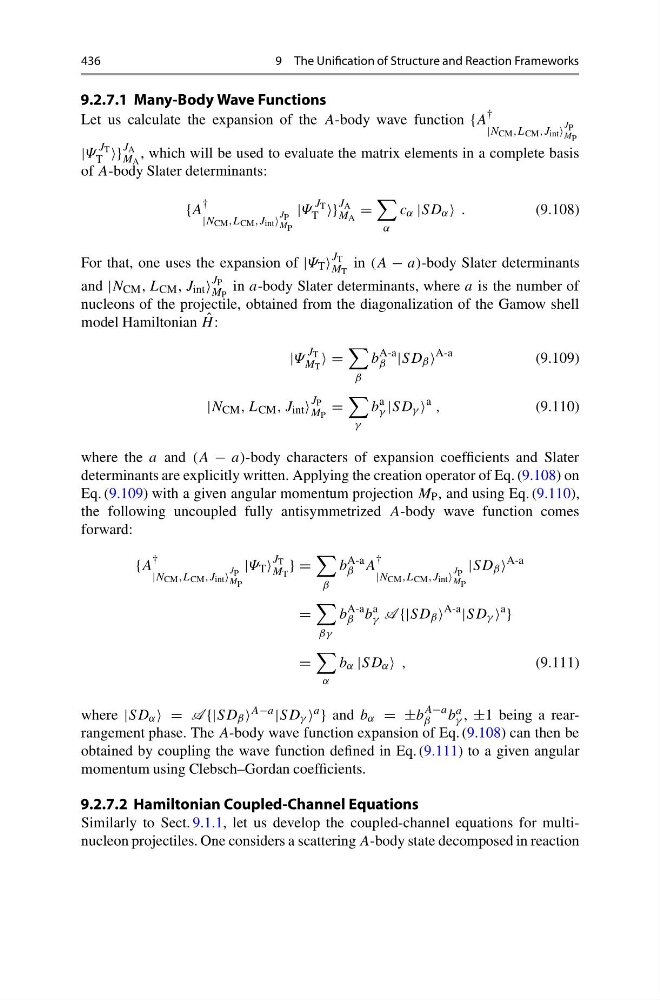
Let us calculate the expansion of the A-body wave function {A
†
|N CM ,L CM ,J int
J P
M P
|Ψ
J T
T
J A
M A
, which will be used to evaluate the matrix elements in a complete basis
of A-body Slater determinants:
{A
†
|N CM ,L CM ,J int
J P
M P
|Ψ
J T
T
J A
M A
=
α
c α |SD α .
(9.108)
For that, one uses the expansion of |Ψ T
J T
M T
in (A − a)-body Slater determinants
and |N CM , L CM , J int
J P
M P
in a-body Slater determinants, where a is the number of
nucleons of the projectile, obtained from the diagonalization of the Gamow shell
model Hamiltonian ˆ
H :
|Ψ
J T
M T
=
β
b
A-a
β |SD β
A-a
(9.109)
|N CM , L CM , J int
J P
M P
=
γ
b
a
γ |SD γ
a ,
(9.110)
where the a and (A − a)-body characters of expansion coefficients and Slater
determinants are explicitly written. Applying the creation operator of Eq. (9.108) on
Eq. (9.109) with a given angular momentum projection M P , and using Eq. (9.110),
the following uncoupled fully antisymmetrized A-body wave function comes
forward:
{A
†
|N CM ,L CM ,J int
J P
M P
|Ψ T
J T
M T
} =
β
b
A-a
β A
†
|N CM ,L CM ,J int
J P
M P
|SD β
A-a
=
βγ
b
A-a
β b
a
γ A {|SD β
A-a
|SD γ
a
}
=
α
b α |SD α ,
(9.111)
where |SD α = A {|SD β A−a |SD γ a } and b α = ±b
A−a
β
b a
γ , ±1 being a rearrangement phase. The A-body wave function expansion of Eq. (9.108) can then be
obtained by coupling the wave function defined in Eq. (9.111) to a given angular
momentum using Clebsch–Gordan coefficients.
9.2.7.2 Hamiltonian Coupled-Channel Equations
Similarly to Sect. 9.1.1, let us develop the coupled-channel equations for multinucleon projectiles. One considers a scattering A-body state decomposed in reaction
9 The Unification of Structure and Reaction Frameworks
9.2.7.1 Many-Body Wave Functions
Let us calculate the expansion of the A-body wave function {A
†
|N CM ,L CM ,J int
J P
M P
|Ψ
J T
T
J A
M A
, which will be used to evaluate the matrix elements in a complete basis
of A-body Slater determinants:
{A
†
|N CM ,L CM ,J int
J P
M P
|Ψ
J T
T
J A
M A
=
α
c α |SD α .
(9.108)
For that, one uses the expansion of |Ψ T
J T
M T
in (A − a)-body Slater determinants
and |N CM , L CM , J int
J P
M P
in a-body Slater determinants, where a is the number of
nucleons of the projectile, obtained from the diagonalization of the Gamow shell
model Hamiltonian ˆ
H :
|Ψ
J T
M T
=
β
b
A-a
β |SD β
A-a
(9.109)
|N CM , L CM , J int
J P
M P
=
γ
b
a
γ |SD γ
a ,
(9.110)
where the a and (A − a)-body characters of expansion coefficients and Slater
determinants are explicitly written. Applying the creation operator of Eq. (9.108) on
Eq. (9.109) with a given angular momentum projection M P , and using Eq. (9.110),
the following uncoupled fully antisymmetrized A-body wave function comes
forward:
{A
†
|N CM ,L CM ,J int
J P
M P
|Ψ T
J T
M T
} =
β
b
A-a
β A
†
|N CM ,L CM ,J int
J P
M P
|SD β
A-a
=
βγ
b
A-a
β b
a
γ A {|SD β
A-a
|SD γ
a
}
=
α
b α |SD α ,
(9.111)
where |SD α = A {|SD β A−a |SD γ a } and b α = ±b
A−a
β
b a
γ , ±1 being a rearrangement phase. The A-body wave function expansion of Eq. (9.108) can then be
obtained by coupling the wave function defined in Eq. (9.111) to a given angular
momentum using Clebsch–Gordan coefficients.
9.2.7.2 Hamiltonian Coupled-Channel Equations
Similarly to Sect. 9.1.1, let us develop the coupled-channel equations for multinucleon projectiles. One considers a scattering A-body state decomposed in reaction