

9.2 Generalization to Many-Nucleon Projectiles
423
9.2.1 Clusters in the Berggren Basis Formalism
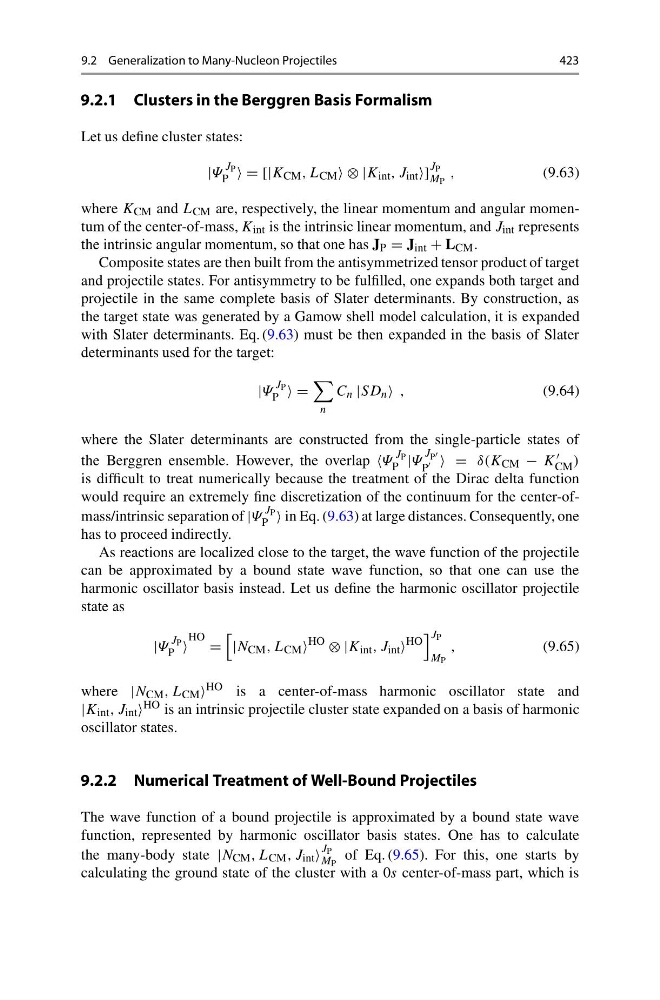
Let us define cluster states:
|Ψ
J P
P = [|K CM , L CM ⊗ |K int , J int ]
J P
M P
,
(9.63)
where K CM and L CM are, respectively, the linear momentum and angular momentum of the center-of-mass, K int is the intrinsic linear momentum, and J int represents
the intrinsic angular momentum, so that one has J P = J int + L CM .
Composite states are then built from the antisymmetrized tensor product of target
and projectile states. For antisymmetry to be fulfilled, one expands both target and
projectile in the same complete basis of Slater determinants. By construction, as
the target state was generated by a Gamow shell model calculation, it is expanded
with Slater determinants. Eq. (9.63) must be then expanded in the basis of Slater
determinants used for the target:
|Ψ
J P
P =
n
C n |SD n ,
(9.64)
where the Slater determinants are constructed from the single-particle states of
the Berggren ensemble. However, the overlap
J P
P |Ψ
J P
P = δ(K CM − K
CM )
is difficult to treat numerically because the treatment of the Dirac delta function
would require an extremely fine discretization of the continuum for the center-ofmass/intrinsic separation of |Ψ
J P
P in Eq. (9.63) at large distances. Consequently, one
has to proceed indirectly.
As reactions are localized close to the target, the wave function of the projectile
can be approximated by a bound state wave function, so that one can use the
harmonic oscillator basis instead. Let us define the harmonic oscillator projectile
state as
|Ψ
J P
P
HO =
|N CM , L CM
HO
⊗ |K int , J int
HO
J P
M P
,
(9.65)
where |N CM , L CM HO is a center-of-mass harmonic oscillator state and
|K int , J int HO is an intrinsic projectile cluster state expanded on a basis of harmonic
oscillator states.
9.2.2 Numerical Treatment of Well-Bound Projectiles
The wave function of a bound projectile is approximated by a bound state wave
function, represented by harmonic oscillator basis states. One has to calculate
the many-body state |N CM , L CM , J int
J P
M P
of Eq. (9.65). For this, one starts by
calculating the ground state of the cluster with a 0s center-of-mass part, which is
423
9.2.1 Clusters in the Berggren Basis Formalism
Let us define cluster states:
|Ψ
J P
P = [|K CM , L CM ⊗ |K int , J int ]
J P
M P
,
(9.63)
where K CM and L CM are, respectively, the linear momentum and angular momentum of the center-of-mass, K int is the intrinsic linear momentum, and J int represents
the intrinsic angular momentum, so that one has J P = J int + L CM .
Composite states are then built from the antisymmetrized tensor product of target
and projectile states. For antisymmetry to be fulfilled, one expands both target and
projectile in the same complete basis of Slater determinants. By construction, as
the target state was generated by a Gamow shell model calculation, it is expanded
with Slater determinants. Eq. (9.63) must be then expanded in the basis of Slater
determinants used for the target:
|Ψ
J P
P =
n
C n |SD n ,
(9.64)
where the Slater determinants are constructed from the single-particle states of
the Berggren ensemble. However, the overlap
J P
P |Ψ
J P
P = δ(K CM − K
CM )
is difficult to treat numerically because the treatment of the Dirac delta function
would require an extremely fine discretization of the continuum for the center-ofmass/intrinsic separation of |Ψ
J P
P in Eq. (9.63) at large distances. Consequently, one
has to proceed indirectly.
As reactions are localized close to the target, the wave function of the projectile
can be approximated by a bound state wave function, so that one can use the
harmonic oscillator basis instead. Let us define the harmonic oscillator projectile
state as
|Ψ
J P
P
HO =
|N CM , L CM
HO
⊗ |K int , J int
HO
J P
M P
,
(9.65)
where |N CM , L CM HO is a center-of-mass harmonic oscillator state and
|K int , J int HO is an intrinsic projectile cluster state expanded on a basis of harmonic
oscillator states.
9.2.2 Numerical Treatment of Well-Bound Projectiles
The wave function of a bound projectile is approximated by a bound state wave
function, represented by harmonic oscillator basis states. One has to calculate
the many-body state |N CM , L CM , J int
J P
M P
of Eq. (9.65). For this, one starts by
calculating the ground state of the cluster with a 0s center-of-mass part, which is