

9.1 Nucleon–Nucleus Reactions
421
• mc 2 , in MeV, is the mass of the nucleon;
• g
i is the dimensionless magnetic orbital momentum of the nucleon i multiplied
by L + 1, so that it is 2 for proton and 0 for neutron.
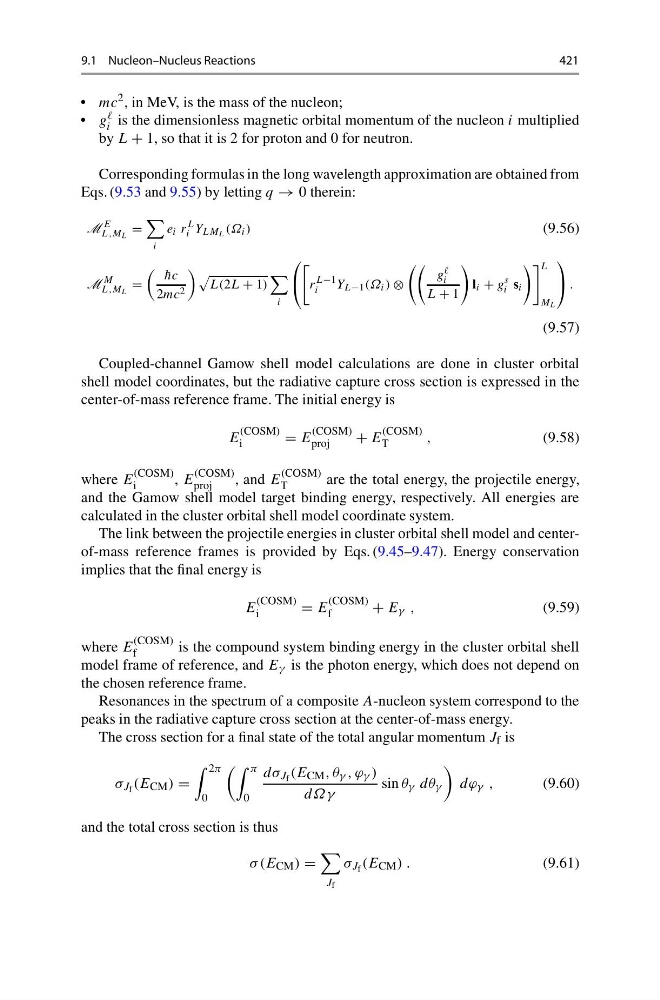
Corresponding formulas in the long wavelength approximation are obtained from
Eqs. (9.53 and 9.55) by letting q → 0 therein:
M
E
L,M L
=
i
e i r
L
i Y LM L (Ω i )
(9.56)
M
M
L,M L
=
¯
hc
2mc 2
L(2L + 1)
i
⎛
⎝
r
L−1
i
Y L−1 (Ω i ) ⊗
g
i
L + 1
l i + g
s
i s i
L
M L
⎞
⎠ .
(9.57)
Coupled-channel Gamow shell model calculations are done in cluster orbital
shell model coordinates, but the radiative capture cross section is expressed in the
center-of-mass reference frame. The initial energy is
E
(COSM)
i
= E
(COSM)
proj
+ E
(COSM)
T
,
(9.58)
where E
(COSM)
i
, E
(COSM)
proj
, and E
(COSM)
T
are the total energy, the projectile energy,
and the Gamow shell model target binding energy, respectively. All energies are
calculated in the cluster orbital shell model coordinate system.
The link between the projectile energies in cluster orbital shell model and centerof-mass reference frames is provided by Eqs. (9.45–9.47). Energy conservation
implies that the final energy is
E
(COSM)
i
= E
(COSM)
f
+ E γ ,
(9.59)
where E
(COSM)
f
is the compound system binding energy in the cluster orbital shell
model frame of reference, and E γ is the photon energy, which does not depend on
the chosen reference frame.
Resonances in the spectrum of a composite A-nucleon system correspond to the
peaks in the radiative capture cross section at the center-of-mass energy.
The cross section for a final state of the total angular momentum J f is
σ J f (E CM ) =
2π
0
π
0
dσ J f (E CM , θ γ , ϕ γ )
dΩγ
sin θ γ dθ γ
dϕ γ ,
(9.60)
and the total cross section is thus
σ (E CM ) =
J f
σ J f (E CM ) .
(9.61)
421
• mc 2 , in MeV, is the mass of the nucleon;
• g
i is the dimensionless magnetic orbital momentum of the nucleon i multiplied
by L + 1, so that it is 2 for proton and 0 for neutron.
Corresponding formulas in the long wavelength approximation are obtained from
Eqs. (9.53 and 9.55) by letting q → 0 therein:
M
E
L,M L
=
i
e i r
L
i Y LM L (Ω i )
(9.56)
M
M
L,M L
=
¯
hc
2mc 2
L(2L + 1)
i
⎛
⎝
r
L−1
i
Y L−1 (Ω i ) ⊗
g
i
L + 1
l i + g
s
i s i
L
M L
⎞
⎠ .
(9.57)
Coupled-channel Gamow shell model calculations are done in cluster orbital
shell model coordinates, but the radiative capture cross section is expressed in the
center-of-mass reference frame. The initial energy is
E
(COSM)
i
= E
(COSM)
proj
+ E
(COSM)
T
,
(9.58)
where E
(COSM)
i
, E
(COSM)
proj
, and E
(COSM)
T
are the total energy, the projectile energy,
and the Gamow shell model target binding energy, respectively. All energies are
calculated in the cluster orbital shell model coordinate system.
The link between the projectile energies in cluster orbital shell model and centerof-mass reference frames is provided by Eqs. (9.45–9.47). Energy conservation
implies that the final energy is
E
(COSM)
i
= E
(COSM)
f
+ E γ ,
(9.59)
where E
(COSM)
f
is the compound system binding energy in the cluster orbital shell
model frame of reference, and E γ is the photon energy, which does not depend on
the chosen reference frame.
Resonances in the spectrum of a composite A-nucleon system correspond to the
peaks in the radiative capture cross section at the center-of-mass energy.
The cross section for a final state of the total angular momentum J f is
σ J f (E CM ) =
2π
0
π
0
dσ J f (E CM , θ γ , ϕ γ )
dΩγ
sin θ γ dθ γ
dϕ γ ,
(9.60)
and the total cross section is thus
σ (E CM ) =
J f
σ J f (E CM ) .
(9.61)