

9.1 Nucleon–Nucleus Reactions
419
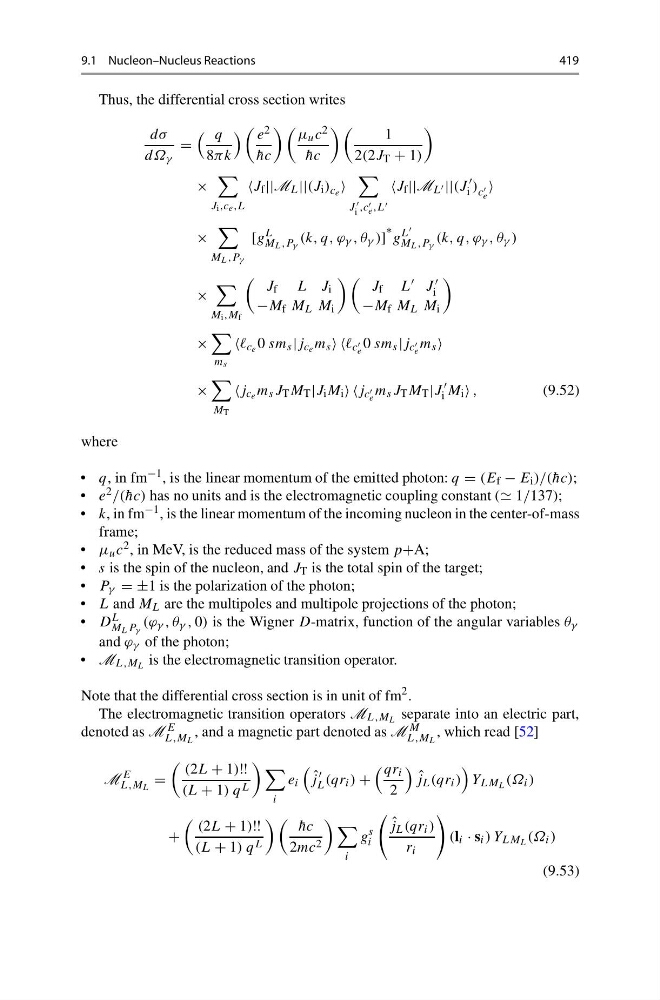
Thus, the differential cross section writes
dσ
dΩ γ
=
q
8πk
e 2
¯
hc
μ u c 2
¯
hc
1
2(2J T + 1)
×
J i ,c e ,L
f ||M L ||(J i ) c e
J
i ,c
e ,L
J f ||M L ||(J
i ) c
e
×
M L ,P γ
[g
L
M L ,P γ
(k, q, ϕ γ , θ γ )]
∗ g
L
M L ,P γ
(k, q, ϕ γ , θ γ )
×
M i ,M f
J f L J i
−M f M L M i
J f L J
i
−M f M L M i
×
m s
c e 0 sm s |j c e m s c
e
0 sm s |j c
e
m s
×
M T
c e m s J T M T |J i M i c
e
m s J T M T |J
i M i ,
(9.52)
where
• q, in fm −1 , is the linear momentum of the emitted photon: q = (E f − E i )/( ¯
hc);
• e 2 /( ¯
hc) has no units and is the electromagnetic coupling constant ( 1/137);
• k, in fm −1 , is the linear momentum of the incoming nucleon in the center-of-mass
frame;
• μ u c 2 , in MeV, is the reduced mass of the system p+A;
• s is the spin of the nucleon, and J T is the total spin of the target;
• P γ = ±1 is the polarization of the photon;
• L and M L are the multipoles and multipole projections of the photon;
• D L
M L P γ
(ϕ γ , θ γ , 0) is the Wigner D-matrix, function of the angular variables θ γ
and ϕ γ of the photon;
• M L,M L is the electromagnetic transition operator.
Note that the differential cross section is in unit of fm
2 .
The electromagnetic transition operators M L,M L separate into an electric part,
denoted as M E
L,M L
, and a magnetic part denoted as M M
L,M L
, which read [52]
M
E
L,M L
=
(2L + 1)!!
(L + 1) q L
i
e i
ˆ
j
L (qr i ) +
qr i
2
ˆ
j L (qr i )
Y LM L (Ω i )
+
(2L + 1)!!
(L + 1) q L
¯
hc
2mc 2
i
g
s
i
ˆ
j L (qr i )
r i
(l i · s i ) Y LM L (Ω i )
(9.53)
419
Thus, the differential cross section writes
dσ
dΩ γ
=
q
8πk
e 2
¯
hc
μ u c 2
¯
hc
1
2(2J T + 1)
×
J i ,c e ,L
f ||M L ||(J i ) c e
J
i ,c
e ,L
J f ||M L ||(J
i ) c
e
×
M L ,P γ
[g
L
M L ,P γ
(k, q, ϕ γ , θ γ )]
∗ g
L
M L ,P γ
(k, q, ϕ γ , θ γ )
×
M i ,M f
J f L J i
−M f M L M i
J f L J
i
−M f M L M i
×
m s
c e 0 sm s |j c e m s c
e
0 sm s |j c
e
m s
×
M T
c e m s J T M T |J i M i c
e
m s J T M T |J
i M i ,
(9.52)
where
• q, in fm −1 , is the linear momentum of the emitted photon: q = (E f − E i )/( ¯
hc);
• e 2 /( ¯
hc) has no units and is the electromagnetic coupling constant ( 1/137);
• k, in fm −1 , is the linear momentum of the incoming nucleon in the center-of-mass
frame;
• μ u c 2 , in MeV, is the reduced mass of the system p+A;
• s is the spin of the nucleon, and J T is the total spin of the target;
• P γ = ±1 is the polarization of the photon;
• L and M L are the multipoles and multipole projections of the photon;
• D L
M L P γ
(ϕ γ , θ γ , 0) is the Wigner D-matrix, function of the angular variables θ γ
and ϕ γ of the photon;
• M L,M L is the electromagnetic transition operator.
Note that the differential cross section is in unit of fm
2 .
The electromagnetic transition operators M L,M L separate into an electric part,
denoted as M E
L,M L
, and a magnetic part denoted as M M
L,M L
, which read [52]
M
E
L,M L
=
(2L + 1)!!
(L + 1) q L
i
e i
ˆ
j
L (qr i ) +
qr i
2
ˆ
j L (qr i )
Y LM L (Ω i )
+
(2L + 1)!!
(L + 1) q L
¯
hc
2mc 2
i
g
s
i
ˆ
j L (qr i )
r i
(l i · s i ) Y LM L (Ω i )
(9.53)