

9.1 Nucleon–Nucleus Reactions
417
Note that the φ-dependence disappears from scattering amplitudes, as one would
expect in this axially symmetric process.
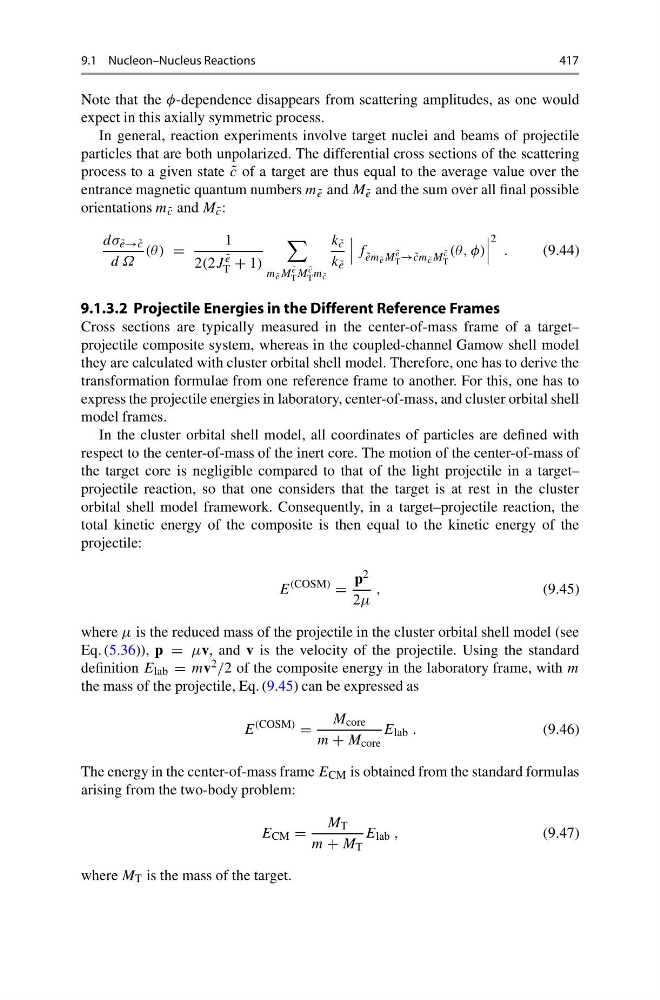
In general, reaction experiments involve target nuclei and beams of projectile
particles that are both unpolarized. The differential cross sections of the scattering
process to a given state ˜
c of a target are thus equal to the average value over the
entrance magnetic quantum numbers m ˜
e and M ˜
e and the sum over all final possible
orientations m ˜
c and M ˜
c :
dσ ˜
e→˜ c
d Ω
(θ ) =
1
2(2J
˜
e
T + 1)
m ˜
e M ˜
e
T M ˜
c
T m ˜
c
k ˜
c
k ˜
e
f ˜
em ˜
e M ˜
e
T →˜ cm ˜
c M ˜
c
T
(θ, φ)
2
.
(9.44)
9.1.3.2 Projectile Energies in the Different Reference Frames
Cross sections are typically measured in the center-of-mass frame of a target–
projectile composite system, whereas in the coupled-channel Gamow shell model
they are calculated with cluster orbital shell model. Therefore, one has to derive the
transformation formulae from one reference frame to another. For this, one has to
express the projectile energies in laboratory, center-of-mass, and cluster orbital shell
model frames.
In the cluster orbital shell model, all coordinates of particles are defined with
respect to the center-of-mass of the inert core. The motion of the center-of-mass of
the target core is negligible compared to that of the light projectile in a target–
projectile reaction, so that one considers that the target is at rest in the cluster
orbital shell model framework. Consequently, in a target–projectile reaction, the
total kinetic energy of the composite is then equal to the kinetic energy of the
projectile:
E
(COSM)
=
p 2
2μ
,
(9.45)
where μ is the reduced mass of the projectile in the cluster orbital shell model (see
Eq. (5.36)), p = μv, and v is the velocity of the projectile. Using the standard
definition E lab = mv 2 /2 of the composite energy in the laboratory frame, with m
the mass of the projectile, Eq. (9.45) can be expressed as
E
(COSM)
=
M core
m + M core
E lab .
(9.46)
The energy in the center-of-mass frame E CM is obtained from the standard formulas
arising from the two-body problem:
E CM =
M T
m + M T
E lab ,
(9.47)
where M T is the mass of the target.
417
Note that the φ-dependence disappears from scattering amplitudes, as one would
expect in this axially symmetric process.
In general, reaction experiments involve target nuclei and beams of projectile
particles that are both unpolarized. The differential cross sections of the scattering
process to a given state ˜
c of a target are thus equal to the average value over the
entrance magnetic quantum numbers m ˜
e and M ˜
e and the sum over all final possible
orientations m ˜
c and M ˜
c :
dσ ˜
e→˜ c
d Ω
(θ ) =
1
2(2J
˜
e
T + 1)
m ˜
e M ˜
e
T M ˜
c
T m ˜
c
k ˜
c
k ˜
e
f ˜
em ˜
e M ˜
e
T →˜ cm ˜
c M ˜
c
T
(θ, φ)
2
.
(9.44)
9.1.3.2 Projectile Energies in the Different Reference Frames
Cross sections are typically measured in the center-of-mass frame of a target–
projectile composite system, whereas in the coupled-channel Gamow shell model
they are calculated with cluster orbital shell model. Therefore, one has to derive the
transformation formulae from one reference frame to another. For this, one has to
express the projectile energies in laboratory, center-of-mass, and cluster orbital shell
model frames.
In the cluster orbital shell model, all coordinates of particles are defined with
respect to the center-of-mass of the inert core. The motion of the center-of-mass of
the target core is negligible compared to that of the light projectile in a target–
projectile reaction, so that one considers that the target is at rest in the cluster
orbital shell model framework. Consequently, in a target–projectile reaction, the
total kinetic energy of the composite is then equal to the kinetic energy of the
projectile:
E
(COSM)
=
p 2
2μ
,
(9.45)
where μ is the reduced mass of the projectile in the cluster orbital shell model (see
Eq. (5.36)), p = μv, and v is the velocity of the projectile. Using the standard
definition E lab = mv 2 /2 of the composite energy in the laboratory frame, with m
the mass of the projectile, Eq. (9.45) can be expressed as
E
(COSM)
=
M core
m + M core
E lab .
(9.46)
The energy in the center-of-mass frame E CM is obtained from the standard formulas
arising from the two-body problem:
E CM =
M T
m + M T
E lab ,
(9.47)
where M T is the mass of the target.