

9.1 Nucleon–Nucleus Reactions
415
where the radial amplitude u
e,J A
c
(r) is explicitly written for a given composite state
J A and entrance channel e. The |(c, r) channel state is here written as
|(c, r) = ˆ
A {|Ψ
J c
T
T ⊗ |r r c j c m c τ c
J A
M A
.
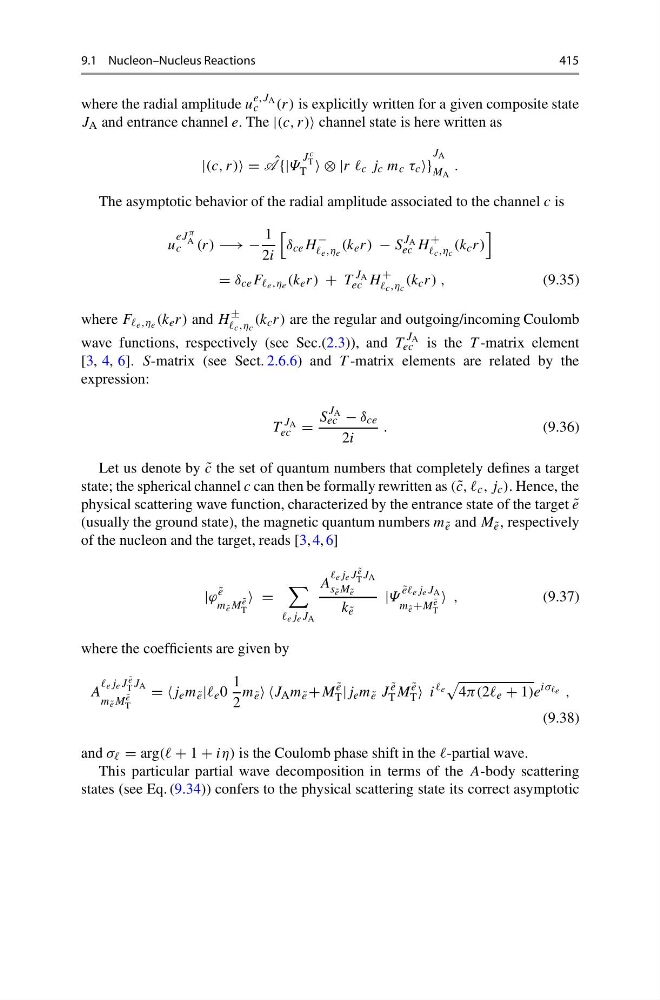
The asymptotic behavior of the radial amplitude associated to the channel c is
u
eJ π
A
c (r) −→ −
1
2i
δ ce H
−
e ,η e
(k e r) − S
J A
ec H
+
c ,η c
(k c r)
= δ ce F e ,η e (k e r) + T
J A
ec H
+
c ,η c
(k c r) ,
(9.35)
where F e ,η e (k e r) and H
±
c ,η c
(k c r) are the regular and outgoing/incoming Coulomb
wave functions, respectively (see Sec.(2.3)), and T
J A
ec is the T -matrix element
[3, 4, 6]. S-matrix (see Sect. 2.6.6) and T -matrix elements are related by the
expression:
T
J A
ec =
S
J A
ec − δ ce
2i
.
(9.36)
Let us denote by ˜
c the set of quantum numbers that completely defines a target
state; the spherical channel c can then be formally rewritten as ( ˜
c, , c , j c ). Hence, the
physical scattering wave function, characterized by the entrance state of the target ˜
e
(usually the ground state), the magnetic quantum numbers m ˜
e and M ˜
e , respectively
of the nucleon and the target, reads [3, 4, 6]
|ϕ
˜
e
m ˜
e M ˜
e
T
=
e j e J A
A
e j e J ˜
e
T J A
s ˜
e M ˜
e
k ˜
e
|Ψ
˜
ee e j e J A
m ˜
e +M ˜
e
T
,
(9.37)
where the coefficients are given by
A
e j e J ˜
e
T J A
m ˜
e M ˜
e
T
= =j e m ˜
e | e 0
1
2
m ˜
e A m ˜
e +M
˜
e
T |j e m ˜
e J
˜
e
T M
˜
e
T i
e
4π(2 e + 1)e
iσ e ,
(9.38)
and σ = arg(( + 1 + iη) is the Coulomb phase shift in the -partial wave.
This particular partial wave decomposition in terms of the A-body scattering
states (see Eq. (9.34)) confers to the physical scattering state its correct asymptotic
415
where the radial amplitude u
e,J A
c
(r) is explicitly written for a given composite state
J A and entrance channel e. The |(c, r) channel state is here written as
|(c, r) = ˆ
A {|Ψ
J c
T
T ⊗ |r r c j c m c τ c
J A
M A
.
The asymptotic behavior of the radial amplitude associated to the channel c is
u
eJ π
A
c (r) −→ −
1
2i
δ ce H
−
e ,η e
(k e r) − S
J A
ec H
+
c ,η c
(k c r)
= δ ce F e ,η e (k e r) + T
J A
ec H
+
c ,η c
(k c r) ,
(9.35)
where F e ,η e (k e r) and H
±
c ,η c
(k c r) are the regular and outgoing/incoming Coulomb
wave functions, respectively (see Sec.(2.3)), and T
J A
ec is the T -matrix element
[3, 4, 6]. S-matrix (see Sect. 2.6.6) and T -matrix elements are related by the
expression:
T
J A
ec =
S
J A
ec − δ ce
2i
.
(9.36)
Let us denote by ˜
c the set of quantum numbers that completely defines a target
state; the spherical channel c can then be formally rewritten as ( ˜
c, , c , j c ). Hence, the
physical scattering wave function, characterized by the entrance state of the target ˜
e
(usually the ground state), the magnetic quantum numbers m ˜
e and M ˜
e , respectively
of the nucleon and the target, reads [3, 4, 6]
|ϕ
˜
e
m ˜
e M ˜
e
T
=
e j e J A
A
e j e J ˜
e
T J A
s ˜
e M ˜
e
k ˜
e
|Ψ
˜
ee e j e J A
m ˜
e +M ˜
e
T
,
(9.37)
where the coefficients are given by
A
e j e J ˜
e
T J A
m ˜
e M ˜
e
T
= =j e m ˜
e | e 0
1
2
m ˜
e A m ˜
e +M
˜
e
T |j e m ˜
e J
˜
e
T M
˜
e
T i
e
4π(2 e + 1)e
iσ e ,
(9.38)
and σ = arg(( + 1 + iη) is the Coulomb phase shift in the -partial wave.
This particular partial wave decomposition in terms of the A-body scattering
states (see Eq. (9.34)) confers to the physical scattering state its correct asymptotic