

410
9 The Unification of Structure and Reaction Frameworks
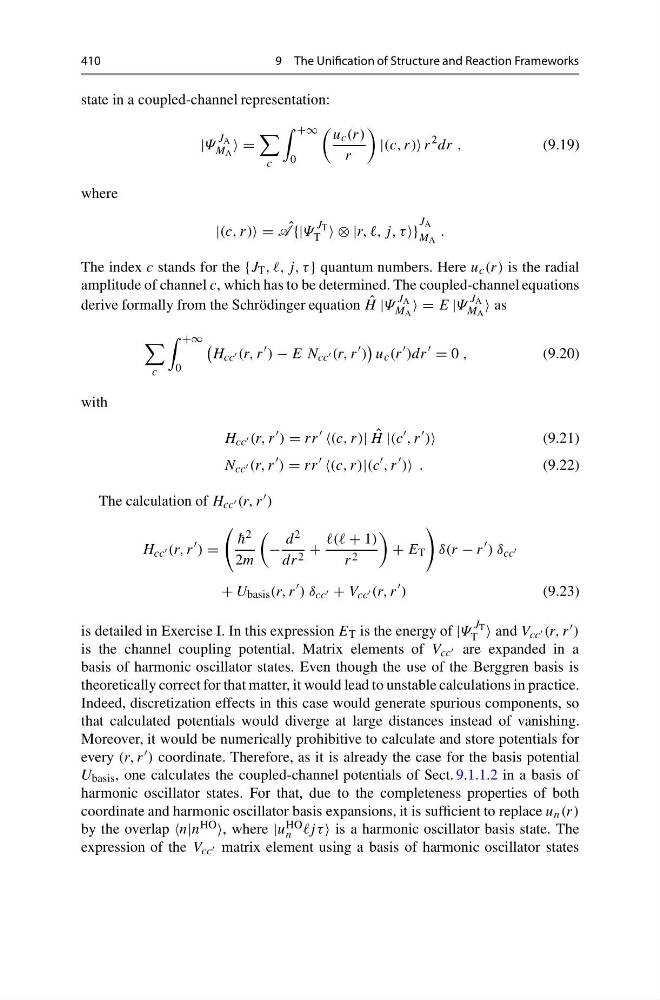
state in a coupled-channel representation:
|Ψ
J A
M A
=
c
+∞
0
u c (r)
r
|(c, r) r
2 dr ,
(9.19)
where
|(c, r) = ˆ
A {|Ψ
J T
T ⊗ |r, ,, j, τ
J A
M A
.
The index c stands for the {J T , ,, j, τ } quantum numbers. Here u c (r) is the radial
amplitude of channel c, which has to be determined. The coupled-channel equations
derive formally from the Schrödinger equation ˆ
H |Ψ
J A
M A
= E |Ψ
J A
M A
as
c
+∞
0
H cc (r, r
) − E N cc (r, r
)
u c (r
)dr
= 0 ,
(9.20)
with
H cc (r, r
) = rr
(c, r)| ˆ
H |(c
, r
)
(9.21)
N cc (r, r
) = rr
(c, r)|(c
, r
) .
(9.22)
The calculation of H cc (r, r )
H cc (r, r
) =
¯
h
2
2m
−
d 2
dr 2 +
+ 1)
r 2
+ E T
δ(r − r
) δ cc
+ U basis (r, r
) δ cc + V cc (r, r
)
(9.23)
is detailed in Exercise I. In this expression E T is the energy of |Ψ
J T
T and V cc (r, r )
is the channel coupling potential. Matrix elements of V cc are expanded in a
basis of harmonic oscillator states. Even though the use of the Berggren basis is
theoretically correct for that matter, it would lead to unstable calculations in practice.
Indeed, discretization effects in this case would generate spurious components, so
that calculated potentials would diverge at large distances instead of vanishing.
Moreover, it would be numerically prohibitive to calculate and store potentials for
every (r, r ) coordinate. Therefore, as it is already the case for the basis potential
U basis , one calculates the coupled-channel potentials of Sect. 9.1.1.2 in a basis of
harmonic oscillator states. For that, due to the completeness properties of both
coordinate and harmonic oscillator basis expansions, it is sufficient to replace u n (r)
by the overlap HO , where |u HO
n τ is a harmonic oscillator basis state. The
expression of the V cc matrix element using a basis of harmonic oscillator states
9 The Unification of Structure and Reaction Frameworks
state in a coupled-channel representation:
|Ψ
J A
M A
=
c
+∞
0
u c (r)
r
|(c, r) r
2 dr ,
(9.19)
where
|(c, r) = ˆ
A {|Ψ
J T
T ⊗ |r, ,, j, τ
J A
M A
.
The index c stands for the {J T , ,, j, τ } quantum numbers. Here u c (r) is the radial
amplitude of channel c, which has to be determined. The coupled-channel equations
derive formally from the Schrödinger equation ˆ
H |Ψ
J A
M A
= E |Ψ
J A
M A
as
c
+∞
0
H cc (r, r
) − E N cc (r, r
)
u c (r
)dr
= 0 ,
(9.20)
with
H cc (r, r
) = rr
(c, r)| ˆ
H |(c
, r
)
(9.21)
N cc (r, r
) = rr
(c, r)|(c
, r
) .
(9.22)
The calculation of H cc (r, r )
H cc (r, r
) =
¯
h
2
2m
−
d 2
dr 2 +
+ 1)
r 2
+ E T
δ(r − r
) δ cc
+ U basis (r, r
) δ cc + V cc (r, r
)
(9.23)
is detailed in Exercise I. In this expression E T is the energy of |Ψ
J T
T and V cc (r, r )
is the channel coupling potential. Matrix elements of V cc are expanded in a
basis of harmonic oscillator states. Even though the use of the Berggren basis is
theoretically correct for that matter, it would lead to unstable calculations in practice.
Indeed, discretization effects in this case would generate spurious components, so
that calculated potentials would diverge at large distances instead of vanishing.
Moreover, it would be numerically prohibitive to calculate and store potentials for
every (r, r ) coordinate. Therefore, as it is already the case for the basis potential
U basis , one calculates the coupled-channel potentials of Sect. 9.1.1.2 in a basis of
harmonic oscillator states. For that, due to the completeness properties of both
coordinate and harmonic oscillator basis expansions, it is sufficient to replace u n (r)
by the overlap HO , where |u HO
n τ is a harmonic oscillator basis state. The
expression of the V cc matrix element using a basis of harmonic oscillator states