

9.1 Nucleon–Nucleus Reactions
407
9.1.1 Coupled-Channel Hamiltonian for Structure and Reaction
Observables
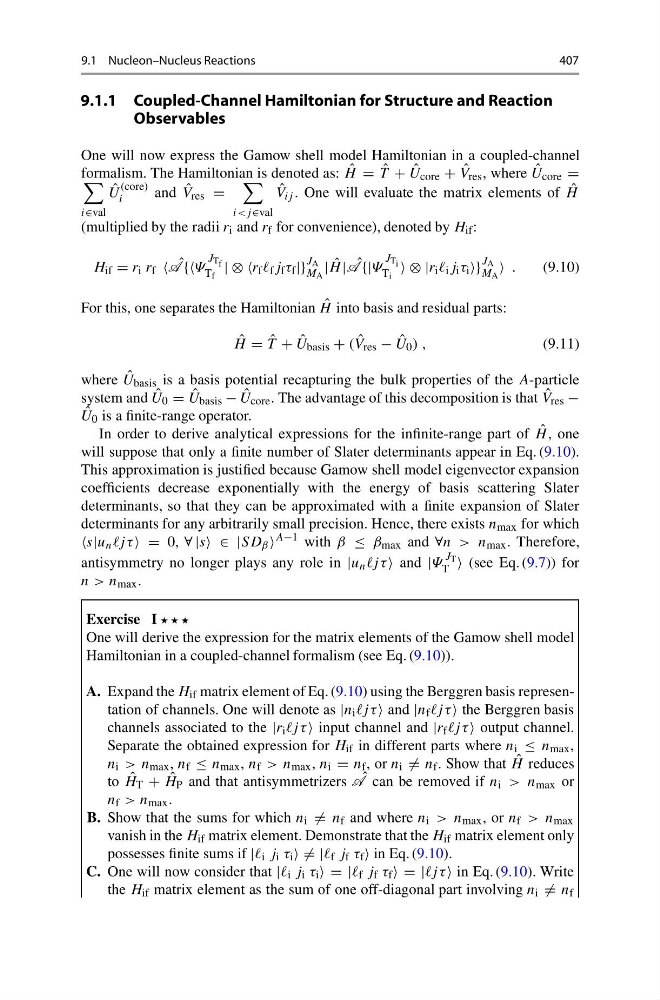
One will now express the Gamow shell model Hamiltonian in a coupled-channel
formalism. The Hamiltonian is denoted as: ˆ
H = ˆ
T + ˆ
U core + ˆ
V res , where ˆ
U core =
i∈val
ˆ
U
(core)
i
and ˆ
V res =
i
V ij . One will evaluate the matrix elements of ˆ
H
(multiplied by the radii r i and r f for convenience), denoted by H if :
H if = r i r f ˆ
A {{Ψ
J T f
T f
| ⊗ ⊗r f f j f τ f |}
J A
M A
| ˆ
H | ˆ
A {|Ψ
J T i
T i
⊗ |r i i j i τ i
J A
M A
.
(9.10)
For this, one separates the Hamiltonian ˆ
H into basis and residual parts:
ˆ
H = ˆ
T + ˆ
U basis + ( ˆ
V res − ˆ
U 0 ) ,
(9.11)
where ˆ
U basis is a basis potential recapturing the bulk properties of the A-particle
system and ˆ
U 0 = ˆ
U basis − ˆ
U core . The advantage of this decomposition is that ˆ
V res −
ˆ
U 0 is a finite-range operator.
In order to derive analytical expressions for the infinite-range part of ˆ
H , one
will suppose that only a finite number of Slater determinants appear in Eq. (9.10).
This approximation is justified because Gamow shell model eigenvector expansion
coefficients decrease exponentially with the energy of basis scattering Slater
determinants, so that they can be approximated with a finite expansion of Slater
determinants for any arbitrarily small precision. Hence, there exists n max for which
n j τ = 0, ∀ |s ∈ |SD β
A−1 with β ≤ β max and ∀n > n max . Therefore,
antisymmetry no longer plays any role in |u n j τ and |Ψ
J T
T (see Eq. (9.7)) for
n > n max .
Exercise I
One will derive the expression for the matrix elements of the Gamow shell model
Hamiltonian in a coupled-channel formalism (see Eq. (9.10)).
A. Expand the H if matrix element of Eq. (9.10) using the Berggren basis representation of channels. One will denote as |n i j τ and |n f j τ the Berggren basis
channels associated to the |r i j τ input channel and |r f j τ output channel.
Separate the obtained expression for H if in different parts where n i ≤ n max ,
n i > n max , n f ≤ n max , n f > n max , n i = n f , or n i = n f . Show that ˆ
H reduces
to ˆ
H T + ˆ
H P and that antisymmetrizers ˆ
A can be removed if n i > n max or
n f > n max .
B. Show that the sums for which n i = n f and where n i > n max , or n f > n max
vanish in the H if matrix element. Demonstrate that the H if matrix element only
possesses finite sums if | i j i τ i = | f j f τ f in Eq. (9.10).
C. One will now consider that | i j i τ i = | f j f τ f = |j τ in Eq. (9.10). Write
the H if matrix element as the sum of one off-diagonal part involving n i = n f
407
9.1.1 Coupled-Channel Hamiltonian for Structure and Reaction
Observables
One will now express the Gamow shell model Hamiltonian in a coupled-channel
formalism. The Hamiltonian is denoted as: ˆ
H = ˆ
T + ˆ
U core + ˆ
V res , where ˆ
U core =
i∈val
ˆ
U
(core)
i
and ˆ
V res =
i
V ij . One will evaluate the matrix elements of ˆ
H
(multiplied by the radii r i and r f for convenience), denoted by H if :
H if = r i r f ˆ
A {{Ψ
J T f
T f
| ⊗ ⊗r f f j f τ f |}
J A
M A
| ˆ
H | ˆ
A {|Ψ
J T i
T i
⊗ |r i i j i τ i
J A
M A
.
(9.10)
For this, one separates the Hamiltonian ˆ
H into basis and residual parts:
ˆ
H = ˆ
T + ˆ
U basis + ( ˆ
V res − ˆ
U 0 ) ,
(9.11)
where ˆ
U basis is a basis potential recapturing the bulk properties of the A-particle
system and ˆ
U 0 = ˆ
U basis − ˆ
U core . The advantage of this decomposition is that ˆ
V res −
ˆ
U 0 is a finite-range operator.
In order to derive analytical expressions for the infinite-range part of ˆ
H , one
will suppose that only a finite number of Slater determinants appear in Eq. (9.10).
This approximation is justified because Gamow shell model eigenvector expansion
coefficients decrease exponentially with the energy of basis scattering Slater
determinants, so that they can be approximated with a finite expansion of Slater
determinants for any arbitrarily small precision. Hence, there exists n max for which
n j τ = 0, ∀ |s ∈ |SD β
A−1 with β ≤ β max and ∀n > n max . Therefore,
antisymmetry no longer plays any role in |u n j τ and |Ψ
J T
T (see Eq. (9.7)) for
n > n max .
Exercise I
One will derive the expression for the matrix elements of the Gamow shell model
Hamiltonian in a coupled-channel formalism (see Eq. (9.10)).
A. Expand the H if matrix element of Eq. (9.10) using the Berggren basis representation of channels. One will denote as |n i j τ and |n f j τ the Berggren basis
channels associated to the |r i j τ input channel and |r f j τ output channel.
Separate the obtained expression for H if in different parts where n i ≤ n max ,
n i > n max , n f ≤ n max , n f > n max , n i = n f , or n i = n f . Show that ˆ
H reduces
to ˆ
H T + ˆ
H P and that antisymmetrizers ˆ
A can be removed if n i > n max or
n f > n max .
B. Show that the sums for which n i = n f and where n i > n max , or n f > n max
vanish in the H if matrix element. Demonstrate that the H if matrix element only
possesses finite sums if | i j i τ i = | f j f τ f in Eq. (9.10).
C. One will now consider that | i j i τ i = | f j f τ f = |j τ in Eq. (9.10). Write
the H if matrix element as the sum of one off-diagonal part involving n i = n f