

8.3 Multi-Neutron Resonances
389
body force decreases. This explosion of the width is already visible in the no-core
Gamow shell model results with natural orbitals where the width increases faster
than in the NCGSM-2p2h calculations. Another hint for the explosion of the
width is the impossibility to perform the density matrix renormalization group
calculations far above the four-neutron threshold, even when using the improved
identification technique for broad resonances. This is due to the strong couplings to
the continuum, resulting in large overlaps between complex-energy scattering states
and the targeted decaying resonance, making them indistinguishable. Finally, while
the energy of the four-neutron system may be compatible with the experimental
value when f → 1, calculations including more than two particles in the continuum
as in Table 8.3 suggest that the width of the tetraneutron is larger than Γ ≈ 3.7 MeV,
as can be seen from the NCGSM-2p2h calculation in Fig. 8.7.
This first attempt to determine the binding energy of the tetraneutron has
shown that the no-core Gamow shell model is accurate enough to deal with this
difficult theoretical problem. The consideration of model spaces of different levels
of truncation, as well as the use of the density matrix renormalization group in a
non-truncated model space, proved that the tetraneutron energy can be reasonably
estimated by extrapolating no-core Gamow shell model results in truncated spaces
into an infinite space and the physical nucleon–nucleon interaction. One should
stress, however, that the density matrix renormalization group cannot provide
with definitive information about the width of the tetraneutron, as its domain of
applicability is where the tetraneutron is either bound or has a relatively small width,
i.e. in the overbinding regime of nucleon–nucleon interactions.
8.3.2 Trineutron and Tetraneutron in the Auxiliary Potential
Method
Another method to identify physical resonant states of multi-neutron systems has
been introduced in the quantum Monte Carlo framework [118, 126]. It relies on the
use of potentials confining the valence neutrons in an external trap. In this method,
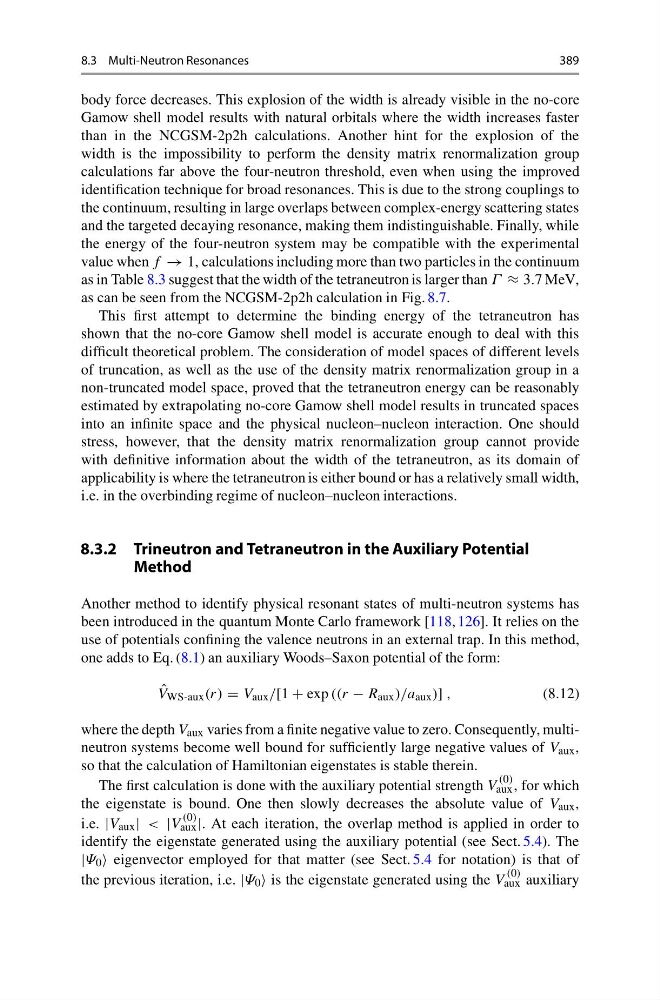
one adds to Eq. (8.1) an auxiliary Woods–Saxon potential of the form:
ˆ
V WS-aux (r) = V aux /[1 + exp ((r − R aux )/a aux )] ,
(8.12)
where the depth V aux varies from a finite negative value to zero. Consequently, multineutron systems become well bound for sufficiently large negative values of V aux ,
so that the calculation of Hamiltonian eigenstates is stable therein.
The first calculation is done with the auxiliary potential strength V
(0)
aux , for which
the eigenstate is bound. One then slowly decreases the absolute value of V aux ,
i.e. |V aux | < |V
(0)
aux |. At each iteration, the overlap method is applied in order to
identify the eigenstate generated using the auxiliary potential (see Sect. 5.4). The
|Ψ 0 eigenvector employed for that matter (see Sect. 5.4 for notation) is that of
the previous iteration, i.e. |Ψ 0 is the eigenstate generated using the V
(0)
aux auxiliary
389
body force decreases. This explosion of the width is already visible in the no-core
Gamow shell model results with natural orbitals where the width increases faster
than in the NCGSM-2p2h calculations. Another hint for the explosion of the
width is the impossibility to perform the density matrix renormalization group
calculations far above the four-neutron threshold, even when using the improved
identification technique for broad resonances. This is due to the strong couplings to
the continuum, resulting in large overlaps between complex-energy scattering states
and the targeted decaying resonance, making them indistinguishable. Finally, while
the energy of the four-neutron system may be compatible with the experimental
value when f → 1, calculations including more than two particles in the continuum
as in Table 8.3 suggest that the width of the tetraneutron is larger than Γ ≈ 3.7 MeV,
as can be seen from the NCGSM-2p2h calculation in Fig. 8.7.
This first attempt to determine the binding energy of the tetraneutron has
shown that the no-core Gamow shell model is accurate enough to deal with this
difficult theoretical problem. The consideration of model spaces of different levels
of truncation, as well as the use of the density matrix renormalization group in a
non-truncated model space, proved that the tetraneutron energy can be reasonably
estimated by extrapolating no-core Gamow shell model results in truncated spaces
into an infinite space and the physical nucleon–nucleon interaction. One should
stress, however, that the density matrix renormalization group cannot provide
with definitive information about the width of the tetraneutron, as its domain of
applicability is where the tetraneutron is either bound or has a relatively small width,
i.e. in the overbinding regime of nucleon–nucleon interactions.
8.3.2 Trineutron and Tetraneutron in the Auxiliary Potential
Method
Another method to identify physical resonant states of multi-neutron systems has
been introduced in the quantum Monte Carlo framework [118, 126]. It relies on the
use of potentials confining the valence neutrons in an external trap. In this method,
one adds to Eq. (8.1) an auxiliary Woods–Saxon potential of the form:
ˆ
V WS-aux (r) = V aux /[1 + exp ((r − R aux )/a aux )] ,
(8.12)
where the depth V aux varies from a finite negative value to zero. Consequently, multineutron systems become well bound for sufficiently large negative values of V aux ,
so that the calculation of Hamiltonian eigenstates is stable therein.
The first calculation is done with the auxiliary potential strength V
(0)
aux , for which
the eigenstate is bound. One then slowly decreases the absolute value of V aux ,
i.e. |V aux | < |V
(0)
aux |. At each iteration, the overlap method is applied in order to
identify the eigenstate generated using the auxiliary potential (see Sect. 5.4). The
|Ψ 0 eigenvector employed for that matter (see Sect. 5.4 for notation) is that of
the previous iteration, i.e. |Ψ 0 is the eigenstate generated using the V
(0)
aux auxiliary