

8.3 Multi-Neutron Resonances
387
Table 8.3 Energies and widths (in brackets) of the J π = 0 + four-neutron pole (in MeV) for
various two-body interactions. The asterisk means that only the two-body part of the interaction
was considered (adapted from Ref. [128])
Λ = 1.7 fm
−1
Λ = 1.9 fm
−1
Λ = 2.1 fm
−1
N 3 LO
7.27 (3.69)
7.28 (3.67)
7.28 (3.69)
N 2 LO opt
7.32 (3.74)
7.33 (3.78)
7.34 (3.95)
N 2 LO sat *
7.24 (3.48)
7.22 (3.58)
7.27 (3.55)
JISP16
7.00 (3.72)
N 3 LO
n
Λ = 1.9 fm
-1
4n-threshold
J
π = 0
+
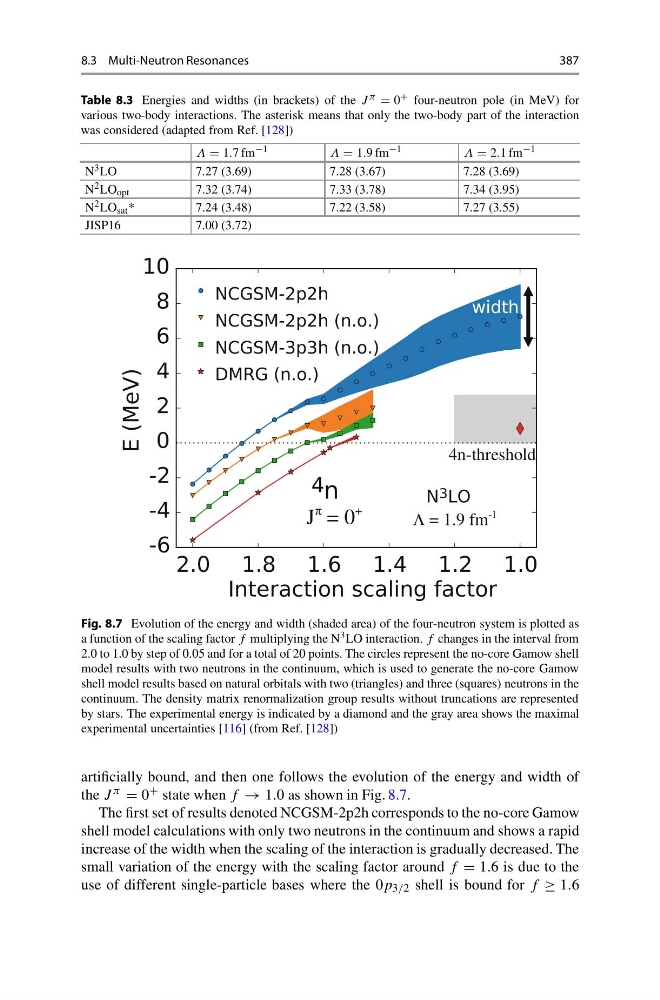
Fig. 8.7 Evolution of the energy and width (shaded area) of the four-neutron system is plotted as
a function of the scaling factor f multiplying the N 3 LO interaction. f changes in the interval from
2.0 to 1.0 by step of 0.05 and for a total of 20 points. The circles represent the no-core Gamow shell
model results with two neutrons in the continuum, which is used to generate the no-core Gamow
shell model results based on natural orbitals with two (triangles) and three (squares) neutrons in the
continuum. The density matrix renormalization group results without truncations are represented
by stars. The experimental energy is indicated by a diamond and the gray area shows the maximal
experimental uncertainties [116] (from Ref. [128])
artificially bound, and then one follows the evolution of the energy and width of
the J π = 0 + state when f → 1.0 as shown in Fig. 8.7.
The first set of results denoted NCGSM-2p2h corresponds to the no-core Gamow
shell model calculations with only two neutrons in the continuum and shows a rapid
increase of the width when the scaling of the interaction is gradually decreased. The
small variation of the energy with the scaling factor around f = 1.6 is due to the
use of different single-particle bases where the 0p 3/2 shell is bound for f ≥ 1.6
387
Table 8.3 Energies and widths (in brackets) of the J π = 0 + four-neutron pole (in MeV) for
various two-body interactions. The asterisk means that only the two-body part of the interaction
was considered (adapted from Ref. [128])
Λ = 1.7 fm
−1
Λ = 1.9 fm
−1
Λ = 2.1 fm
−1
N 3 LO
7.27 (3.69)
7.28 (3.67)
7.28 (3.69)
N 2 LO opt
7.32 (3.74)
7.33 (3.78)
7.34 (3.95)
N 2 LO sat *
7.24 (3.48)
7.22 (3.58)
7.27 (3.55)
JISP16
7.00 (3.72)
N 3 LO
n
Λ = 1.9 fm
-1
4n-threshold
J
π = 0
+
Fig. 8.7 Evolution of the energy and width (shaded area) of the four-neutron system is plotted as
a function of the scaling factor f multiplying the N 3 LO interaction. f changes in the interval from
2.0 to 1.0 by step of 0.05 and for a total of 20 points. The circles represent the no-core Gamow shell
model results with two neutrons in the continuum, which is used to generate the no-core Gamow
shell model results based on natural orbitals with two (triangles) and three (squares) neutrons in the
continuum. The density matrix renormalization group results without truncations are represented
by stars. The experimental energy is indicated by a diamond and the gray area shows the maximal
experimental uncertainties [116] (from Ref. [128])
artificially bound, and then one follows the evolution of the energy and width of
the J π = 0 + state when f → 1.0 as shown in Fig. 8.7.
The first set of results denoted NCGSM-2p2h corresponds to the no-core Gamow
shell model calculations with only two neutrons in the continuum and shows a rapid
increase of the width when the scaling of the interaction is gradually decreased. The
small variation of the energy with the scaling factor around f = 1.6 is due to the
use of different single-particle bases where the 0p 3/2 shell is bound for f ≥ 1.6