

346
7 Wave Functions in the Vicinity of Particle-Emission Threshold
-1 -0.9 -0.8 -0.7 -0.6 -0.5 -0.4 -0.3 -0.2 -0.1
E (MeV)
1
1.1
1.2
1.3
1.4
1.5
1.6
1.7
1.8
1.9
2
2.1
S[0s
1/2 s
1/2 ]
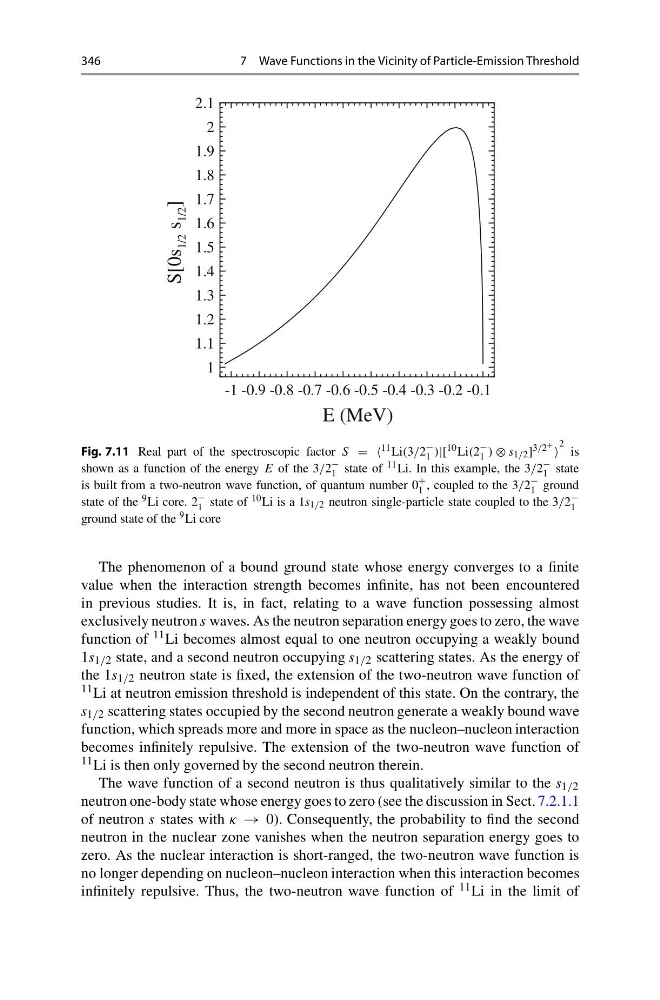
Fig. 7.11 Real part of the spectroscopic factor S = = 11 Li(3/2
−
1 )|[ 10 Li(2
−
1 ) ⊗ s 1/2 ] 3/2 +
2 is
shown as a function of the energy E of the 3/2
−
1 state of 11 Li. In this example, the 3/2
−
1 state
is built from a two-neutron wave function, of quantum number 0
+
1 , coupled to the 3/2
−
1 ground
state of the 9 Li core. 2
−
1 state of 10 Li is a 1s 1/2 neutron single-particle state coupled to the 3/2
−
1
ground state of the 9 Li core
The phenomenon of a bound ground state whose energy converges to a finite
value when the interaction strength becomes infinite, has not been encountered
in previous studies. It is, in fact, relating to a wave function possessing almost
exclusively neutron s waves. As the neutron separation energy goes to zero, the wave
function of 11 Li becomes almost equal to one neutron occupying a weakly bound
1s 1/2 state, and a second neutron occupying s 1/2 scattering states. As the energy of
the 1s 1/2 neutron state is fixed, the extension of the two-neutron wave function of
11 Li at neutron emission threshold is independent of this state. On the contrary, the
s 1/2 scattering states occupied by the second neutron generate a weakly bound wave
function, which spreads more and more in space as the nucleon–nucleon interaction
becomes infinitely repulsive. The extension of the two-neutron wave function of
11 Li is then only governed by the second neutron therein.
The wave function of a second neutron is thus qualitatively similar to the s 1/2
neutron one-body state whose energy goes to zero (see the discussion in Sect. 7.2.1.1
of neutron s states with κ → 0). Consequently, the probability to find the second
neutron in the nuclear zone vanishes when the neutron separation energy goes to
zero. As the nuclear interaction is short-ranged, the two-neutron wave function is
no longer depending on nucleon–nucleon interaction when this interaction becomes
infinitely repulsive. Thus, the two-neutron wave function of 11 Li in the limit of
7 Wave Functions in the Vicinity of Particle-Emission Threshold
-1 -0.9 -0.8 -0.7 -0.6 -0.5 -0.4 -0.3 -0.2 -0.1
E (MeV)
1
1.1
1.2
1.3
1.4
1.5
1.6
1.7
1.8
1.9
2
2.1
S[0s
1/2 s
1/2 ]
Fig. 7.11 Real part of the spectroscopic factor S = = 11 Li(3/2
−
1 )|[ 10 Li(2
−
1 ) ⊗ s 1/2 ] 3/2 +
2 is
shown as a function of the energy E of the 3/2
−
1 state of 11 Li. In this example, the 3/2
−
1 state
is built from a two-neutron wave function, of quantum number 0
+
1 , coupled to the 3/2
−
1 ground
state of the 9 Li core. 2
−
1 state of 10 Li is a 1s 1/2 neutron single-particle state coupled to the 3/2
−
1
ground state of the 9 Li core
The phenomenon of a bound ground state whose energy converges to a finite
value when the interaction strength becomes infinite, has not been encountered
in previous studies. It is, in fact, relating to a wave function possessing almost
exclusively neutron s waves. As the neutron separation energy goes to zero, the wave
function of 11 Li becomes almost equal to one neutron occupying a weakly bound
1s 1/2 state, and a second neutron occupying s 1/2 scattering states. As the energy of
the 1s 1/2 neutron state is fixed, the extension of the two-neutron wave function of
11 Li at neutron emission threshold is independent of this state. On the contrary, the
s 1/2 scattering states occupied by the second neutron generate a weakly bound wave
function, which spreads more and more in space as the nucleon–nucleon interaction
becomes infinitely repulsive. The extension of the two-neutron wave function of
11 Li is then only governed by the second neutron therein.
The wave function of a second neutron is thus qualitatively similar to the s 1/2
neutron one-body state whose energy goes to zero (see the discussion in Sect. 7.2.1.1
of neutron s states with κ → 0). Consequently, the probability to find the second
neutron in the nuclear zone vanishes when the neutron separation energy goes to
zero. As the nuclear interaction is short-ranged, the two-neutron wave function is
no longer depending on nucleon–nucleon interaction when this interaction becomes
infinitely repulsive. Thus, the two-neutron wave function of 11 Li in the limit of