

342
7 Wave Functions in the Vicinity of Particle-Emission Threshold
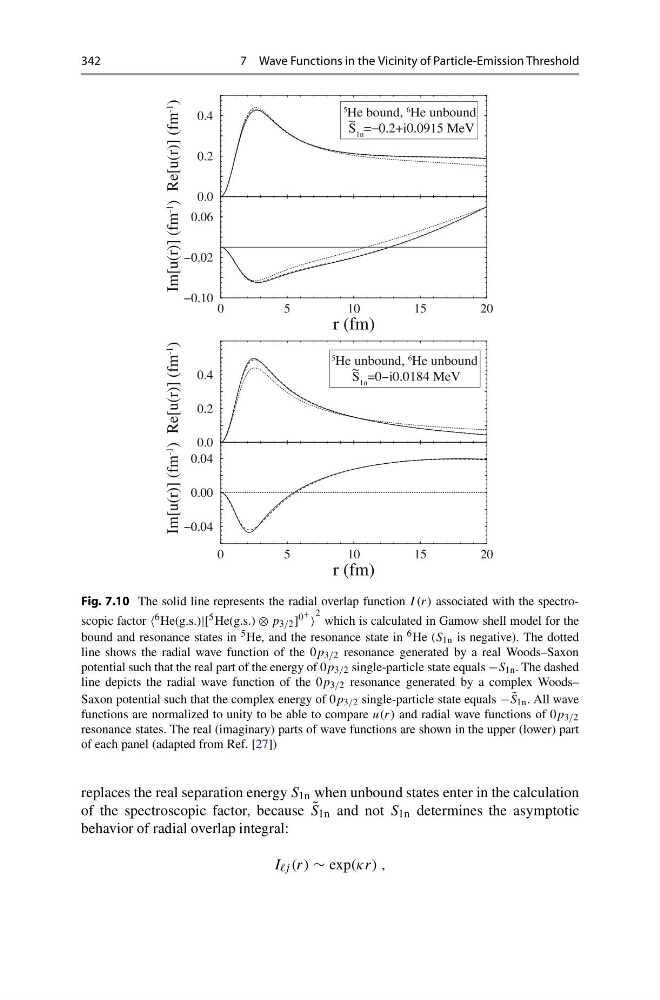
Fig. 7.10 The solid line represents the radial overlap function I (r) associated with the spectroscopic factor 6 He(g.s.)|[ 5 He(g.s.) ⊗ p 3/2 ] 0 +
2 which is calculated in Gamow shell model for the
bound and resonance states in 5 He, and the resonance state in 6 He (S 1n is negative). The dotted
line shows the radial wave function of the 0p 3/2 resonance generated by a real Woods–Saxon
potential such that the real part of the energy of 0p 3/2 single-particle state equals −S 1n . The dashed
line depicts the radial wave function of the 0p 3/2 resonance generated by a complex Woods–
Saxon potential such that the complex energy of 0p 3/2 single-particle state equals − ˜
S 1n . All wave
functions are normalized to unity to be able to compare u(r) and radial wave functions of 0p 3/2
resonance states. The real (imaginary) parts of wave functions are shown in the upper (lower) part
of each panel (adapted from Ref. [27])
replaces the real separation energy S 1n when unbound states enter in the calculation
of the spectroscopic factor, because ˜
S 1n and not S 1n determines the asymptotic
behavior of radial overlap integral:
I j (r) ∼ exp(κr) ,
7 Wave Functions in the Vicinity of Particle-Emission Threshold
Fig. 7.10 The solid line represents the radial overlap function I (r) associated with the spectroscopic factor 6 He(g.s.)|[ 5 He(g.s.) ⊗ p 3/2 ] 0 +
2 which is calculated in Gamow shell model for the
bound and resonance states in 5 He, and the resonance state in 6 He (S 1n is negative). The dotted
line shows the radial wave function of the 0p 3/2 resonance generated by a real Woods–Saxon
potential such that the real part of the energy of 0p 3/2 single-particle state equals −S 1n . The dashed
line depicts the radial wave function of the 0p 3/2 resonance generated by a complex Woods–
Saxon potential such that the complex energy of 0p 3/2 single-particle state equals − ˜
S 1n . All wave
functions are normalized to unity to be able to compare u(r) and radial wave functions of 0p 3/2
resonance states. The real (imaginary) parts of wave functions are shown in the upper (lower) part
of each panel (adapted from Ref. [27])
replaces the real separation energy S 1n when unbound states enter in the calculation
of the spectroscopic factor, because ˜
S 1n and not S 1n determines the asymptotic
behavior of radial overlap integral:
I j (r) ∼ exp(κr) ,