

340
7 Wave Functions in the Vicinity of Particle-Emission Threshold
5 He 6 He
-0.2
-0.1
0
0.1
-S 1n [ 6 He]
0.4
0.6
H O - S M
G S M
Spectroscopic factor Re[S]
5 He 6 He
6 He 7 He
0.4
0.8
0.5
1.0
0.4
0
-0.4
-0.8
0.4
0
-0.4
-0.8
G S M
GS M
HO-SM
H O -S M
Separation energy (MeV)
-S 1n [ 6 He]
-S 1n [ 5 He]
(a)
(b)
(c)
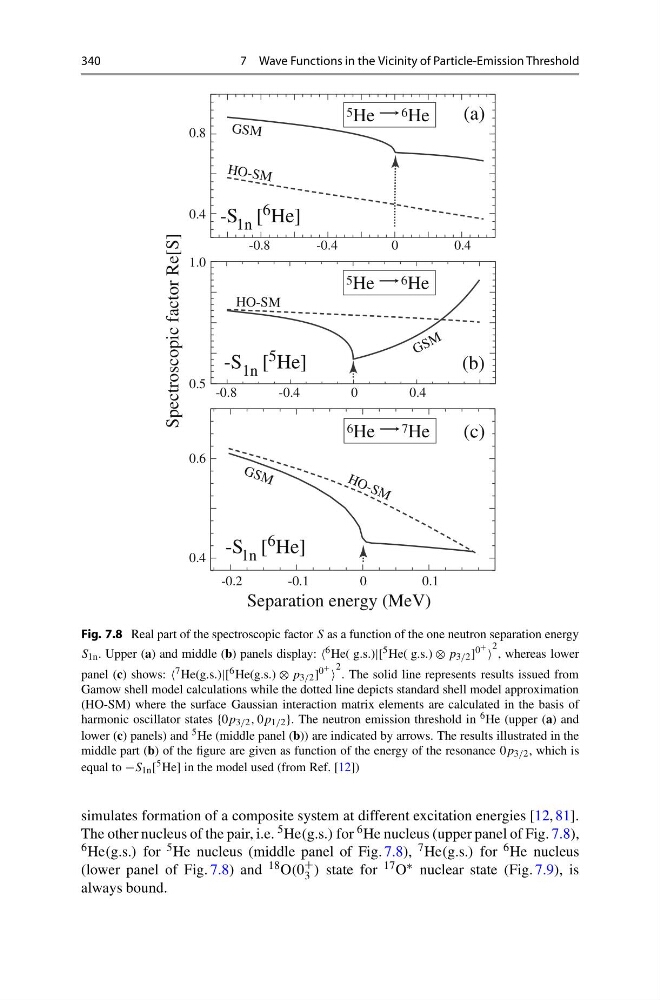
Fig. 7.8 Real part of the spectroscopic factor S as a function of the one neutron separation energy
S 1n . Upper (a) and middle (b) panels display: 6 He( g.s.)|[ 5 He( g.s.) ⊗ p 3/2 ] 0 +
2 , whereas lower
panel (c) shows: 7 He(g.s.)|[ 6 He(g.s.) ⊗ p 3/2 ] 0 +
2 . The solid line represents results issued from
Gamow shell model calculations while the dotted line depicts standard shell model approximation
(HO-SM) where the surface Gaussian interaction matrix elements are calculated in the basis of
harmonic oscillator states {0p 3/2 , 0p 1/2 }. The neutron emission threshold in 6 He (upper (a) and
lower (c) panels) and 5 He (middle panel (b)) are indicated by arrows. The results illustrated in the
middle part (b) of the figure are given as function of the energy of the resonance 0p 3/2 , which is
equal to −S 1n [ 5 He] in the model used (from Ref. [12])
simulates formation of a composite system at different excitation energies [12, 81].
The other nucleus of the pair, i.e. 5 He(g.s.) for 6 He nucleus (upper panel of Fig. 7.8),
6 He(g.s.) for 5 He nucleus (middle panel of Fig. 7.8), 7 He(g.s.) for 6 He nucleus
(lower panel of Fig. 7.8) and 18 O(0
+
3 ) state for 17 O ∗ nuclear state (Fig. 7.9), is
always bound.
7 Wave Functions in the Vicinity of Particle-Emission Threshold
5 He 6 He
-0.2
-0.1
0
0.1
-S 1n [ 6 He]
0.4
0.6
H O - S M
G S M
Spectroscopic factor Re[S]
5 He 6 He
6 He 7 He
0.4
0.8
0.5
1.0
0.4
0
-0.4
-0.8
0.4
0
-0.4
-0.8
G S M
GS M
HO-SM
H O -S M
Separation energy (MeV)
-S 1n [ 6 He]
-S 1n [ 5 He]
(a)
(b)
(c)
Fig. 7.8 Real part of the spectroscopic factor S as a function of the one neutron separation energy
S 1n . Upper (a) and middle (b) panels display: 6 He( g.s.)|[ 5 He( g.s.) ⊗ p 3/2 ] 0 +
2 , whereas lower
panel (c) shows: 7 He(g.s.)|[ 6 He(g.s.) ⊗ p 3/2 ] 0 +
2 . The solid line represents results issued from
Gamow shell model calculations while the dotted line depicts standard shell model approximation
(HO-SM) where the surface Gaussian interaction matrix elements are calculated in the basis of
harmonic oscillator states {0p 3/2 , 0p 1/2 }. The neutron emission threshold in 6 He (upper (a) and
lower (c) panels) and 5 He (middle panel (b)) are indicated by arrows. The results illustrated in the
middle part (b) of the figure are given as function of the energy of the resonance 0p 3/2 , which is
equal to −S 1n [ 5 He] in the model used (from Ref. [12])
simulates formation of a composite system at different excitation energies [12, 81].
The other nucleus of the pair, i.e. 5 He(g.s.) for 6 He nucleus (upper panel of Fig. 7.8),
6 He(g.s.) for 5 He nucleus (middle panel of Fig. 7.8), 7 He(g.s.) for 6 He nucleus
(lower panel of Fig. 7.8) and 18 O(0
+
3 ) state for 17 O ∗ nuclear state (Fig. 7.9), is
always bound.